Antimicrobial consumption on Austrian dairy farms: an observational study of udder disease treatments based on veterinary medication records
- PMID: 29158993
- PMCID: PMC5694652
- DOI: 10.7717/peerj.4072
Antimicrobial consumption on Austrian dairy farms: an observational study of udder disease treatments based on veterinary medication records
Abstract
Background: Antimicrobial use in livestock production is an important contemporary issue, which is of public interest worldwide. Antimicrobials are not freely available to Austrian farmers and can only be administered to livestock by veterinarians, or by farmers who are trained members of the Animal Health Service. Since 2015, veterinarians have been required by law to report antimicrobials dispensed to farmers for use in food-producing animals. The study presented here went further than the statutory framework, and collected data on antimicrobials dispensed to farmers and those administered by veterinarians.
Methods: Seventeen veterinary practices were enrolled in the study via convenience sampling. These veterinarians were asked to contact interested dairy farmers regarding participation in the study (respondent-driven sampling). Data were collected from veterinary practice software between 1st October 2015 and 30th September 2016. Electronic data (89.4%) were transferred via an online interface and paper records (10.6%) were entered by the authors. Antimicrobial treatments with respect to udder disease were analysed by number of defined daily doses per cow and year (nDDDvet/cow/year), based on the European Medicines Agency technical unit, Defined Daily Dose for animals (DDDvet). Descriptive statistics and the Wilcoxon rank sum test were used to analyse the results.
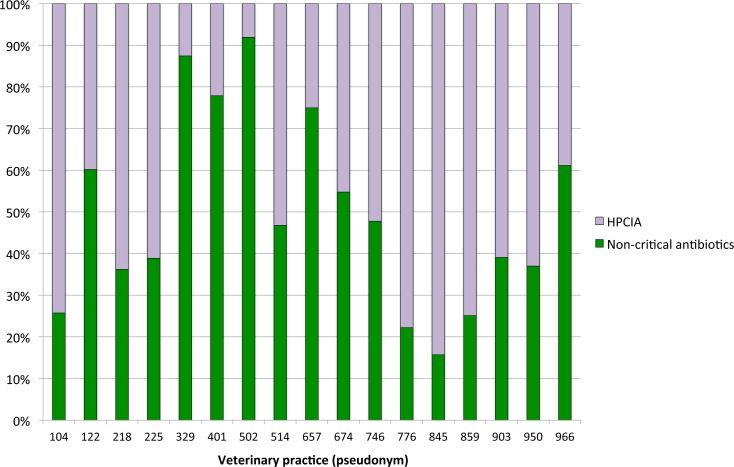
Results: Antimicrobial use data from a total of 248 dairy farms were collected during the study, 232 of these farms treated cows with antibiotics; dry cow therapy was excluded from the current analysis. The mean number of DDDvet/cow/year for the antimicrobial treatment of all udder disease was 1.33 DDDvet/cow/year. Of these treatments, 0.73 DDDvet/cow/year were classed as highest priority critically important antimicrobials (HPCIAs), according to the World Health Organization (WHO) definition. The Wilcoxon rank sum test determined a statistically significant difference between the median number of DDDvet/cow/year for acute and chronic mastitis treatment (W = 10,734, p < 0.001). The most commonly administered antimicrobial class for the treatment of acute mastitis was beta-lactams. Intramammary penicillin was used at a mean of 0.63 DDDvet/cow/year, followed by the third generation cephalosporin, cefoperazone, (a HPCIA) at 0.60 DDDvet/cow/year. Systemic antimicrobial treatments were used at a lower overall level than intramammary treatments for acute mastitis.
Discussion: This study demonstrated that Austrian dairy cows in the study population were treated with antimicrobial substances for udder diseases at a relatively low frequency, however, a substantial proportion of these treatments were with substances considered critically important for human health. While it is vital that sick cows are treated, reductions in the overall use of antimicrobials, and critically important substances in particular, are still possible.
Keywords: Antibiotic; Antimicrobial; Cattle; DDD; Dairy cow; Defined daily dose; Mastitis; Udder disease.
Conflict of interest statement
The authors declare there are no competing interests.
Figures


References
-
- Austrian Federal Ministry of Health (BMG) Verordnung des Bundesministers für Gesundheit über die Anerkennung und den Betrieb von Tiergesundheitsdiensten (Tiergesundheitsdienst—Verordnung 2009—TGD-VO 2009) (Regulation of the Minister of Health on the Recognition and Operation of Animal Health Services) Bundesministerium für Gesundheit, Austriahttps://www.ris.bka.gv.at/eli/bgbl/II/2009/434. [27 October 2017];2009
-
- Austrian Federal Ministry of Health (BMG) Veterinär-Antibiotika- MengenströmeVO sowie Änderung der Apothekenbetriebsordnung 2005 und der Verordnung über die Einrichtung und Führung der Tierärzteliste (Veterinary Antibiotic Volume Movements Regulation, as well as Alterations to the Pharmacy Requirements 2005 and the Regulation concerning the List of Licensed Veterinarians) Bundesministerium für Gesundheit, Austriahttps://www.ris.bka.gv.at/eli/bgbl/II/2014/83. [27 October 2017];2014
-
- Austrian Federal Ministry of Health and Women’s Affairs (BMGF) Tierarzneimittelkontrollgesetz—TAKG (Control of Veterinary Medicinal Products Law) https://www.ris.bka.gv.at/GeltendeFassung.wxe?Abfrage=Bundesnormen&Geset.... [27 October 2017];2002
LinkOut - more resources
Full Text Sources
Research Materials