


Correlation Between Postoperative Early Recurrence of Hepatocellular Carcinoma and Mesenchymal Circulating Tumor Cells in Peripheral Blood
- PMID: 29159757
- PMCID: PMC5869875
- DOI: 10.1007/s11605-017-3619-3
Correlation Between Postoperative Early Recurrence of Hepatocellular Carcinoma and Mesenchymal Circulating Tumor Cells in Peripheral Blood
Abstract
Background: Circulating tumor cells (CTCs) have been actively studied for their functions in hepatocellular carcinoma (HCC) recurrence. However, the relationship between circulating tumor cells subtypes and hepatocellular carcinoma recurrence is still unclear.
Methods: CTCs were collected from the peripheral blood of 62 postoperative HCC patients. The CTCs were isolated with a filtration-based method. Multiplex fluorescence in situ hybridization was used to characterize the CTCs based on mRNA expression levels of epithelial and mesenchymal markers.
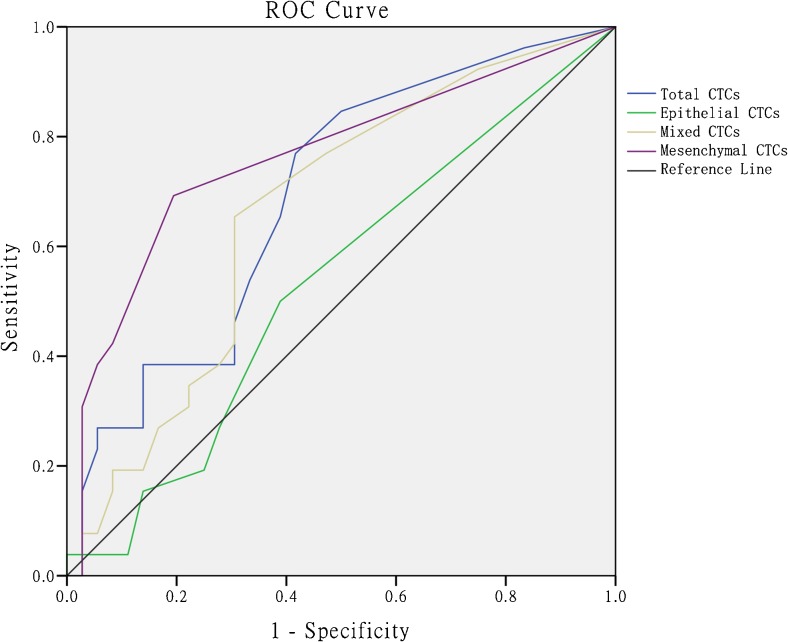
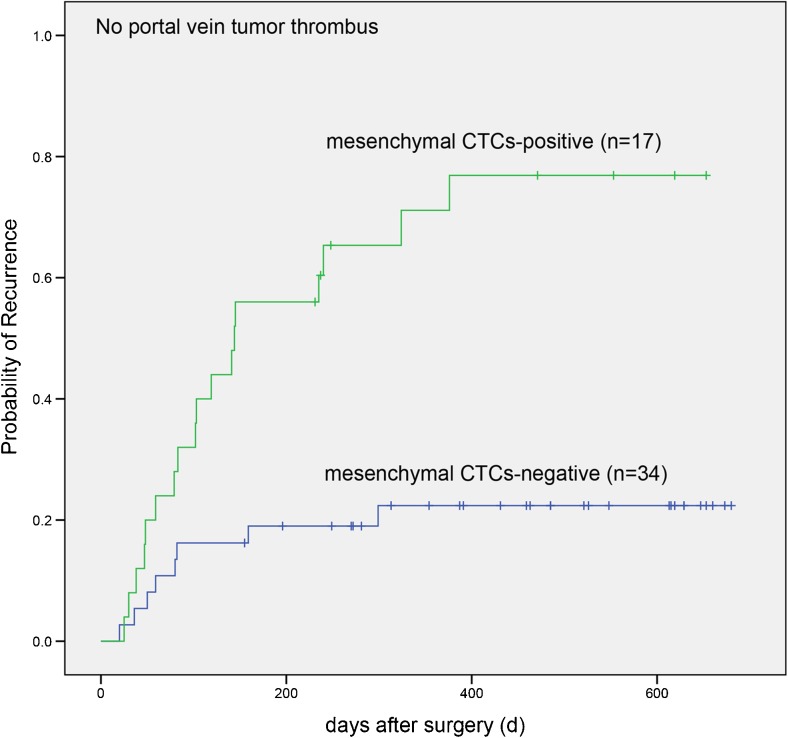
Results: Of the 62 HCC patients, 26 were diagnosed with early recurrence (ER) and 36 did not experience recurrence. Comparison between the recurrence group and the non-recurrence group showed the total number of CTCs, mesenchymal CTCs, and mixed CTCs in the recurrence group was significantly higher than in the non-recurrence group. Receiver operator characteristic (ROC) curve analysis was performed to define the positive cutoff values as follows: total number of CTCs ≥ 4, mesenchymal CTCs ≥ 1, and mixed CTCs ≥ 3. Analysis showed that portal vein tumor thrombus (hazard ratio [HR] = 2.905, P = 0.023) and mesenchymal CTC positivity (HR = 3.453, P = 0.007) were independent risk factors for ER. The correlation between the presence of mesenchymal CTCs and time to recurrence was further examined, and the results showed significantly shortened postoperative disease-free survival in patients positive for mesenchymal CTCs (P < 0.001).
Conclusions: HCC patients with positive peripheral mesenchymal CTCs have a more serious risk of ER, which could be a potential biomarker in HCC prognosis monitoring.
Keywords: Circulating tumor cells (CTCs); Early recurrence(ER); Epithelial-mesenchymal transition (EMT); Hepatocellular carcinoma (HCC).
Conflict of interest statement
Ethics Approval and Consent to Participate
This study was approved by the Clinical Research Ethics Committee of Zhujiang Hospital of Southern Medical University (with numbers ZJYY-2014-GDEK-002). All participants provided informed written consent prior to their entry into the study. In the case that changes in the protocol are necessary, relevant amendments are made and submitted to the ethics trial registration authorities for approval.
Competing Interests
The authors declare that they have no competing interests.
Availability of Data and Materials
Please contact the author for data requests.
Figures
References
-
- Wang R, Chen XZ, Zhang MG, Tang L, Wu H. Incidence and mortality of liver cancer in mainland China: changes in first decade of 21st century. Hepato-Gastroenterology. 2015;62:118–121. - PubMed
-
- Colombo F, Baldan F, Mazzucchelli S, Martin-Padura I, Marighetti P, Cattaneo A, Foglieni B, Spreafico M, Guerneri S, Baccarin M, et al. Evidence of distinct tumour-propagating cell populations with different properties in primary human hepatocellular carcinoma. Plos One. 2011;6:e21369. doi: 10.1371/journal.pone.0021369. - DOI - PMC - PubMed
-
- Imamura H, Matsuyama Y, Tanaka E, Ohkubo T, Hasegawa K, Miyagawa S, Sugawara Y, Minagawa M, Takayama T, Kawasaki S, et al. Risk factors contributing to early and late phase intrahepatic recurrence of hepatocellular carcinoma after hepatectomy. J Hepatol. 2003;38:200–207. doi: 10.1016/S0168-8278(02)00360-4. - DOI - PubMed
Publication types
MeSH terms
LinkOut - more resources
Full Text Sources
Other Literature Sources
Medical
