The US President's Malaria Initiative, Plasmodium falciparum transmission and mortality: A modelling study
- PMID: 29161259
- PMCID: PMC5697814
- DOI: 10.1371/journal.pmed.1002448
The US President's Malaria Initiative, Plasmodium falciparum transmission and mortality: A modelling study
Abstract
Background: Although significant progress has been made in reducing malaria transmission globally in recent years, a large number of people remain at risk and hence the gains made are fragile. Funding lags well behind amounts needed to protect all those at risk and ongoing contributions from major donors, such as the President's Malaria Initiative (PMI), are vital to maintain progress and pursue further reductions in burden. We use a mathematical modelling approach to estimate the impact of PMI investments to date in reducing malaria burden and to explore the potential negative impact on malaria burden should a proposed 44% reduction in PMI funding occur.
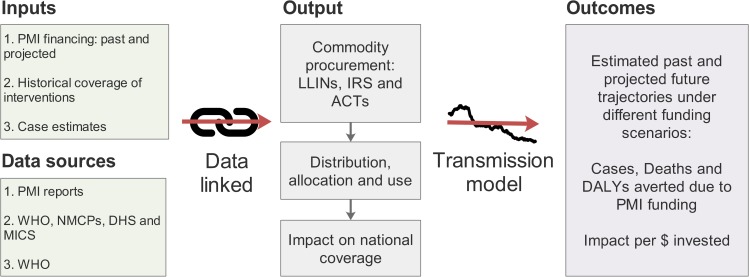
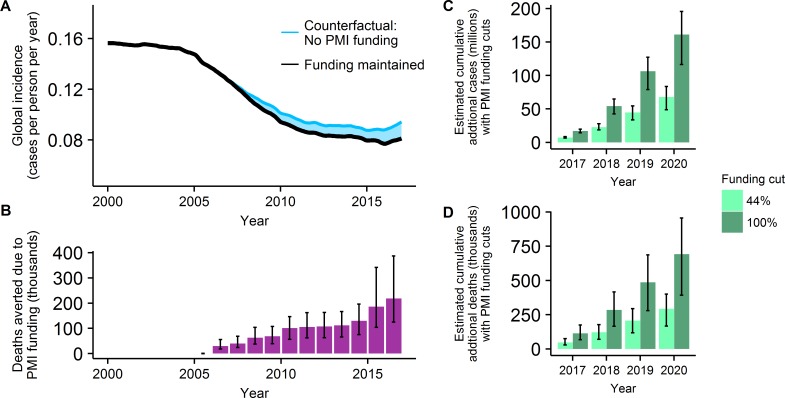
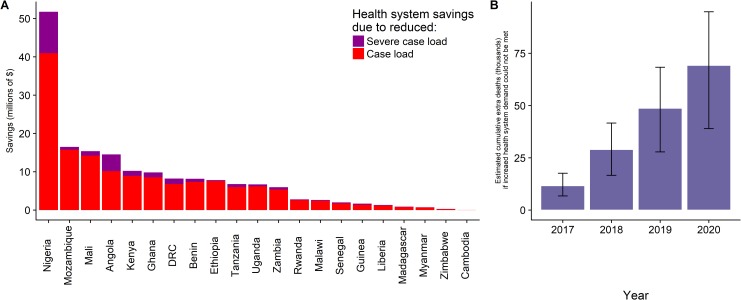
Methods and findings: We combined an established mathematical model of Plasmodium falciparum transmission dynamics with epidemiological, intervention, and PMI-financing data to estimate the contribution PMI has made to malaria control via funding for long-lasting insecticide treated nets (LLINs), indoor residual spraying (IRS), and artemisinin combination therapies (ACTs). We estimate that PMI has prevented 185 million (95% CrI: 138 million, 230 million) malaria cases and saved 940,049 (95% CrI: 545,228, 1.4 million) lives since 2005. If funding is maintained, PMI-funded interventions are estimated to avert a further 162 million (95% CrI: 116 million, 194 million) cases, saving a further 692,589 (95% CrI: 392,694, 955,653) lives between 2017 and 2020. With an estimate of US$94 (95% CrI: US$51, US$166) per Disability Adjusted Life Year (DALY) averted, PMI-funded interventions are highly cost-effective. We also demonstrate the further impact of this investment by reducing caseloads on health systems. If a 44% reduction in PMI funding were to occur, we predict that this loss of direct aid could result in an additional 67 million (95% CrI: 49 million, 82 million) cases and 290,649 (95% CrI: 167,208, 395,263) deaths between 2017 and 2020. We have not modelled indirect impacts of PMI funding (such as health systems strengthening) in this analysis.
Conclusions: Our model estimates that PMI has played a significant role in reducing malaria cases and deaths since its inception. Reductions in funding to PMI could lead to large increases in the number of malaria cases and deaths, damaging global goals of malaria control and elimination.
Conflict of interest statement
PW discloses his consultancy services to the Global Fund to support investment case and allocation modelling and country planning support. ACG discloses financial consultancy services to the Global Fund to support investment case and allocation modelling and country planning support and unrestricted research grants from a range of funders, including BMGF, UK Medical Research Council, The Wellcome Trust, NIH, Malaria Vaccine Initiative, Medicines for Malaria Venture, Integrated Vector Control Consortium, and Gavi. She is also a member of WHO Malaria Policy Advisory Committee and of WHO Global Technical Strategy for Malaria Scientific Committee. HCS discloses her consultancy from the Global Fund for country support planning and modelling impact of national malaria elimination strategies.
Figures
References
-
- Bhatt S, Weiss DJ, Cameron E, Bisanzio D, Mappin B, Dalrymple U, et al. The effect of malaria control on Plasmodium falciparum in Africa between 2000 and 2015. Nature. 2015;8: 207–211. doi: 10.1038/nature15535 - DOI - PMC - PubMed
-
- Alonso PL, Tanner M. Public health challenges and prospects for malaria control and elimination. Nat Med. 2013;19: 150–155. doi: 10.1038/nm.3077 - DOI - PubMed
-
- Snow RW, Guerra CA, Mutheu JJ, Hay SI. International funding for malaria control in relation to populations at risk of stable Plasmodium falciparum transmission. PLoS Med. 2008;5: 1068–1078. doi: 10.1371/journal.pmed.0050142 - DOI - PMC - PubMed
-
- Cohen JM, Smith DL, Cotter C, Ward A, Yamey G, Sabot OJ, et al. Malaria resurgence: a systematic review and assessment of its causes. Malar J. 2012;11: 122 doi: 10.1186/1475-2875-11-122 - DOI - PMC - PubMed
-
- World Health Organization. World Malaria Report. Geneva; 2016.
MeSH terms
Substances
Grants and funding
LinkOut - more resources
Full Text Sources
Other Literature Sources
Molecular Biology Databases