


Mitochondrial DNA sequence context in the penetrance of mitochondrial t-RNA mutations: A study across multiple lineages with diagnostic implications
- PMID: 29161289
- PMCID: PMC5697862
- DOI: 10.1371/journal.pone.0187862
Mitochondrial DNA sequence context in the penetrance of mitochondrial t-RNA mutations: A study across multiple lineages with diagnostic implications
Abstract
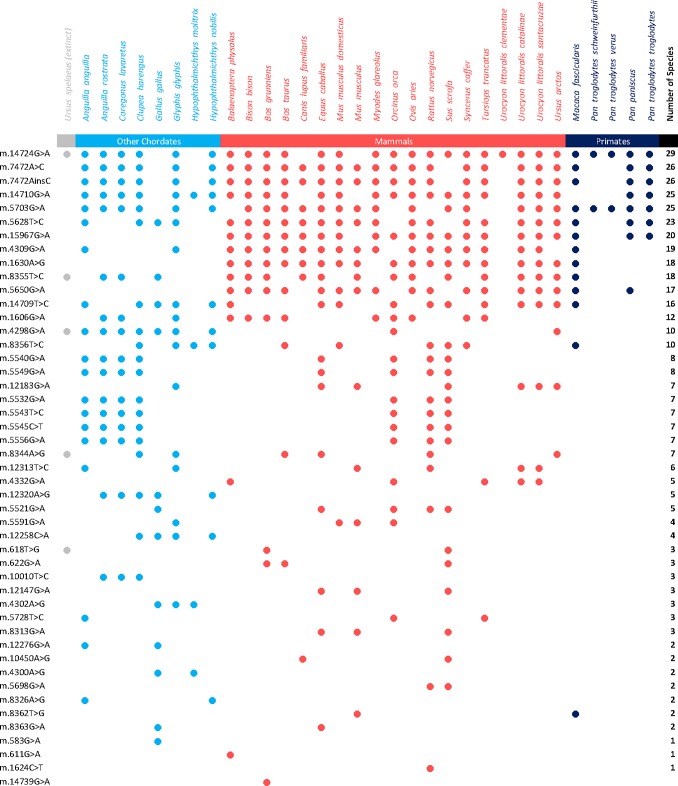
Mitochondrial DNA (mtDNA) mutations are well recognized as an important cause of inherited disease. Diseases caused by mtDNA mutations exhibit a high degree of clinical heterogeneity with a complex genotype-phenotype relationship, with many such mutations exhibiting incomplete penetrance. There is evidence that the spectrum of mutations causing mitochondrial disease might differ between different mitochondrial lineages (haplogroups) seen in different global populations. This would point to the importance of sequence context in the expression of mutations. To explore this possibility, we looked for mutations which are known to cause disease in humans, in animals of other species unaffected by mtDNA disease. The mt-tRNA genes are the location of many pathogenic mutations, with the m.3243A>G mutation on the mt-tRNA-Leu(UUR) being the most frequently seen mutation in humans. This study looked for the presence of m.3243A>G in 2784 sequences from 33 species, as well as any of the other mutations reported in association with disease located on mt-tRNA-Leu(UUR). We report a number of disease associated variations found on mt-tRNA-Leu(UUR) in other chordates, as the major population variant, with m.3243A>G being seen in 6 species. In these, we also found a number of mutations which appear compensatory and which could prevent the pathogenicity associated with this change in humans. This work has important implications for the discovery and diagnosis of mtDNA mutations in non-European populations. In addition, it might provide a partial explanation for the conflicting results in the literature that examines the role of mtDNA variants in complex traits.
Conflict of interest statement
Figures
References
-
- Tuppen HA, Blakely EL, Turnbull DM, Taylor RW. Mitochondrial DNA mutations and human disease. Biochim Biophys Acta. 2010;1797(2):113–28. doi: 10.1016/j.bbabio.2009.09.005 Epub Sep 15. - DOI - PubMed
-
- Elson JL, Andrews RM, Chinnery PF, Lightowlers RN, Turnbull DM, Howell N. Analysis of European mtDNAs for recombination. Am J Hum Genet. 2001;68(1):145–53. Epub 2000 Dec 11. doi: 10.1086/316938 - DOI - PMC - PubMed
-
- Yarham JW, Elson JL, Blakely EL, McFarland R, Taylor RW. Mitochondrial tRNA mutations and disease. Wiley Interdiscip Rev RNA. 2010;1(2):304–24. doi: 10.1002/wrna.27 Epub 2010 Jul 21. - DOI - PubMed
-
- Skladal DH, J. Thorburn D.R. Minimum birth prevalence of mitochondrial respiratory chain disorders in children. Brain. 2003;126(Pt 8):1905–12. Epub 2003 May 21. doi: 10.1093/brain/awg170 - DOI - PubMed
-
- Gorman GS, Schaefer AM, Ng Y, Gomez N, Blakely EL, Alston CL, et al. Prevalence of nuclear and mitochondrial DNA mutations related to adult mitochondrial disease. Ann Neurol. 2015;77(5):753–9. doi: 10.1002/ana.24362 Epub 2015 Mar 28. - DOI - PMC - PubMed
MeSH terms
Substances
LinkOut - more resources
Full Text Sources
Other Literature Sources
Medical
