


Prenatal famine exposure, adulthood obesity patterns and risk of type 2 diabetes
- PMID: 29161448
- PMCID: PMC5913613
- DOI: 10.1093/ije/dyx228
Prenatal famine exposure, adulthood obesity patterns and risk of type 2 diabetes
Abstract
Background: Prenatal exposure to famine and adulthood obesity have been independently related to the risk of type 2 diabetes; however, little is known about the joint effects of these risk factors at different stages of life on adulthood diabetes risk.
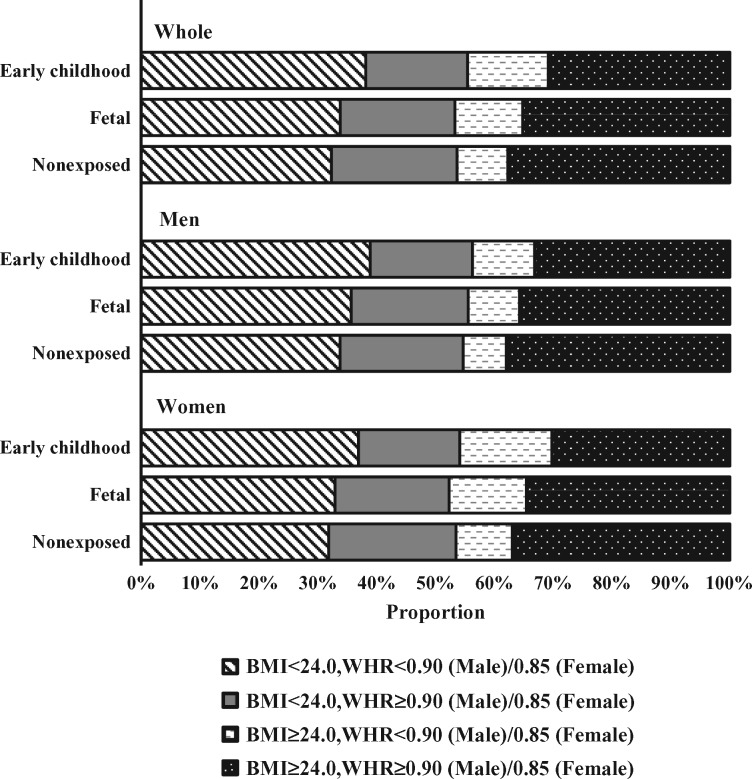
Methods: The analysis included 88 830 participants of the China Kadoorie Biobank, who were born around the time of the Chinese Great Famine and without diabetes, cardiovascular diseases, or cancer at baseline. We defined famine exposure subgroups as nonexposed (born between 1 October 1962 and 30 September 964), fetal-exposed (born between 1 October 1959 and 30 September 1961) and early-childhood exposed (born between 1 October 1956 and 30 September 1958). General obesity was assessed by body mass index (BMI: overweight ≥ 24.0, obesity ≥ 28.0) and abdominal obesity assessed by waist-to-hip ratio (WHR, men/women: moderate ≥ 0.90/0.85, high ≥ 0.95/0.90).
Results: During a median 7.3 years (642 552 person-years) of follow-up, we identified 1372 incident cases of type 2 diabetes. Compared with nonexposed and early-childhood exposed participants combined as a single comparison group, fetal-exposed participants showed an increased risk of diabetes in adulthood [hazard ratio (HR) = 1.25; 95% confidence interval (CI): 1.07-1.45]. The association between general obesity and diabetes was consistent across subgroups according to famine exposure (P for interaction > 0.05). A stronger association between abdominal obesity and diabetes was observed in the fetal-exposed subgroup than in other subgroups (P for interaction = 0.025 in the whole population). This interaction was more obvious in women (P = 0.013) but not in men (P = 0.699). Compared with normal-BMI and -WHR participants, those with both general (BMI ≥ 24.0) and abdominal (WHR ≥ 0.90/0.85) obesity in adulthood had 5.32 (95% CI: 3.81-7.43)-, 3.13 (2.48-3.94)- and 4.43 (3.45-5.68)-fold higher risks if these were carried during, before and after times of famine, respectively.
Conclusions: Coexistence of prenatal experience of undernutrition and abdominal obesity in adulthood was associated with a higher risk of type 2 diabetes.
Figures
Comment in
-
Reply: Interaction or mediation by adult obesity of the relation between fetal famine exposure and type 2 diabetes?Int J Epidemiol. 2019 Apr 1;48(2):656-657. doi: 10.1093/ije/dyy295. Int J Epidemiol. 2019. PMID: 30668862 Free PMC article. No abstract available.
-
Interaction or mediation by adult obesity of the relation between fetal famine exposure and type 2 diabetes?Int J Epidemiol. 2019 Apr 1;48(2):654-656. doi: 10.1093/ije/dyy293. Int J Epidemiol. 2019. PMID: 30689914 No abstract available.
References
-
- Pan X, Yang W, Li G, Liu J. Prevalence of diabetes and its risk factors in China, 1994. National Diabetes Prevention and Control Cooperative Group. Diabetes Care 1997;20:1664–69. - PubMed
-
- Xu Y, Wang L, He J, et al. Prevalence and control of diabetes in Chinese adults. JAMA 2013;310:948–59. - PubMed
-
- Hossain P, Kawar B, El Nahas M. Obesity and diabetes in the developing world - a growing challenge. N Engl J Med 2007;356:213–15. - PubMed
-
- Hales C, Barker D. Type 2 (non-insulin-dependent) diabetes mellitus: the thrifty phenotype hypothesis, 1992. Int J Epidemiol 2013;42:1215–22. - PubMed
Publication types
MeSH terms
Grants and funding
LinkOut - more resources
Full Text Sources
Other Literature Sources
Medical
Molecular Biology Databases
