. 2018 Feb:179:40-53.
doi: 10.1016/j.jinorgbio.2017.11.002. Epub 2017 Nov 8.

To what extent do structural changes in catalytic metal sites affect enzyme function?

Affiliations

To what extent do structural changes in catalytic metal sites affect enzyme function?

Yana Valasatava et al. J Inorg Biochem. 2018 Feb.

Abstract

About half of known enzymatic reactions involve metals. Enzymes belonging to the same superfamily often evolve to catalyze different reactions on the same structural scaffold. The work presented here investigates how functional differentiation, within superfamilies that contain metalloenzymes, relates to structural changes at the catalytic metal site. In general, when the catalytic metal site is unchanged across the enzymes of a superfamily, the functional differentiation within the superfamily tends to be low and the mechanism conserved. Conversely, all types of structural changes in the metal binding site are observed for superfamilies with high functional differentiation. Overall, the catalytic role of the metal ions appears to be one of the most conserved features of the enzyme mechanism within metalloenzyme superfamilies. In particular, when the catalytic role of the metal ion does not involve a redox reaction (i.e. there is no exchange of electrons with the substrate), this role is almost always maintained even when the site undergoes significant structural changes. In these enzymes, functional diversification is most often associated with modifications in the surrounding protein matrix, which has changed so much that the enzyme chemistry is significantly altered. On the other hand, in more than 50% of the examples where the metal has a redox role in catalysis, changes at the metal site modify its catalytic role. Further, we find that there are no examples in our dataset where metal sites with a redox role are lost during evolution.

Synopsis: In this paper we investigate how functional diversity within superfamilies of metalloenzymes relates to structural changes at the catalytic metal site. Evolution tends to strictly conserve the metal site. When changes occur, they do not modify the catalytic role of non-redox metals whereas they affect the role of redox-active metals.

Keywords: Bioinorganic chemistry; Copper; Enzymes; Evolution; Iron; Magnesium; Metallo-proteins; Zinc.


Figures

Image 1
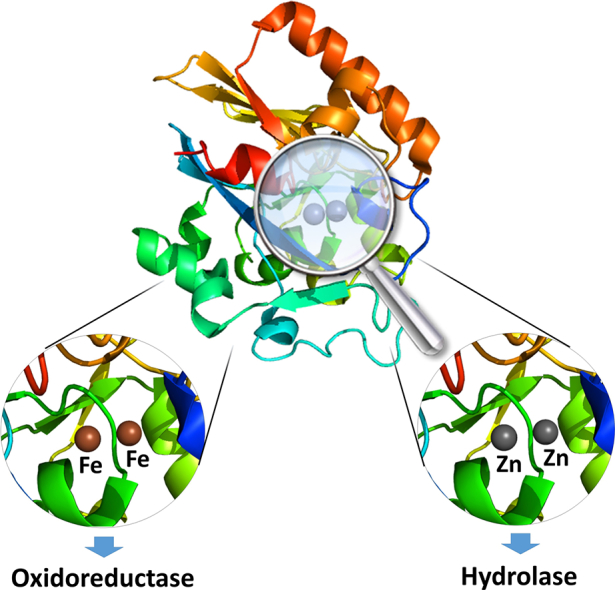
Graphical abstract
Fig. 1
Fig. 1
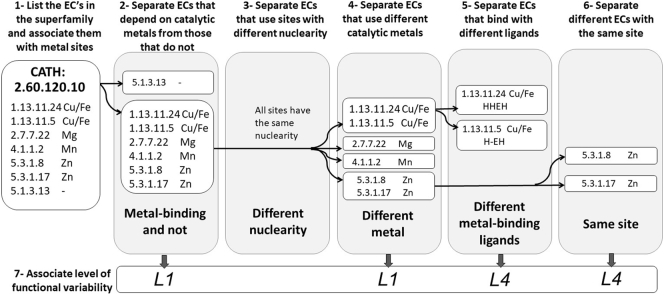
Pipeline to separate a given CATH superfamily into defined subgroups based on subsequent splitting events. The occurrence of splitting events (steps 1–6) is evaluated hierarchically. The level of functional differentiation (defined as the highest level at which the EC numbers changed for any possible pair of superfamily members in the different subgroups created) is assigned to each splitting event at the end of the procedure (step 7). It is important to note that this pipeline does not necessarily capture the evolutionary history of the family and its members.
Fig. 2
Fig. 2
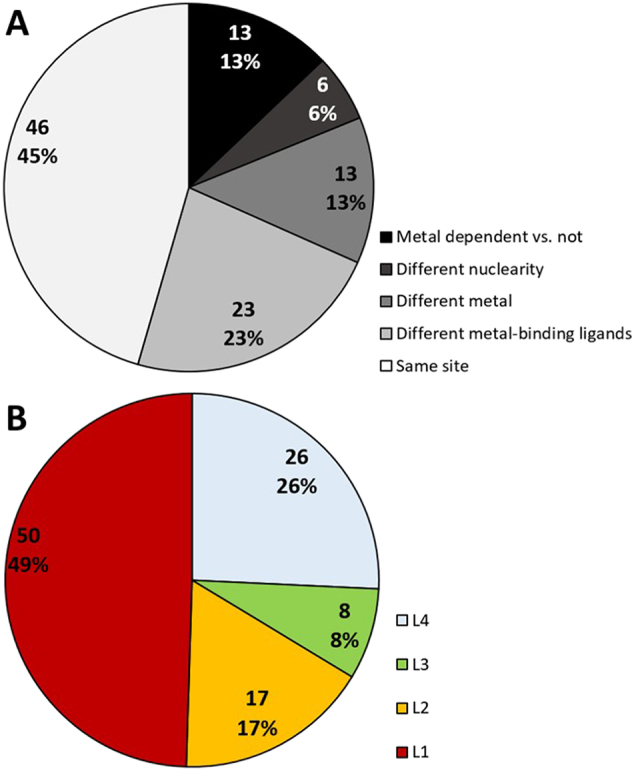
Separation of the 101 splitting events based on (A) the type of metal site changes and (B) the maximum functional differentiation.
Fig. 3
Fig. 3
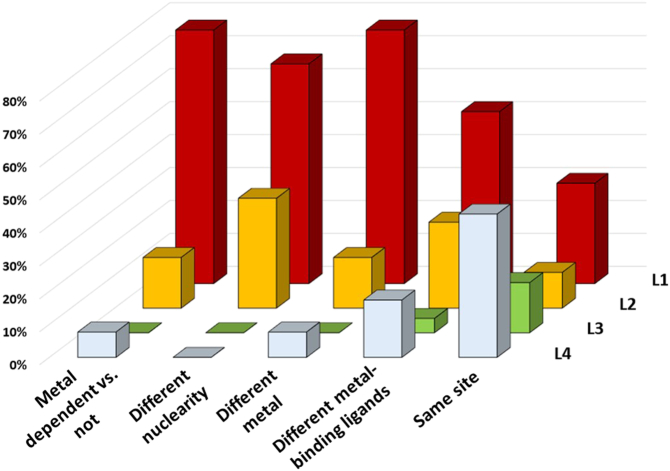
Relationship between functional differentiation and types of metal site variation.
Fig. 4
Fig. 4
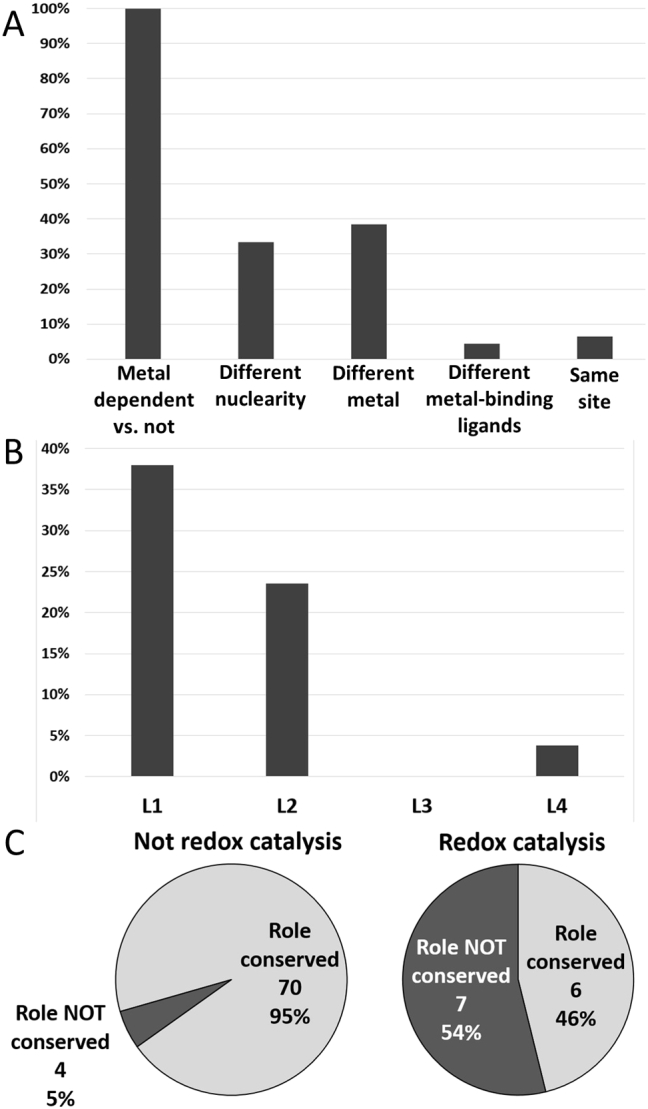
Statistics on the relationship between splitting events and change in the catalytic role of the metal site. The figure shows the percentage of splitting events for which the catalytic role of the metal ion is not conserved, separated by the type of structural change in the site (Panel A), and by the level of functional differentiation (Panel B). Panel C shows the same ratio for sites where the metal ion does not have a redox role (left) and for sites where the metal ion has a redox role (right), taking into account only superfamilies containing exclusively metalloenzymes.
Fig. 5
Fig. 5
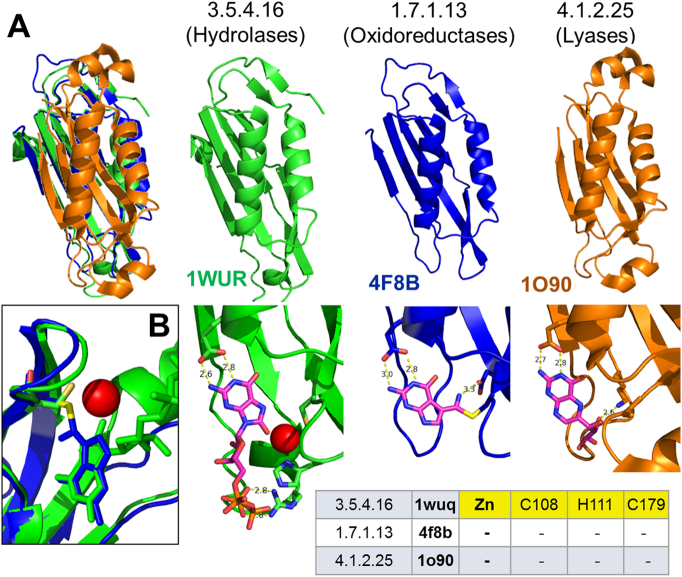
A superfamily (CATH 3.30.1130.10) containing enzymes with different EC numbers and gaining/losing a catalytic metal-binding site. The aligned protein structures (top), the aligned active sites with substrate-analogs bound (middle, the metal ion is depicted as a red sphere), and the structure-based alignment of the metal-binding ligands (bottom) are shown. The EC number of each enzyme is shown above the structure. (For interpretation of the references to color in this figure legend, the reader is referred to the web version of this article.)
Fig. 6
Fig. 6
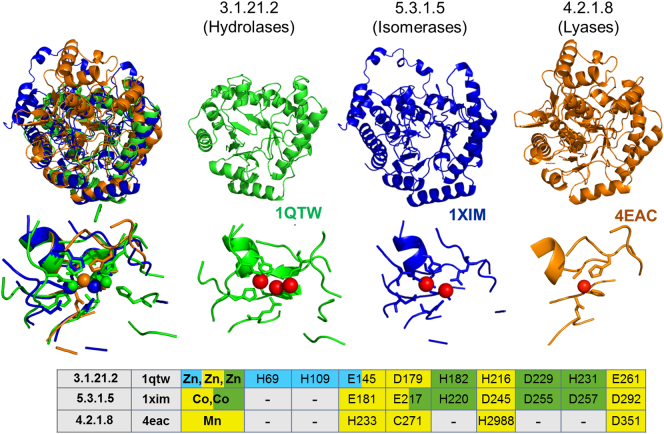
A superfamily (CATH 3.20.20.150) containing enzymes with different EC numbers and different nuclearity of the metal site. The aligned protein structures (top), the aligned metal site structures (middle, metal ions are depicted as red spheres), and the structure-based alignment of the metal-binding ligands (bottom, different colors indicate the ligands of individual metal ions) are shown. The EC number of each enzyme is reported above the structure. (For interpretation of the references to color in this figure legend, the reader is referred to the web version of this article.)
Fig. 7
Fig. 7
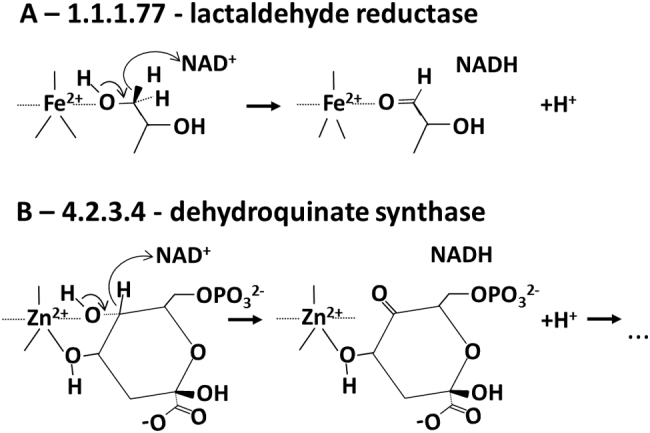
Comparison of the mechanisms of (A) lactaldehyde reductase and (B) dehydroquinate synthase. These two metal-dependent enzymes share the same fold and the binding site of the metal ion is located in corresponding positions in the two proteins. The enzymes are dependent on iron(II) and zinc(II), respectively, yet the reaction mechanism is analogous (see text for details).

References

    1. Martinez C.S., Rahman S.A., Furnham N., Thornton J.M. Biophys. J. 2015;109:1082–1086. - PMC - PubMed
    1. Dayhoff M.O., Barker W.C., Hunt L.T. Methods Enzymol. 1983;91:524–545. - PubMed
    1. Holm L., Sander C. Nucleic Acids Res. 1999;27:244–247. - PMC - PubMed
    1. Levitt M. Proc. Natl. Acad. Sci. U. S. A. 2009;106:11079–11084. - PMC - PubMed
    1. Lo Conte L., Ailey B., Hubbard T.J., Brenner S.E., Murzin A.G., Chothia C. Nucleic Acids Res. 2000;28:257–259. - PMC - PubMed

Publication types

LinkOut - more resources