


Silodosin for the treatment of lower urinary tract symptoms in men with benign prostatic hyperplasia
- PMID: 29161773
- PMCID: PMC6486059
- DOI: 10.1002/14651858.CD012615.pub2
Silodosin for the treatment of lower urinary tract symptoms in men with benign prostatic hyperplasia
Abstract
Background: A variety of alpha-blockers are used for treating lower urinary tract symptoms (LUTS) in men with benign prostatic hyperplasia (BPH). Silodosin is a novel, more selective alpha-blocker, which is specific to the lower urinary tract and may have fewer side effects than other alpha-blockers.
Objectives: To assess the effects of silodosin for the treatment of LUTS in men with BPH.
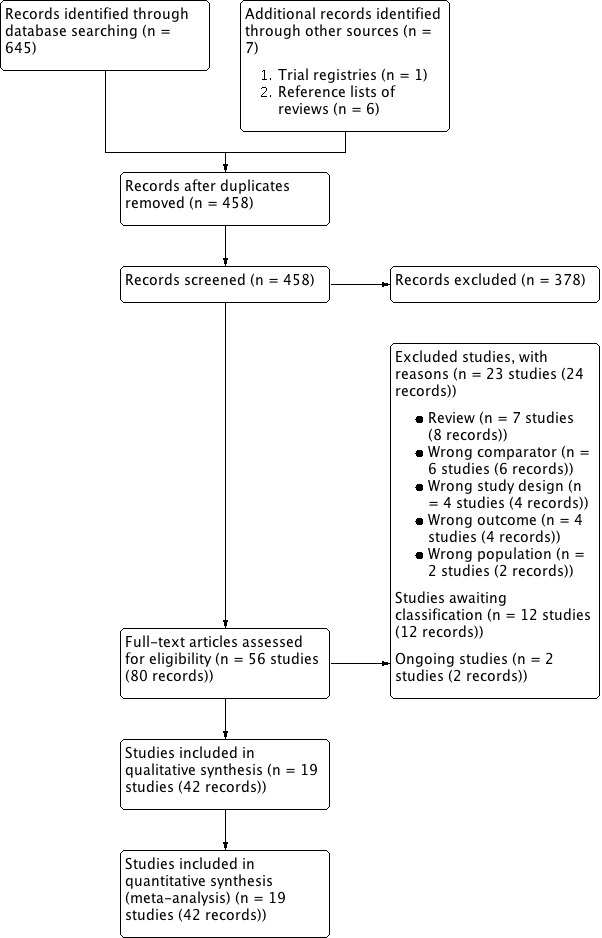
Search methods: We performed a comprehensive search using multiple databases (Cochrane Library, MEDLINE, EMBASE, Scopus, Google Scholar, and Web of Science), trials registries, other sources of grey literature, and conference proceedings with no restrictions on the language of publication or publication status up until 13 June 2017.
Selection criteria: We included all parallel, randomized controlled trials. We also included cross-over designs.
Data collection and analysis: Two review authors independently classified studies and abstracted data from the included studies. We performed statistical analyses using a random-effects model and interpreted them according to the Cochrane Handbook for Systematic Reviews of Interventions. We rated the quality of evidence according to the GRADE approach.
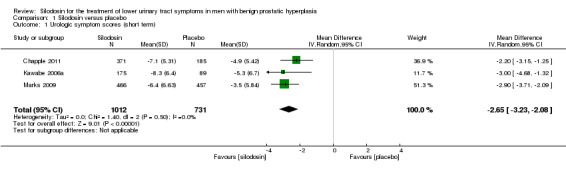
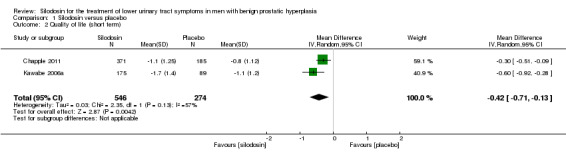
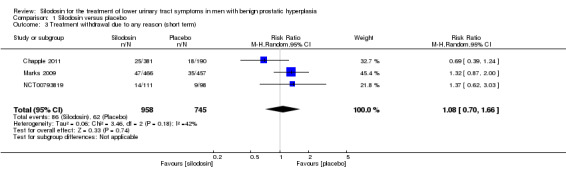
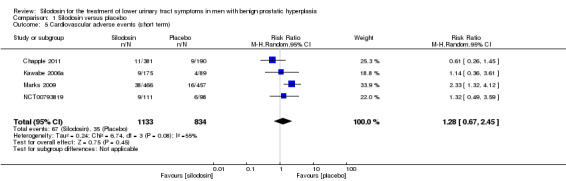
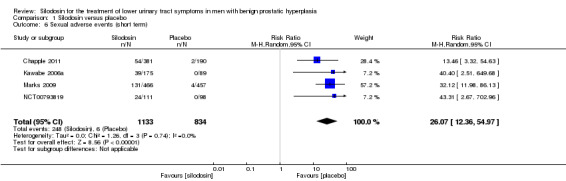
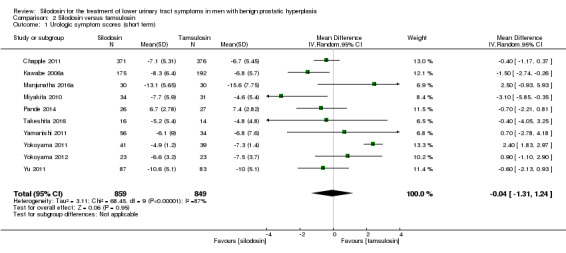
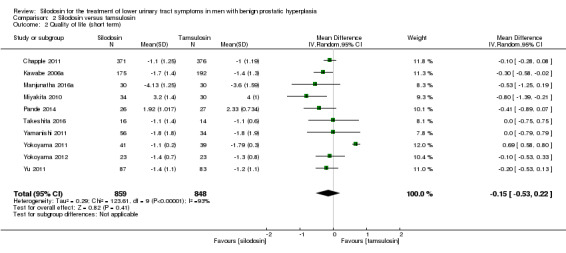
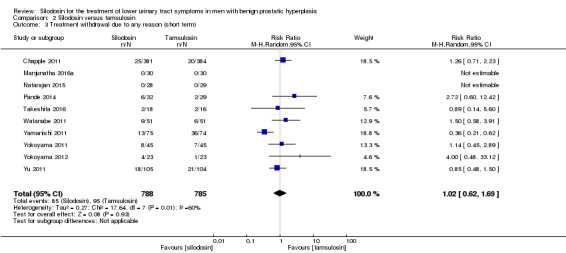
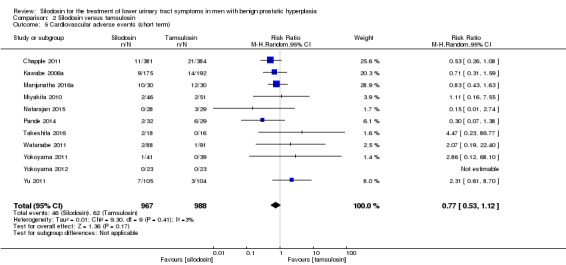
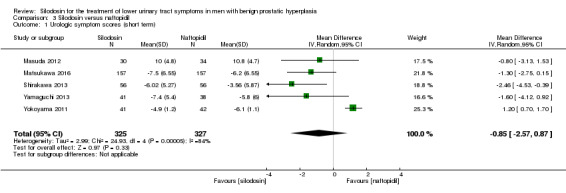
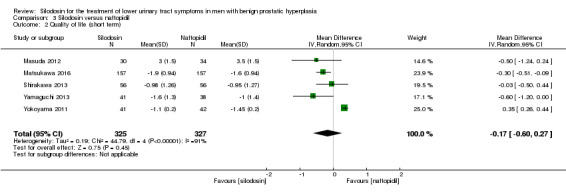
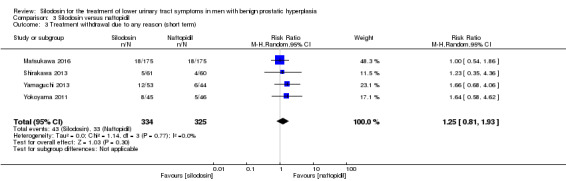
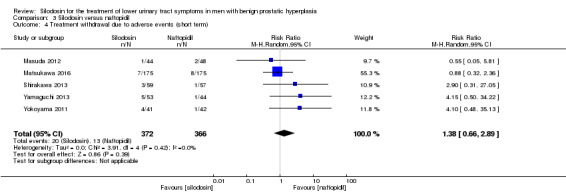
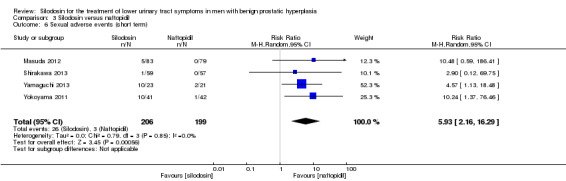
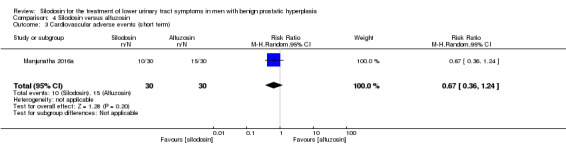
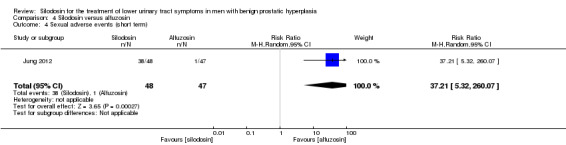
Main results: We included 19 unique studies with 4295 randomized participants across four comparisons for short-term follow-up. The mean age, prostate volume, and International Prostate Symptom Score were 66.5 years, 38.2 mL, and 19.1, respectively. Silodosin versus placeboBased on four studies with a total of 1968 randomized participants, silodosin may reduce urologic symptom scores in an appreciable number of men (mean difference (MD) -2.65, 95% confidence interval (CI) -3.23 to -2.08; low-quality evidence). Silodosin likely does not result in a clinically important reduction in quality of life (MD -0.42, 95% CI -0.71 to -0.13; moderate-quality evidence). It may not increase rates of treatment withdrawal for any reason (relative risk (RR) 1.08, 95% CI 0.70 to 1.66; low-quality evidence). We are uncertain about the effect of silodosin on cardiovascular adverse events (RR 1.28, 95% CI 0.67 to 2.45; very low-quality evidence). Silodosin likely increases sexual adverse events (RR 26.07, 95% CI 12.36 to 54.97; moderate-quality evidence); this would result in 180 more sexual adverse events per 1000 men (95% CI 82 more to 388 more). Silodosin versus tamsulosinBased on 13 studies with a total of 2129 randomized participants, silodosin may result in little to no difference in urologic symptom scores (MD -0.04, 95% CI -1.31 to 1.24; low-quality evidence) and quality of life (MD -0.15, 95% CI -0.53 to 0.22; low-quality evidence). We are uncertain about treatment withdrawals for any reason (RR 1.02, 95% CI 0.62 to 1.69; very low-quality evidence). Silodosin may result in little to no difference in cardiovascular adverse events (RR 0.77, 95% CI 0.53 to 1.12; low-quality evidence). Silodosin likely increases sexual adverse events (RR 6.05, 95% CI 3.55 to 10.31; moderate-quality evidence); this would result in 141 more sexual adverse events per 1000 men (95% CI 71 more to 261 more). Silodosin versus naftopidilBased on five studies with a total of 763 randomized participants, silodosin may result in little to no differences in urologic symptom scores (MD -0.85, 95% CI -2.57 to 0.87; low-quality evidence), quality of life (MD -0.17, 95% CI -0.60 to 0.27; low-quality evidence), treatment withdrawal for any reason (RR 1.25, 95% CI 0.81 to 1.93; low-quality evidence), and cardiovascular adverse events (RR 1.02, 95% CI 0.41 to 2.56; low-quality evidence). Silodosin likely increases sexual adverse events (RR 5.93, 95% CI 2.16 to 16.29; moderate-quality evidence); this would result in 74 more sexual adverse events per 1000 men (95% CI 17 more to 231 more). Silodosin versus alfuzosinBased on two studies with a total of 155 randomized participants, silodosin may or may not result in a clinically important increase in urologic symptom scores (MD 3.83, 95% CI 0.12 to 7.54; low-quality evidence). Silodosin likely results in little to no difference in quality of life (MD 0.14, 95% CI -0.46 to 0.74; moderate-quality evidence). We found no event of treatment withdrawal for any reason. Silodosin may not reduce cardiovascular adverse events (RR 0.67, 95% CI 0.36 to 1.24; low-quality evidence) but likely increases sexual adverse events (RR 37.21, 95% CI 5.32 to 260.07; moderate-quality evidence); this would result in 217 more sexual adverse events per 1000 men (95% CI 26 more to 1000 more).
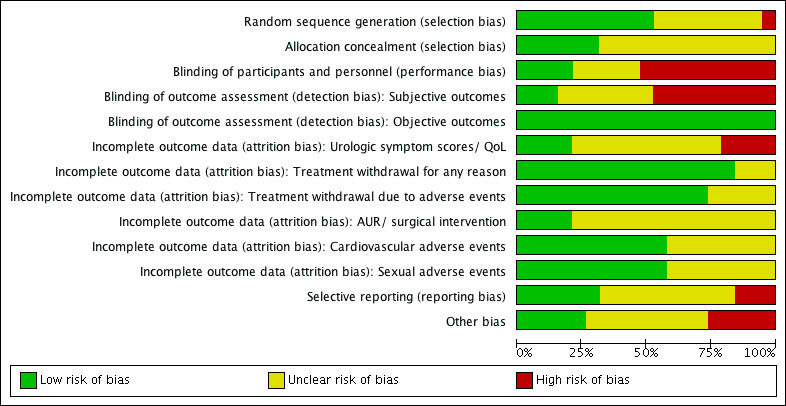
Authors' conclusions: Silodosin may reduce urologic symptom scores in an appreciable number of men compared to placebo. Quality of life and treatment withdrawals for any reason appears similar. Its efficacy appears similar to that of other alpha blockers (tamsulosin, naftopidil and alfuzosin) but the rate of sexual side effects is likely higher. Our certainty in the estimates of effect was lowered due to study limitations, inconsistency and imprecision.
Conflict of interest statement
JHJ: none known
JK: none known
RM: none known
BR: none known
MHK: none known
PD: PD serves as Co‐ordinating Editor of Cochrane Urology. However, he was not involved in the editorial processing or decision‐making for this review. Other editors of Cochrane Urology managed the editorial process, including final sign‐off for this review.
Figures







Update of
References
References to studies included in this review
Chapple 2011 {published data only}
-
- Chapple CR, Montorsi F, Desgrandchamps F, Silodosin European Study Group. Efficacy of silodosin as compared with tamsulosin and placebo for the treatment of the signs and symptoms of benign prostatic hyperplasia. a multicentre, randomised, double‐blind, controlled trial. European Urology Supplements 2010;9(2):313. [DOI: ]
-
- Chapple CR, Montorsi F, Tammela TL, Wirth M, Koldewijn E, Fernandez Fernandez E, et al. Silodosin therapy for lower urinary tract symptoms in men with suspected benign prostatic hyperplasia: results of an international, randomized, double‐blind, placebo‐ and active‐controlled clinical trial performed in Europe. European Urology 2011;59(3):342‐52. [DOI: 10.1016/j.eururo.2010.10.046; PUBMED: 21109344] - DOI - PubMed
-
- Chapple CR, Montorsi F, Tammela Tl, Wirth M, Koldewijn E, Fernandez Fernandez E. Silodosin therapy for lower urinary tract symptoms in men with suspected benign prostatic hyperplasia: results of an international, randomized, double‐blind, placebo‐ and active‐controlled clinical trial performed in Europe. Urologia 2012;5:38‐42, 44‐5. [PUBMED: 23342615] - PubMed
-
- EUCTR2005‐005665‐11‐GB. Evaluation of the efficacy and safety of silodosin vs. Tamsulosin and placebo in the treatment of the signs and symptoms of benign prostatic hyperplasia. Multicentre, randomised, double‐blind, controlled trial with an optional long‐term open‐label extension phase. apps.who.int/trialsearch/Trial2.aspx?TrialID=EUCTR2005‐005665‐11‐GB (date first received 10 October 2017).
-
- NCT00359905. Evaluation of the Efficacy and Safety of Silodosin in the Treatment of the Signs and Symptoms of BPH. https://clinicaltrials.gov/ct2/show/NCT00359905?term=NCT00359905&rank=1 (date first received 10 October 2017).
Jung 2012 {published data only}
-
- Jung GW, Park SJ, Seo J. Effect of short‐term treatment with silodosin on ejaculatory function in sexually active men with benign prostate hyperplasia. Journal of Urology 2012; Vol. 187, issue 4 Supplement:e511. [DOI: ]
-
- Park SJ, Jung GW, Seo JH. Effect of short‐term treatment with silodosin on ejaculatory function in sexually active men with benign prostate hyperplasia. European Urology Supplements 2012;11(1):e744. [DOI: ]
Kawabe 2006a {published data only}
-
- Kawabe K, Yoshida M, Homma Y, Silodosin Clinical Study Group. Silodosin, a new alpha1A‐adrenoceptor‐selective antagonist for treating benign prostatic hyperplasia: results of a phase III randomized, placebo‐controlled, double‐blind study in Japanese men. BJU International 2006;98(5):1019‐24. [DOI: 10.1111/j.1464-410X.2006.06448.x; PUBMED: 16945121] - DOI - PubMed
-
- Yoshida M, Kawabe K, Homma Y. Silodosin, a new effective alpha 1A‐adrenoceptor selective antagonist for the treatment of benign prostatic hyperplasia: results of a phase 3 randomized, placebo‐controlled, double‐blind study. Journal of Urology 2005;173(4 Supplement):445.
Manjunatha 2016a {published data only}
-
- CTRI/2013/07/003805. A clinical study of the effects of the three licensed drugs alfuzosin, tamsulosin and silodosin in patients with benign prostatic hyperplasia, a disease predominantly causing urinary problems in aging men. apps.who.int/trialsearch/Trial2.aspx?TrialID=CTRI/2013/07/003805 (date first received 01 September 2017).
-
- Manjunatha R, Pundarikaksha HP, Madhusudhana HR, Amarkumar J, Hanumantharaju BK. A randomized, comparative, open‐label study of efficacy and tolerability of alfuzosin, tamsulosin and silodosin in benign prostatic hyperplasia. Indian Journal of Pharmacology 2016; Vol. 48, issue 2:134‐40. [DOI: 10.4103/0253-7613.178825; PUBMED: 27127315] - DOI - PMC - PubMed
Marks 2009 {published data only}
-
- Gittelman MC, Marks LS, Hill LA, Volinn W, Hoel G. Efficacy and safety of silodosin in different age groups of men with symptoms of benign prostatic hyperplasia. Journal of the American Geriatrics Society 2009;57(Supplement s1):S122. [DOI: 10.1111/j.1532-5415.2009.02272.x] - DOI
-
- Marks LS, Gittelman MC, Hill LA, Volinn W, Hoel G. Rapid efficacy of the highly selective α1A‐adrenoceptor antagonist silodosin in men with signs and symptoms of benign prostatic hyperplasia: pooled results of 2 phase 3 studies. Journal of Urology 2009;181(6):2634‐40. [DOI: 10.1016/j.juro.2009.02.034; PUBMED: 19371887] - DOI - PubMed
-
- Marks LS, Gittelman MC, Hill LA, Volinn W, Hoel G. Rapid efficacy of the highly selective α1A‐adrenoceptor antagonist silodosin in men with signs and symptoms of benign prostatic hyperplasia: pooled results of 2 phase 3 studies. Journal of Urology 2013;189(1 Suppl):S122‐8. [DOI: http://dx.doi.org/10.1016/j.juro.2012.11.020] - PubMed
-
- Marks LS, Gittelman MC, Hill LA, Volinn W, Hoel G. Rapid response of irritative and obstructive urinary symptoms of benign prostatic hyperplasia to treatment with silodosin in 2 randomized studies. Journal of Urology 2009;181(4):694. [DOI: ]
-
- NCT00224107. A New Drug for Benign Prostatic Hyperplasia (BPH) Compared With Placebo. clinicaltrials.gov/ct2/show/NCT00224107?term=NCT00224107&rank=1 (date first received 10 October 2017).
Masuda 2012 {published data only}
-
- Masuda M, Jinza S, Masuko H, Asakura T, Hashiba T. Comparison of naftopidil and silodosin in the treatment of male lower urinary tract symptoms associated with benign prostatic hyperplasia: a randomized, crossover study. Acta Urologica Japonica 2012;58(12):671‐8. [PUBMED: 23328162] - PubMed
Matsukawa 2016 {published data only}
-
- Matsukawa Y, Funahashi Y, Takai S, Majima T, Ogawa T, Narita H, et al. Comparison of silodosin and naftopidil for efficacy in the treatment of benign prostatic enlargement complicated by overactive bladder: a randomized, prospective study (SNIPER study). Journal of Urology 2017;197(2):452‐8. [DOI: 10.1016/j.juro.2016.08.111; PUBMED: 27615436] - DOI - PubMed
Miyakita 2010 {published data only}
-
- Miyakita H, Yokoyama E, Onodera Y, Utsunomiya T, Tokunaga M, Tojo T, et al. Short‐term effects of crossover treatment with silodosin and tamsulosin hydrochloride for lower urinary tract symptoms associated with benign prostatic hyperplasia. International Journal of Urology 2010;17(10):869‐75. [DOI: ] - PubMed
Natarajan 2015 {published data only}
-
- Natarajan B, Kalra Y. Silodosin versus tamsulosin in symptomatic benign prostatic hyperplasia‐Our experience. Journal Of Pharmacy 2015;5(6):8‐10. [DOI: 10.9790/XXXXXXXXX] - DOI
NCT00793819 {unpublished data only}
-
- NCT00793819. A double‐blind, placebo‐controlled phase 2 study of silodosin 8 mg daily for the treatment of nocturia in men with benign prostatic hyperplasia. clinicaltrials.gov/ct2/show/NCT00793819?term=NCT00793819&rank=1 (date first received 01 September 2017).
Pande 2014 {published data only}
-
- CTRI/2014/01/004366. Evaluation of the effectiveness and safety of silodosin in comparison to tamsulosin in benign prostatic hyperplasia. ctri.nic.in/Clinicaltrials/pdf_generate.php?trialid=7666&EncHid=&... (date first received 10 October 2017).
Shirakawa 2013 {published data only}
-
- JPRN‐UMIN000008331. A comparative study on the clinical effects of silodosin and naftopidil in Japanese patients with lower urinary tract symptoms associated with benign prostatic hyperplasia. apps.who.int/trialsearch/Trial2.aspx?TrialID=JPRN‐UMIN000008331 (date first received 10 October 2017).
-
- Shirakawa T, Haraguchi T, Matsumoto M, Morishita S, Minayoshi K, Miyazaki J, et al. A comparative study on the clinical effects of silodosin and naftopidil in patients with lower urinary tract symptoms associated with benign prostatic hyperplasia. Urology 2010;76(3 Supplement):S106.
-
- Shirakawa T, Haraguchi T, Matsumoto Y, Takeda M, Morishita S, Minayoshi K, et al. A comparative study on the clinical effects of silodosin and naftopidil in patients with lower urinary tract symptoms associated with benign prostatic hyperplasia. International Urogynecology Journal and Pelvic Floor Dysfunction 2011;22:S1209.
-
- Shirakawa T, Haraguchi T, Matsumoto Y, Takeda M, Morishita S, Minayoshi K, et al. A comparative study on the clinical effects of silodosin and naftopidil in patients with lower urinary tract symptoms associated with benign prostatic hyperplasia (abstract number 887). Joint Meeting of the International Continence Society (ICS) and the International Urogynecological Association. 2010:23‐27.
-
- Shirakawa T, Haraguchi T, Shigemura K, Morishita S, Minayoshi K, Miyazaki J, et al. Silodosin versus naftopidil in Japanese patients with lower urinary tract symptoms associated with benign prostatic hyperplasia: a randomized multicenter study. International Journal of Urology 2013; Vol. 20, issue 9:903‐10. [DOI: 10.1111/iju.12055; PUBMED: 23252453] - DOI - PubMed
Takeshita 2016 {published data only}
-
- JPRN‐UMIN000004918. Silodosin 4mg versus tamsulosin 0.2mg once daily; randomized crossover study. apps.who.int/trialsearch/Trial2.aspx?TrialID=JPRN‐UMIN000004918 (date first received 25 October 2017).
-
- Takeshita H, Moriyama S, Arai Y, Washino S, Saito K, Chiba K, et al. Randomized crossover comparison of the short‐term efficacy and safety of single half‐dose silodosin and tamsulosin hydrochloride in men with lower urinary tract symptoms secondary to benign prostatic hyperplasia. LUTS: Lower Urinary Tract Symptoms 2016;8(1):38‐43. [DOI: 10.1111/luts.12106] - DOI - PubMed
Watanabe 2011 {published data only}
-
- Watanabe T, Ozono S, Kageyama S. A randomized crossover study comparing patient preference for tamsulosin and silodosin in patients with lower urinary tract symptoms associated with benign prostatic hyperplasia. Journal of International Medical Research 2011;39(1):129‐42. [PUBMED: 21672315 ] - PubMed
-
- Watanabe T, Ozono S, Kageyama S. Erratum to A randomized crossover study comparing patient preference for tamsulosin and silodosin in patients with lower urinary tract symptoms associated with benign prostatic hyperplasia (J Int Med Res 2011;39:129‐42). Journal of International Medical Research 2011;39(3):1122. - PubMed
Yamaguchi 2013 {published data only}
-
- Takahashi S, Yamaguchi K. Treatment of benign prostatic hyperplasia and aging: impacts of alpha‐1 blockers on sexual function. Journal of Men's Health 2011;8(Supplement 1):S25‐8.
Yamanishi 2011 {published data only}
-
- Yamanishi T, Sakakibara R, Uchiyama T. Comparison of the effects of silodosin and tamsulosin for the treatment of benign prostatic hyperplasia (Abstract number 290). 41st Annual Meeting of the International Continence Society. 2011.
Yokoyama 2011 {published data only}
-
- Yokoyama T, Hara R, Fukumoto K, Fujii T, Jo Y, Miyaji Y, et al. Effects of three types of alpha‐1 adrenoceptor blocker on lower urinary tract symptoms and sexual function in males with benign prostatic hyperplasia. International Journal of Urology 2011;18(3):225‐30. [DOI: 10.1111/j.1442-2042.2010.02708.x; PUBMED: 21272091] - DOI - PubMed
Yokoyama 2012 {published data only}
-
- Yokoyama T, Fukumoto K, Hara R, Fujii T, Jo Y, Miyaji Y, et al. Comparison of different a1‐adrenoceptor antagonists, tamsulosin hydrochloride and silodosin for treatment of male lower urinary tract symptoms: a prospective randomized crossover study. International Journal of Urology 2011;18(5):404. [DOI: 10.1111/j.1442-2042.2011.02758.x] - DOI
-
- Yokoyama T, Hara R, Fujii T, Jo Y, Miyaji Y, Nagai A. Comparison of two different α1‐adrenoceptor antagonists, tamsulosin and silodosin, in the treatment of male lower urinary tract symptoms suggestive of benign prostatic hyperplasia: a prospective randomized crossover study. LUTS: Lower Urinary Tract Symptoms 2012;4(1):14‐8. [DOI: 10.1111/j.1757-5672.2011.00099.x; PUBMED: 26676453] - DOI - PubMed
Yu 2011 {published data only}
-
- Yu HJ, Lin AT, Yang SS, Tsui KH, Wu HC, Cheng CL, et al. Non‐inferiority of silodosin to tamsulosin in treating patients with lower urinary tract symptoms (LUTS) associated with benign prostatic hyperplasia (BPH). BJU International 2011;108(11):1843‐8. [DOI: 10.1111/j.1464-410X.2011.10233.x; PUBMED: 21592295 ] - DOI - PubMed
References to studies excluded from this review
Abramowicz 2009 {published data only}
-
- Abramowicz M, Zuccotti G, Pflomm JM, Daron SM, Houst BM, Zanone CE, et al. Silodosin (Rapaflo) for benign prostatic hyperplasia. Medical Letter on Drugs and Therapeutics 2009;51(1303):3‐4. - PubMed
Alcántara Montero 2016 {published data only}
-
- Alcántara Montero A. Silodosin in the treatment of lower urinary tract symptoms due to benign prostatic hyperplasia: The standard approach and «real life» use [Silodosina en el tratamiento de los síntomas del tracto urinario inferior en el varón por hiperplasia benigna de próstata: enfoque estándar y uso en la «vida real»]. Revista Mexicana de Urología 2016;76(6):352‐9. [DOI: 10.1016/j.uromx.2016.09.005] - DOI
Araki 2013 {published data only}
-
- Araki T, Monden K, Araki M. Comparison of 7 α1‐adrenoceptor antagonists in patients with lower urinary tract symptoms associated with benign prostatic hyperplasia: a short‐term crossover study. Acta Medica Okayama 2013;67(4):245‐51. [PUBMED: 23970323] - PubMed
Boeri 2016 {published data only}
Cakiroglu 2016 {published data only}
-
- Cakiroglu B, Hazar İ, Sinanoglu O, Arda E, Ekici S. Comparison of transurethral incision and silodosin in LUTS patients in terms of retrograde ejaculation. European Urology Supplements 2016;5(15):e1236. [DOI: 10.1016/S1569-9056(16)15063-8] - DOI
Chapple 2009 {published data only}
-
- Chapple CR, Silodosin European Study Group. Silodosin: a new α‐adrenoceptor antagonist highly selective for the lower urinary tract. European Urology Supplements 2009;8(4):238. [DOI: ]
Curran 2011 {published data only}
JPRN‐UMIN000007917 {unpublished data only}
-
- JPRN‐UMIN000007917. Efficacy of silodosin in benign prostatic hyperplasia with overactive bladder. apps.who.int/trialsearch/Trial2.aspx?TrialID=JPRN‐UMIN000007917 (date first received 01 September 2017).
Kawabe 2006b {published data only}
-
- Kawabe K, Yoshida M, Arakawa S, Takeuchi H. Long‐term evaluation of silodosin, a new α1A‐adrenoceptor selective antagonist for the treatment of benign prostatic hyperplasia: phase III long‐term study. Japanese Journal of Urological Surgery 2006;19:153‐64.
Kobayashi 2008 {published data only}
-
- Kobayashi K, Masumori N, Hisasue SI, Kato R, Hashimoto K, Itoh N, et al. Inhibition of seminal emission Is the main cause of anejaculation induced by a new highly selective α1A‐Blocker in normal volunteers. Journal of Sexual Medicine 2008;5(9):2185‐90. [DOI: 10.1111/j.1743-6109.2008.00779.x] - DOI - PubMed
Kobayashi 2009 {published data only}
Manjunatha 2016b {published data only}
-
- Manjunatha R, Pundarikaksha HP, Madhusudhana HR. A prospective analysis of the cost‐effectiveness of alfuzosin, tamsulosin and silodosin for 12 weeks in benign prostatic hyperplasia. International Journal of Basic & Clinical Pharmacology 2016;5(6):2481‐7. [DOI: 10.18203/2319-2003.ijbcp20164109] - DOI
Matsukawa 2012 {published data only}
-
- Matsukawa Y, Hattori R, Mazima T, Yamamoto T, Yoshino Y, Gotoh M. Is combination therapy with an anticholinergic agent and an alpha1‐adrenoceptor antagonist useful as first‐line treatment in patients with benign prostatic hyperplasia complicated by overactive bladder? A randomized, prospective, comparative study using a urodynamic study. European Urology Supplements 2012;11(1):e753. [DOI: ]
Matsukawa 2017 {published data only}
-
- Matsukawa Y, Takai S, Funahashi Y, Majima T, Kato M, Yamamoto T, et al. Effects of withdrawing alpha‐1 blocker from the combination therapy with alpha‐1 blocker and 5‐alpha‐reductase inhibitor in patients with lower urinary tract symptoms suggestive of benign prostatic hyperplasia: a prospective and comparative trial using urodynamics. Journal of Urology 2017 [Epub ahead of print]; Vol. May. [DOI: 10.1016/j.juro.2017.05.031; PUBMED: 28499730 ] - DOI - PubMed
Michel 2011 {published data only}
-
- Michel MC, Casi M, Antonellini A. Silodosin consistently improves nocturia in men with LUTS suggestive of BPH. Analysis of three phase III placebo‐controlled studies. European Urology Supplements 2011;10(2):121‐2. [DOI: ]
Montorsi 2010 {published data only}
Montorsi 2013 {published data only}
-
- Montorsi F. Profile of silodosin. Urologiia 2013;2:112‐4, 116‐7. [PUBMED: 23789376 ] - PubMed
Prescrire Int 2011 {published data only}
-
- Prescribe International. Silodosin. Prescrire International 2011;20(118):180. - PubMed
Prescrire Int 2012 {published data only}
-
- Prescribe International. Silodosin: erectile and ejaculatory disorders. Prescrire International 2012; Vol. 21, issue 127:129. - PubMed
Roehrborn 2009 {published data only}
-
- Roehrborn CG, Lepor H, Kaplan SA. Retrograde ejaculation induced by silodosin is the result of relaxation of smooth musculature in the male uro‐genital tracts and is associated with greater urodynamic and symptomatic improvements in men LUTS secondary to BPH. Journal of Urology 2009;181(4):694‐5. [DOI: ]
Yoshida 2017 {published data only}
Yoshihisa 2012 {published data only}
-
- Yoshihisa M, Ryohei H, Shun T, Tokunori Y, Momokazu G. The effect of combination therapy with an anticholinergic agent and an + 1‐adrenoceptor antagonist in patients with benign prostatic hyperplasia complicated by an overactive bladder: a randomized, prospective, comparative, urodynamic study. International Journal of Urology 2012;19:180. [DOI: 10.1111/j.1442-2042.2012.03167.x] - DOI
Zhou 2011 {published data only}
-
- Zhou Y, Sun PH, Liu YW, Zhao X, Meng L, Cui YM. Safety and pharmacokinetic studies of silodosin, a new alpha(1A)‐adrenoceptor selective antagonist, in healthy Chinese male subjects. Biological and Pharmaceutical Bulletin 2011;34(8):1240‐5. [PUBMED: 21804212 ] - PubMed
References to studies awaiting assessment
CTRI/2010/091/000526 {unpublished data only}
-
- CTRI/2010/091/000526. A clinical trial to study the effects of silodosin in patients with benign prostatic hyperplasia. apps.who.int/trialsearch/Trial2.aspx?TrialID=CTRI/2010/091/000526 (date first received 01 September 2017).
Devana 2014 {published data only}
-
- Devana SK, Singh SK, Ravi Mohan SM, Mandal AK. A prospective randomized study on the short term efficacy of three alpha 1 adrenergic blockers in patients with symptomatic benign prostatic hyperplasia. Indian Journal of Urology 2014; Vol. 30:S96.
Jha 2015 {published data only}
-
- Jha SK, Kumar A, Vasudeva P, Kumar R, Singh H, Kumar G. Prospective randomised comparative study of safety and efficacy of silodosin versus tamsulosin in the medical management of benign prostatic enlargement causing lower urinary tract symptoms. Indian Journal of Urology 2015; Vol. 31:S69.
JPRN‐UMIN000003125 {unpublished data only}
-
- JPRN‐UMIN000003125. CLSS‐based assessment of alfa‐adrenoceptor blockers for male LUTS (CLAM‐STUDY). apps.who.int/trialsearch/Trial2.aspx?TrialID=JPRN‐UMIN000003125 (date first received 01 September 2017).
JPRN‐UMIN000005151 {unpublished data only}
-
- JPRN‐UMIN000005151. The clinical study for evaluating the early efficacy and safety of alpha‐1‐adrenoreceptor antagonists in patient with benign prostatic hyperplasia. apps.who.int/trialsearch/Trial2.aspx?TrialID=JPRN‐UMIN000005151 (date first received 01 September 2017).
JPRN‐UMIN000008538 {unpublished data only}
-
- JPRN‐UMIN000008538. Comparison of the long‐term efficacy of silodosin and tamsulosin for the treatment of benign prostatic hyperplasia. apps.who.int/trialsearch/Trial2.aspx?TrialID=JPRN‐UMIN000008538 (date first received 01 September 2017).
JPRN‐UMIN000011556 {unpublished data only}
-
- JPRN‐UMIN000011556. Comparative study of early efficacy of once‐daily dosing between silodosin 4mg and tamsulosin 0.2mg for voiding symptoms associated with benign prostatic hyperplasia. apps.who.int/trialsearch/Trial2.aspx?TrialID=JPRN‐UMIN000011556 (date first received 01 September 2017).
Mandal 2013 {published data only}
-
- Mandal A, Devana S, Singh S, Mavuduru R. Evaluation of short term efficacy of different alfa adrenergic blockers on LUTS in patients with symptomatic BPH. Journal of Endourology 2013; Vol. 27:A75‐76.
Manohar 2014 {published data only}
-
- Manohar CS, Kamath AJ. Prospective randomize study of clinical out come of management of luts in BPH using silodosin/tamsulosin/alfuzosin. Indian Journal of Urology 2014; Vol. 30:S94‐5.
Miyamae 2011 {published data only}
-
- Miyamae K, Kitani K, Miyamoto K, Nakakuma K, Yamamoto T, Maehara A, et al. Investigation of the early effects of 1‐blockers in a comparative study focusing on patient evaluation. International Urogynecology Journal and Pelvic Floor Dysfunction 2011; Vol. 22:S253‐4.
NCT01222650 {unpublished data only}
-
- NCT01222650. A randomized, double‐blind, placebo‐controlled, multicentre study of KSO‐0400 in BPH patients with LUTS. clinicaltrials.gov/ct2/show/NCT01222650?term=NCT01222650&rank=1 (date first received 01 September 2017).
Pawar 2015 {published data only}
-
- Pawar DS, Kumar A, Singh R, Singh SK. Comparative evaluation of silodosin and tamsulosin in treatment of patients with lower urinary tract symptoms with benign prostatic hyperplasia. Indian Journal of Urology 2015; Vol. 31:S137.
References to ongoing studies
CTRI/2013/10/004112 {unpublished data only}
-
- CTRI/2013/10/004112. A study to find out the medication which offers maximum health benefits with minimum spending by the patient among the three commonly used medications in the treatment of benign prostatic hyperplasia, a disease in aging men which results in bothersome urinary problems. apps.who.int/trialsearch/Trial2.aspx?TrialID=CTRI/2013/10/004112 (date first received 01 September 2017).
JPRN‐UMIN000003609 {unpublished data only}
-
- JPRN‐UMIN000003609. The effects of selective alpha‐1‐adrenergic receptor antagonists in patients with lower urinary tract symptoms caused by benign prostatic hyperplasia who failed to obtain sufficient efficacy by previous alpha‐1‐blockades. A comparison of naftopidil or silodosin. apps.who.int/trialsearch/Trial2.aspx?TrialID=JPRN‐UMIN000003609 (date first received 01 September 2017).
Additional references
AUA Practice Guidelines Committee 2003
-
- AUA Practice Guidelines Committee. AUA guideline on management of benign prostatic hyperplasia (2003). Chapter 1: Diagnosis and treatment recommendations. Journal of Urology 2003;170(2 Pt 1):530‐47. - PubMed
Barry 1992
-
- Barry MJ, Fowler FJ Jr, O'Leary MP, Bruskewitz RC, Holtgrewe HL, Mebust WK, et al. The American Urological Association symptom index for benign prostatic hyperplasia. The Measurement Committee of the American Urological Association. Journal of Urology 1992;148(5):1549‐57; discussion 1564. - PubMed
Barry 1995
-
- Barry MJ, Williford WO, Chang Y, Machi M, Jones KM, Walker‐Corkery E, et al. Benign prostatic hyperplasia specific health status measures in clinical research: how much change in the American Urological Association symptom index and the benign prostatic hyperplasia impact index is perceptible to patients?. Journal of Urology 1995;154(5):1770‐4. - PubMed
Barry 1997
-
- Barry MJ, Fowler FJ Jr, Bin L, Pitts JC 3rd, Harris CJ, Mulley AG Jr. The natural history of patients with benign prostatic hyperplasia as diagnosed by North American urologists. Journal of Urology 1997;157(1):10‐4; discussion 14‐5. - PubMed
Brasure 2016
-
- Brasure M, MacDonald R, Dahm P, Olson CM, Nelson VA, Fink HA, et al. AHRQ comparative effectiveness reviews. Newer Medications for Lower Urinary Tract Symptoms Attributed to Benign Prostatic Hyperplasia: a Review. Rockville (MD): Agency for Healthcare Research and Quality (US), 2016. - PubMed
Castiglione 2014
-
- Castiglione F, Benigni F, Briganti A, Salonia A, Villa L, Nini A, et al. Naftopidil for the treatment of benign prostate hyperplasia: a systematic review. Current Medical Research and Opinion 2014;30(4):719‐32. - PubMed
Cornu 2010
-
- Cornu JN, Cussenot O, Haab F, Lukacs B. A widespread population study of actual medical management of lower urinary tract symptoms related to benign prostatic hyperplasia across Europe and beyond official clinical guidelines. European Urology 2010;58(3):450‐6. - PubMed
Covidence [Computer program]
-
- Veritas Health Innovation. Covidence. Version accessed 17 November 2017. Melbourne, Australia: Veritas Health Innovation, 2013.
Crawford 2006
-
- Crawford ED, Wilson SS, McConnell JD, Slawin KM, Lieber MC, Smith JA, et al. Baseline factors as predictors of clinical progression of benign prostatic hyperplasia in men treated with placebo. Journal of Urology 2006;175(4):1422‐6; discussion 1426‐7. - PubMed
Cui 2012
-
- Cui Y, Zong H, Zhang Y. The efficacy and safety of silodosin in treating BPH: a systematic review and meta‐analysis. International Urology and Nephrology 2012;44(6):1601‐9. - PubMed
Dahm 2016
-
- Dahm P, Brasure M, MacDonald R, Olson CM, Nelson VA, Fink HA, et al. Comparative effectiveness of newer medications for lower urinary tract symptoms attributed to benign prostatic hyperplasia: a systematic review and meta‐analysis. European Urology 2016 Oct 4 [Epub ahead of print]. [DOI: 10.1016/j.eururo.2016.09.032] - DOI - PMC - PubMed
Deeks 2011
-
- Deeks JJ, Higgins JP, Altman DG, editor(s). Chapter 9: Analysing data and undertaking meta‐analyses. In: Higgins JP, Green S, editor(s). Cochrane Handbook for Systematic Reviews of Interventions Version 5.1.0 (updated March 2011). The Cochrane Collaboration, 2011. Available from handbook.cochrane.org.
Ding 2013
Djavan 1999
-
- Djavan B, Marberger M. A meta‐analysis on the efficacy and tolerability of alpha1‐adrenoceptor antagonists in patients with lower urinary tract symptoms suggestive of benign prostatic obstruction. European Urology 1999;36(1):1‐13. - PubMed
EAU 2017
-
- European Association of Urology. Treatment of non‐neurogenic male LUTS. uroweb.org/guideline/treatment‐of‐non‐neurogenic‐male‐luts/ (date first received 17 August 2017).
Egan 2016
-
- Egan KB. The epidemiology of benign prostatic hyperplasia associated with lower urinary tract symptoms: prevalence and incident rates. Urologic Clinics of North America 2016;43(3):289‐97. - PubMed
EndNote [Computer program]
-
- Clarivate Analytics. EndNote. Version 7.5. Clarivate Analytics, 2016.
Fusco 2016
-
- Fusco F, Palmieri A, Ficarra V, Giannarini G, Novara G, Longo N, et al. Alpha1‐blockers improve benign prostatic obstruction in men with lower urinary tract symptoms: a systematic review and meta‐analysis of urodynamic studies. European Urology 2016;69(6):1091‐101. - PubMed
Gacci 2014
-
- Gacci M, Ficarra V, Sebastianelli A, Corona G, Serni S, Shariat SF, et al. Impact of medical treatments for male lower urinary tract symptoms due to benign prostatic hyperplasia on ejaculatory function: a systematic review and meta‐analysis. Journal of Sexual Medicine 2014;11(6):1554‐66. - PubMed
GRADEpro GDT 2015 [Computer program]
-
- McMaster University (developed by Evidence Prime). GRADEpro GDT 2015. Version accessed 17 November 2017. Hamilton (ON): McMaster University (developed by Evidence Prime), 2015.
Guyatt 2008
-
- Guyatt GH, Oxman AD, Vist GE, Kunz R, Falck‐Ytter Y, Schünemann HJ, GRADE Working Group. GRADE: what is "quality of evidence" and why is it important to clinicians?. BMJ (Clinical Research Ed.) 2008;336(7651):995‐8. [DOI: 10.1136/bmj.39490.551019.BE] - DOI - PMC - PubMed
Guyatt 2011a
-
- Guyatt GH, Oxman AD, Kunz R, Brozek J, Alonso‐Coello P, Rind D, et al. GRADE guidelines 6. Rating the quality of evidence‐‐imprecision. Journal of Clinical Epidemiology 2011;64(12):1283‐93. - PubMed
Guyatt 2011b
Higgins 2002
Higgins 2003
Higgins 2011a
-
- Higgins JPT, Deeks JJ (editors). Chapter 7: Selecting studies and collecting data. In: Higgins JPT, Green S (editors), Cochrane Handbook for Systematic Reviews of Interventions Version 5.1.0 (updated March 2011). The Cochrane Collaboration, 2011. Available from handbook.cochrane.org.
Higgins 2011b
-
- Higgins JP, Altman DG, Sterne JAC, editor(s). Chapter 8: Assessing risk of bias in included studies. In: Higgins JP, Green S, editor(s). Cochrane Handbook for Systematic Reviews of Interventions Version 5.1.0 (updated March 2011). The Cochrane Collaboration, 2011. Available from handbook.cochrane.org.
Higgins 2011c
-
- Higgins JP, Deeks JJ, Altman DG, editor(s). Chapter 16: Special topics in statistics. In: Higgins JP, Green S, editor(s). Cochrane Handbook for Systematic Reviews of Interventions Version 5.1.0 (updated March 2011). The Cochrane Collaboration, 2011. Available from handbook.cochrane.org.
Jaeschke 1989
-
- Jaeschke R, Singer J, Guyatt GH. Measurement of health status. Ascertaining the minimal clinically important difference. Controlled Clinical Trials 1989;10(4):407‐15. - PubMed
Johnston 2010
Johnston 2013
Juliao 2012
-
- Juliao AA, Plata M, Kazzazi A, Bostanci Y, Djavan B. American Urological Association and European Association of Urology guidelines in the management of benign prostatic hypertrophy: revisited. Current Opinion in Urology 2012;22(1):34‐9. - PubMed
Keehn 2016
-
- Keehn A, Taylor J, Lowe FC. Phytotherapy for benign prostatic hyperplasia. Curr Urology Reports 2016;17(7):53. - PubMed
Kozminski 2015
Lepor 2007
Liberati 2009
-
- Liberati A, Altman DG, Tetzlaff J, Mulrow C, Gøtzsche PC, Ioannidis JPA, et al. The PRISMA statement for reporting systematic reviews and meta‐analyses of studies that evaluate health care interventions: explanation and elaboration. PLoS Medicine 2009;6(7):e1000100. [DOI: 10.1371/journal.pmed.1000100] - DOI - PMC - PubMed
MacDonald 2005
-
- MacDonald R, Wilt TJ. Alfuzosin for treatment of lower urinary tract symptoms compatible with benign prostatic hyperplasia: a systematic review of efficacy and adverse effects. Urology 2005;66(4):780‐8. - PubMed
Martin 2014
-
- Martin S, Lange K, Haren MT, Taylor AW, Wittert G. Risk factors for progression or improvement of lower urinary tract symptoms in a prospective cohort of men. Journal of Urology 2014;191(1):130‐7. - PubMed
McConnell 2003
-
- McConnell JD, Roehrborn CG, Bautista OM, Andriole GL Jr, Dixon CM, Kusek JW, et al. Medical Therapy of Prostatic Symptoms (MTOPS) Research Group. The long‐term effect of doxazosin, finasteride, and combination therapy on the clinical progression of benign prostatic hyperplasia. New England Journal of Medicine 2003;349(25):2387‐98. - PubMed
McVary 2011
-
- McVary KT, Roehrborn CG, Avins AL, Barry MJ, Bruskewitz RC, Donnell RF, et al. Update on AUA guideline on the management of benign prostatic hyperplasia. Journal of Urology 2011;185(5):1793‐803. - PubMed
Milani 2005
-
- Milani S, Djavan B. Lower urinary tract symptoms suggestive of benign prostatic hyperplasia: latest update on alpha‐adrenoceptor antagonists. BJU International 2005;95 Suppl 4:29‐36. - PubMed
Minneman 1994
-
- Minneman KP, Esbenshade TA. Alpha 1‐adrenergic receptor subtypes. Annual Review of Pharmacology and Toxicology 1994;34:117‐33. - PubMed
Nair 2016
-
- Nair SM, Pimentel MA, Gilling PJ. A review of laser treatment for symptomatic BPH (benign prostatic hyperplasia). Current Urology Reports 2016;17(6):45. - PubMed
Netto 1999
-
- Netto NR Jr, Lima ML, Netto MR, D'Ancona CA. Evaluation of patients with bladder outlet obstruction and mild international prostate symptom score followed up by watchful waiting. Urology 1999;53(2):314‐6. - PubMed
Novara 2013
-
- Novara G, Tubaro A, Sanseverino R, Spatafora S, Artibani W, Zattoni F, et al. Systematic review and meta‐analysis of randomized controlled trials evaluating silodosin in the treatment of non‐neurogenic male lower urinary tract symptoms suggestive of benign prostatic enlargement. World Journal of Urology 2013;31(4):997‐1008. - PubMed
Novara 2015
-
- Novara G, Chapple CR, Montorsi F. Individual patient data from registrational trials of silodosin in the treatment of non‐neurogenic male lower urinary tract symptoms (LUTS) associated with benign prostatic hyperplasia (BPH): subgroup analyses of efficacy and safety data. BJU International 2015;115(5):802‐14. - PubMed
Oelke 2012
-
- Oelke M, Giuliano F, Mirone V, Xu L, Cox D, Viktrup L. Monotherapy with tadalafil or tamsulosin similarly improved lower urinary tract symptoms suggestive of benign prostatic hyperplasia in an international, randomised, parallel, placebo‐controlled clinical trial. European Urology 2012;61(5):917‐25. - PubMed
Osman 2012
-
- Osman NI, Chapple CR, Cruz F, Desgrandchamps F, Llorente C, Montorsi F. Silodosin: a new subtype selective alpha‐1 antagonist for the treatment of lower urinary tract symptoms in patients with benign prostatic hyperplasia. Expert Opinion on Pharmacotherapy 2012;13(14):2085‐96. - PubMed
Preston 2000
-
- Preston RA, Materson BJ, Reda DJ, Williams DW. Placebo‐associated blood pressure response and adverse effects in the treatment of hypertension: observations from a Department of Veterans Affairs Cooperative Study. Archives of Internal Medicine 2000;160(10):1449‐54. - PubMed
RevMan 2014 [Computer program]
-
- Nordic Cochrane Centre, The Cochrane Collaboration. Review Manager 5 (RevMan 5). Version 5.3. Copenhagen: Nordic Cochrane Centre, The Cochrane Collaboration, 2014.
Roehrborn 2008
-
- Roehrborn CG. Pathology of benign prostatic hyperplasia. International Journal of Impotence Research 2008;20 Suppl 3:S11‐8. - PubMed
Rosenzweig 1993
-
- Rosenzweig P, Brohier S, Zipfel A. The placebo effect in healthy volunteers: influence of experimental conditions on the adverse events profile during phase I studies. Clinical Pharmacology and Therapeutics 1993;54(5):578‐83. - PubMed
Schilit 2009
-
- Schilit S, Benzeroual KE. Silodosin: a selective alpha1A‐adrenergic receptor antagonist for the treatment of benign prostatic hyperplasia. Clinical Therapeutics 2009;31(11):2489‐502. - PubMed
Schulman 2003
-
- Schulman CC. Lower urinary tract symptoms/benign prostatic hyperplasia: minimizing morbidity caused by treatment. Urology 2003;62(3 Suppl 1):24‐33. - PubMed
Schünemann 2011
-
- Schünemann HJ, Oxman AD, Higgins JPT, Vist GE, Glasziou P, Guyatt GH. Chapter 11: Presenting results and ‘Summary of findings' tables. In: Higgins JP, Green S, editor(s), Cochrane Handbook for Systematic Reviews of Interventions Version 5.1.0 (updated March 2011). The Cochrane Collaboration, 2011. Available from handbook.cochrane.org.
Seki 2015
-
- Seki N, Takahashi R, Yamaguchi A, Ito K, Takayama K, Nanri K, et al. Non‐inferiority of silodosin 4 mg once daily to twice daily for storage symptoms score evaluated by the International Prostate Symptom Score in Japanese patients with benign prostatic hyperplasia: a multicenter, randomized, parallel‐group study. International Journal of Urology 2015;22(3):311‐6. - PubMed
Sterne 2011
-
- Sterne JAC, Egger M, Moher D (editors). Chapter 10: Addressing reporting biases. In: Higgins JPT, Green S (editors). Cochrane Handbook for Systematic Reviews of Intervention. Version 5.1.0 (updated March 2011). The Cochrane Collaboration, 2011. Available from handbook.cochrane.org.
Van Kerrebroec 2002
-
- Kerrebroec P, Jardin A, Cangh P, Laval KU, ALFORTI Study Group. Long‐term safety and efficacy of a once‐daily formulation of alfuzosin 10 mg in patients with symptomatic benign prostatic hyperplasia: open‐label extension study. European Urology 2002;41(1)(1):54‐60; discussion 60‐1. - PubMed
Wilt 2006
Yap 2009
-
- Yap TL, Brown C, Cromwell DA, Meulen J, Emberton M. The impact of self‐management of lower urinary tract symptoms on frequency‐volume chart measures. BJU International 2009;104(8):1104‐8. - PubMed
Yoo 2012
Yoshida 2007
-
- Yoshida M, Homma Y, Kawabe K. Silodosin, a novel selective alpha 1A‐adrenoceptor selective antagonist for the treatment of benign prostatic hyperplasia. Expert Opinion on Investigational Drugs 2007;16(12):1955‐65. - PubMed
Publication types
MeSH terms
Substances
LinkOut - more resources
Full Text Sources
Other Literature Sources
Medical
