. 2017 Nov 21;16(1):473.
doi: 10.1186/s12936-017-2123-2.

Host age and Plasmodium falciparum multiclonality are associated with gametocyte prevalence: a 1-year prospective cohort study

Affiliations

Host age and Plasmodium falciparum multiclonality are associated with gametocyte prevalence: a 1-year prospective cohort study

Yaw Adomako-Ankomah et al. Malar J. .

Abstract

Background: Since Plasmodium falciparum transmission relies exclusively on sexual-stage parasites, several malaria control strategies aim to disrupt this step of the life cycle. Thus, a better understanding of which individuals constitute the primary gametocyte reservoir within an endemic population, and the temporal dynamics of gametocyte carriage, especially in seasonal transmission settings, will not only support the effective implementation of current transmission control programmes, but also inform the design of more targeted strategies.

Methods: A 1-year prospective cohort study was initiated in June 2013 with the goal of assessing the longitudinal dynamics of P. falciparum gametocyte carriage in a village in Mali with intense seasonal malaria transmission. A cohort of 500 individuals aged 1-65 years was recruited for this study. Gametocyte prevalence was measured monthly using Pfs25-specific RT-PCR, and analysed for the effects of host age and gender, seasonality, and multiclonality of P. falciparum infection over 1 year.

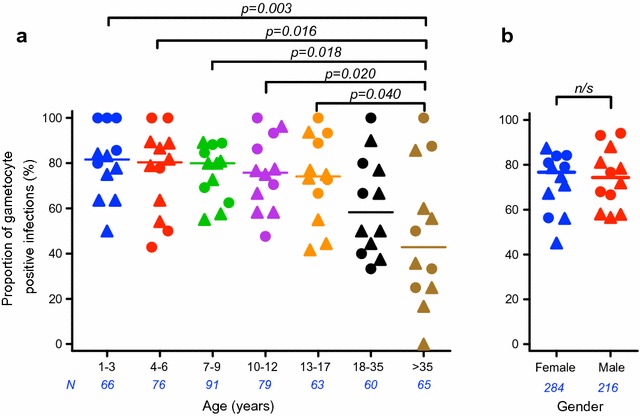
Results: Most P. falciparum infections (51-89%) in this population were accompanied by gametocytaemia throughout the 1-year period. Gametocyte prevalence among P. falciparum-positive individuals (proportion of gametocyte positive infections) was associated with age (p = 0.003) but not with seasonality (wet vs. dry) or gender. The proportion of gametocyte positive infections were similarly high in children aged 1-17 years (74-82% on median among 5 age groups), while older individuals had relatively lower proportion, and those aged > 35 years (median of 43%) had significantly lower than those aged 1-17 years (p < 0.05). Plasmodium falciparum-positive individuals with gametocytaemia were found to have significantly higher P. falciparum multiclonality than those without gametocytaemia (p < 0.033 in two different analyses).

Conclusions: Taken together, these results suggest that a substantial proportion of Pf-positive individuals carries gametocytes throughout the year, and that age is a significant determinant of gametocyte prevalence among these P. falciparum-positive individuals. Furthermore, the presence of multiple P. falciparum genotypes in an infection, a common feature of P. falciparum infections in high transmission areas, is associated with gametocyte prevalence.

Keywords: Gametocytes; Longitudinal; Malaria; Mali; Multiclonality; Plasmodium falciparum.


Figures

Fig. 1
Fig. 1
Population total Plasmodium falciparum prevalence, P. falciparum gametocyte prevalence and clinical malaria incidence. Total P. falciparum prevalence (include both asexual and sexual parasites) and P. falciparum gametocyte prevalence in the entire cohort at each month for 1 year are shown with the 95% confidence intervals (left y-axis). Total P. falciparum positivity was measured by species-specific nested PCR, and, P. falciparum gametocyte positivity by Pfs25 mRNA RT-PCR. In addition, the number of malaria cases over each 1-month period preceding sample collection is shown (right y-axis)
Fig. 2
Fig. 2
Monthly proportion of gametocyte positive infections over 1 year. Proportion of gametocyte positive infections among all P. falciparum positive individuals were assessed once per month, regardless of their treatment status. The error bars indicate the 95% confidence intervals. Number of P. falciparum-positive individuals screened for gametocyte-positivity at each month is shown at the top
Fig. 3
Fig. 3
Proportion of gametocyte positive infections stratified by age (a) and gender (b). Each data-point represents the proportion among the respective age group at one of 12 time-points over the 1-year period. Number of individuals (N) in each age and gender group is shown in blue. Triangles represent wet season time-points (June–December) and circles represent dry season time-points (January–May). a There was a significant age-effect on proportion of gametocyte positive infections (p = 0.003, One-way ANOVA). Groups of children aged 1–17 years have similarly high proportions. The > 35 age-group has significantly lower proportion than age-groups ≤ 17 years (each of all age groups was compared to all other groups by Tukey’s multiple comparison tests, and only significant p-values are shown). b There was no significant difference in gametocyte proportion between males and females (p = 0.755, Mann–Whitney test)
Fig. 4
Fig. 4
Comparison of multiclonality between gametocyte-negative (Nega) and –positive (Posi) individuals among P. falciparum-positive individuals. a Polymorphic proportion (PmP, proportion of polymorphic reactions among the total number of successful reactions) and b complexity of infection (COI, COIL-estimated number of unique P. falciparum genotypes in each infection) among P. falciparum-positive individuals at four time-points (Jun, n = 119; Nov, n = 110; Feb, n = 51; and Apr, n = 41) were pooled and stratified by gametocyte status. Gametocyte positive individuals have significantly higher PmP (p = 0.009, Mann–Whitney test) and COI (p = 0.033, Chi square test) than gametocyte-negative individuals

References

    1. WHO. World Malaria Report 2016. Geneva: World Health Organization; 2016.
    1. Doolan DL, Dobano C, Baird JK. Acquired immunity to malaria. Clin Microbiol Rev. 2009;22:13–36. doi: 10.1128/CMR.00025-08. - DOI - PMC - PubMed
    1. Nassir E, Abdel-Muhsin AM, Suliaman S, Kenyon F, Kheir A, Geha H, et al. Impact of genetic complexity on longevity and gametocytogenesis of Plasmodium falciparum during the dry and transmission-free season of eastern Sudan. Int J Parasitol. 2005;35:49–55. doi: 10.1016/j.ijpara.2004.10.014. - DOI - PubMed
    1. Tran TM, Li S, Doumbo S, Doumtabe D, Huang CY, Dia S, et al. An intensive longitudinal cohort study of Malian children and adults reveals no evidence of acquired immunity to Plasmodium falciparum infection. Clin Infect Dis. 2013;57:40–47. doi: 10.1093/cid/cit174. - DOI - PMC - PubMed
    1. Diallo A, Ndam NT, Moussiliou A, Dos Santos S, Ndonky A, Borderon M, et al. Asymptomatic carriage of Plasmodium in urban Dakar: the risk of malaria should not be underestimated. PLoS ONE. 2012;7:e31100. doi: 10.1371/journal.pone.0031100. - DOI - PMC - PubMed

Publication types

LinkOut - more resources