


Toward a comprehensive evidence map of overview of systematic review methods: paper 1-purpose, eligibility, search and data extraction
- PMID: 29162130
- PMCID: PMC5698938
- DOI: 10.1186/s13643-017-0617-1
Toward a comprehensive evidence map of overview of systematic review methods: paper 1-purpose, eligibility, search and data extraction
Abstract
Background: Overviews of systematic reviews attempt to systematically retrieve and summarise the results of multiple systematic reviews. Methods for conducting, interpreting and reporting overviews are in their infancy. To date, there has been no evidence map of the methods used in overviews, thus making it difficult to determine the gaps and priorities for methods research. Our objectives were to develop and populate a comprehensive framework of methods for conducting, interpreting and reporting overviews (stage I) and to create an evidence map by mapping studies that have evaluated overview methods to the framework (stage II).
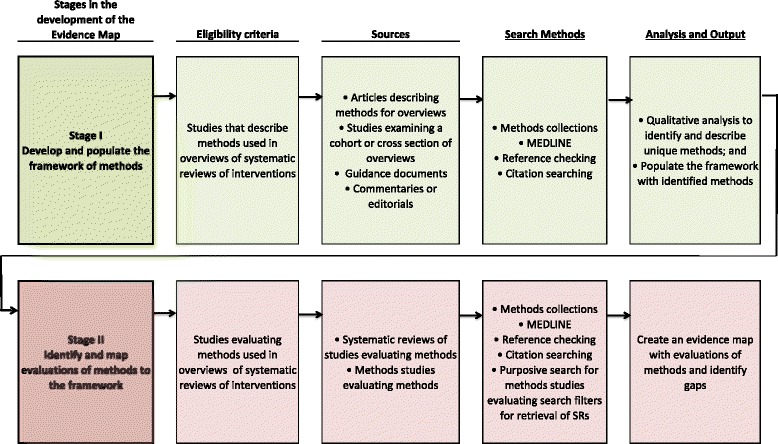
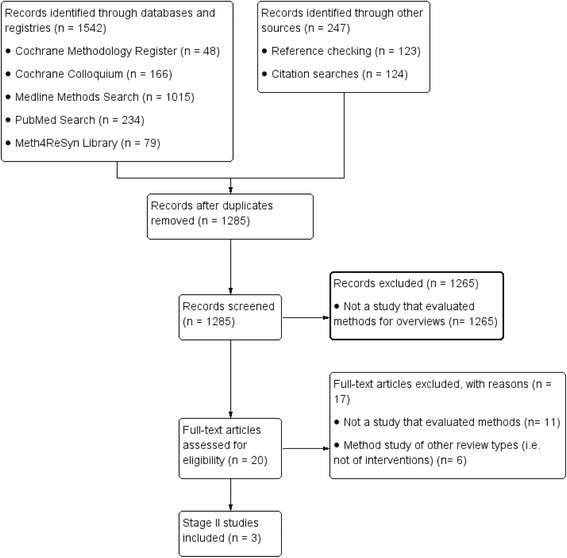
Methods: We searched methods collections (e.g. Cochrane Methodology Register, Meth4ReSyn library, AHRQ Effective Health Care Program) to identify eligible studies for both stages of this research. In stage I, cross-sectional studies, guidance documents and commentaries that described methods proposed for, or used in, overviews were used to develop and populate the framework of methods. Drafts and multiple iterations of the framework were discussed and refined by all authors. In stage II, we identified and described studies evaluating overview methods and mapped these evaluations to the framework.
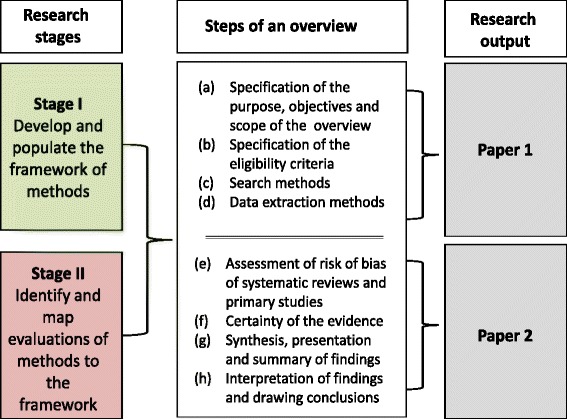
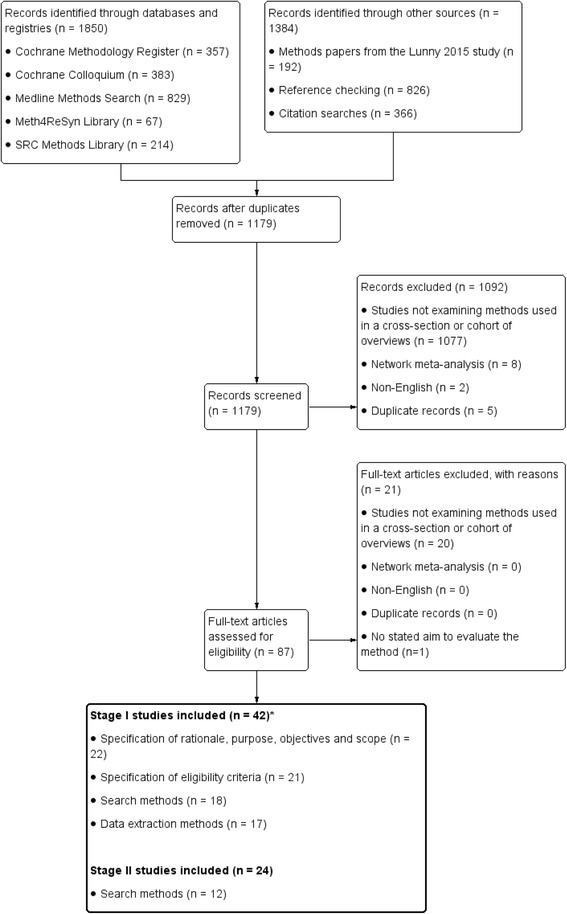
Results: In this paper, we present results for the four initial steps of conducting an overview: (a) specification of the purpose, objectives and scope, (b) specification of the eligibility criteria, (c) search methods and (d) data extraction. Twenty-nine studies mentioned or described methods relevant to one or more of these steps. In the developed framework, identified methods and approaches were grouped according to the steps an overview author would need to undertake. Fifteen studies evaluated identified methods, all of which mapped to the search methods step. These studies either reported the development and evaluation of a new search filter to retrieve systematic reviews or compared the performance of multiple filters.
Conclusion: Gaps in the evaluation of methods were found for the majority of steps in the framework. More empirical studies are needed to evaluate the methods outlined and provide a comprehensive evidence map. The framework is useful for planning these evaluations and for planning methods required to deal with challenges that arise when conducting an overview.
Keywords: Evaluation of methods; Evidence mapping; Evidence synthesis; Meta-review; Overview; Overview methods; Overviews of systematic reviews; Review of reviews; Systematic review methods; Umbrella review.
Conflict of interest statement
Ethics approval and consent to participate
Not applicable.
Consent for publication
Not applicable.
Competing interests
JEM is an Associate Editor of Systematic Reviews and is a Guest Editor for the thematic series ‘Overviews of systematic reviews: development and evaluation of methods’, to which this paper was submitted. SEB is an Associate Editor of Systematic Reviews. Neither JEM nor SEB were involved in the peer-review or editorial decisions for this manuscript. CL and SM declare that they have no competing interests.
Publisher’s Note
Springer Nature remains neutral with regard to jurisdictional claims in published maps and institutional affiliations.
Figures
References
-
- Becker LA, Oxman AD. In: Overviews of reviews. Cochrane Handbook for Systematic Reviews of Interventions. Higgins JPT, Green S, editors. Hoboken: John Wiley & Sons; 2008. pp. 607–631.
-
- Salanti G, Becker L, Caldwell D, Churchill R, Higgins J, Li T, Schmid C. Evolution of Cochrane intervention reviews and overviews of reviews to better accommodate comparisons among multiple interventions. In: Report from a meeting of the Cochrane comparing multiple interventions methods groups. Madrid: Cochrane Comparing Multiple Interventions Methods Groups; 2011.
-
- CMIMG C . Review Type & Methodological Considerations --background paper for the first part of the Paris CMIMG discussion. 2012.
Publication types
MeSH terms
LinkOut - more resources
Full Text Sources
Other Literature Sources
