


The association between early life stress and prefrontal cortex activation during implicit emotion regulation is moderated by sex in early adolescence
- PMID: 29162186
- PMCID: PMC5726300
- DOI: 10.1017/S0954579417001444
The association between early life stress and prefrontal cortex activation during implicit emotion regulation is moderated by sex in early adolescence
Abstract
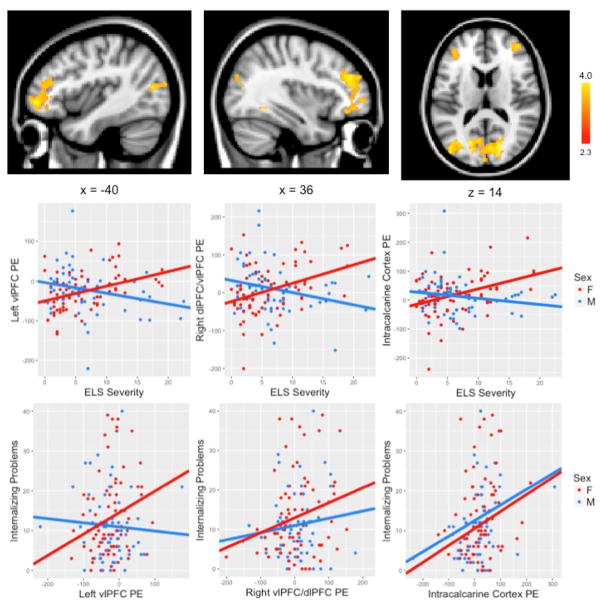
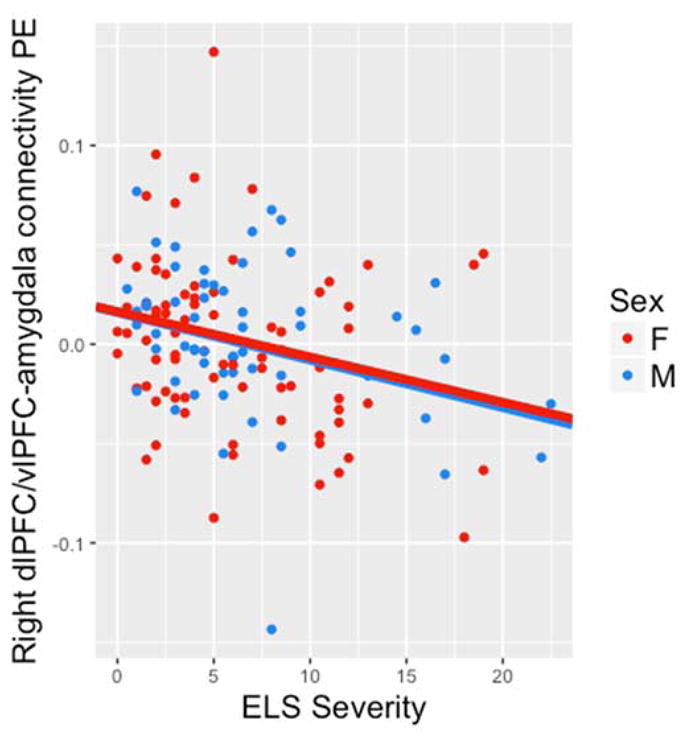
Early life stress (ELS) is a significant risk factor for the emergence of internalizing problems in adolescence. Beginning in adolescence, females are twice as likely as males to experience internalizing disorders. The present study was designed to examine sex differences in the association between ELS and internalizing problems in early pubertal adolescents, and whether and how corticolimbic function and connectivity may underlie these associations. Fifty-nine early pubertal males and 78 early pubertal females, ages 9-13 years (all Tanner Stage 3 or below) underwent functional magnetic resonance imaging as they performed an emotion label task that robustly interrogates corticolimbic function. Participants were also interviewed about their experience of ELS. Females exhibited a positive association between ELS and internalizing problems, whereas males exhibited no such association. Whole-brain and amygdala region of interest analyses indicated that whereas females exhibited a positive association between ELS and the ventrolateral prefrontal cortex during implicit emotion regulation, males showed no such association. Activation in these regions was positively associated with internalizing problems in females but not males; however, activation in these regions did not mediate the association between ELS and internalizing problems. Finally, both boys and girls exhibited an association between ELS and increased negative connectivity between the right ventrolateral prefrontal cortex and bilateral amygdala. Using a carefully characterized sample of early pubertal adolescents, the current study highlights important sex differences in the development of corticolimbic circuitry during a critical period of brain development. These sex differences may play a significant role in subsequent risk for internalizing problems.
Figures
References
-
- Achenbach TM. Integrative Guide to the 1991 CBCL/4-18, YSR, and TRP Profiles. Burlington, VT: University of Vermont, Research Center for Children, Youth, & Families; 1991.
-
- Achenbach TM, Rescorla LA. Manual for the ASEBA School-Age Forms and Profiles. Burlington, VT: University of Vermont, Research Center for Children, Youth, & Families; 2001.
-
- Aiken LS, West SG. Multiple regression: Testing and interpreting interactions. Newbury Park, CA: Sage; 1991.
-
- Andersen SL, Teicher MH. Stress, sensitive periods and maturational events in adolescent depression. Trends in Neurosciences. 2008;31(4):183–191. http://doi.org/10.1016/j.tins.2008.01.004. - DOI - PubMed
-
- Andersen SL, Tomada A, Vincow ES, Valente E, Polcari A, Teicher MH. Preliminary Evidence for Sensitive Periods in the Effect of Childhood Sexual Abuse on Regional Brain Development. Journal of Neuropsychiatry. 2008;20(3):292–301. http://doi.org/10.1176/appi.neuropsych.20.3.292. - DOI - PMC - PubMed
Publication types
MeSH terms
Grants and funding
LinkOut - more resources
Full Text Sources
Other Literature Sources
Medical
