. 2018 Mar;154(4):1080-1095.
doi: 10.1053/j.gastro.2017.11.002. Epub 2017 Nov 21.

Mouse Model of Alagille Syndrome and Mechanisms of Jagged1 Missense Mutations

Affiliations

Mouse Model of Alagille Syndrome and Mechanisms of Jagged1 Missense Mutations

Emma R Andersson et al. Gastroenterology. 2018 Mar.

Abstract

Background & aims: Alagille syndrome is a genetic disorder characterized by cholestasis, ocular abnormalities, characteristic facial features, heart defects, and vertebral malformations. Most cases are associated with mutations in JAGGED1 (JAG1), which encodes a Notch ligand, although it is not clear how these contribute to disease development. We aimed to develop a mouse model of Alagille syndrome to elucidate these mechanisms.

Methods: Mice with a missense mutation (H268Q) in Jag1 (Jag1+/Ndr mice) were outbred to a C3H/C57bl6 background to generate a mouse model for Alagille syndrome (Jag1Ndr/Ndr mice). Liver tissues were collected at different timepoints during development, analyzed by histology, and liver organoids were cultured and analyzed. We performed transcriptome analysis of Jag1Ndr/Ndr livers and livers from patients with Alagille syndrome, cross-referenced to the Human Protein Atlas, to identify commonly dysregulated pathways and biliary markers. We used species-specific transcriptome separation and ligand-receptor interaction assays to measure Notch signaling and the ability of JAG1Ndr to bind or activate Notch receptors. We studied signaling of JAG1 and JAG1Ndr via NOTCH 1, NOTCH2, and NOTCH3 and resulting gene expression patterns in parental and NOTCH1-expressing C2C12 cell lines.

Results: Jag1Ndr/Ndr mice had many features of Alagille syndrome, including eye, heart, and liver defects. Bile duct differentiation, morphogenesis, and function were dysregulated in newborn Jag1Ndr/Ndr mice, with aberrations in cholangiocyte polarity, but these defects improved in adult mice. Jag1Ndr/Ndr liver organoids collapsed in culture, indicating structural instability. Whole-transcriptome sequence analyses of liver tissues from mice and patients with Alagille syndrome identified dysregulated genes encoding proteins enriched at the apical side of cholangiocytes, including CFTR and SLC5A1, as well as reduced expression of IGF1. Exposure of Notch-expressing cells to JAG1Ndr, compared with JAG1, led to hypomorphic Notch signaling, based on transcriptome analysis. JAG1-expressing cells, but not JAG1Ndr-expressing cells, bound soluble Notch1 extracellular domain, quantified by flow cytometry. However, JAG1 and JAG1Ndr cells each bound NOTCH2, and signaling from NOTCH2 signaling was reduced but not completely inhibited, in response to JAG1Ndr compared with JAG1.

Conclusions: In mice, expression of a missense mutant of Jag1 (Jag1Ndr) disrupts bile duct development and recapitulates Alagille syndrome phenotypes in heart, eye, and craniofacial dysmorphology. JAG1Ndr does not bind NOTCH1, but binds NOTCH2, and elicits hypomorphic signaling. This mouse model can be used to study other features of Alagille syndrome and organ development.

Keywords: Alagille; Development; Heart; Jagged1; Kidney; Liver; Notch; Vertebrae.


Conflict of interest statement

Conflicts of interest

The authors disclose no conflicts. A separate project in ERA lab is funded by ModeRNA.

Figures
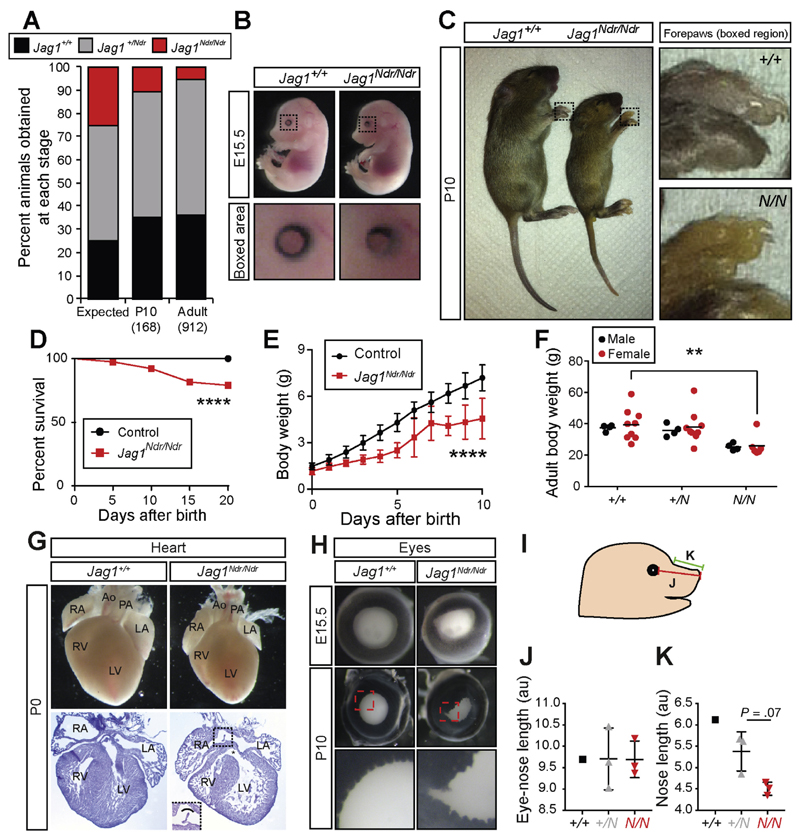
Figure 1
Figure 1
Jag1Ndr/Ndr C3H/C57bl6 mice survive to adulthood with Alagille-like phenotypes. (A) Jag1+/Ndr mice were mated to generate Jag1+/+, Jag1+/Ndr and Jag1Ndr/Ndr offspring. At P10 and adult stages, fewer than the expected 25% of Jag1Ndr/Ndr mice were observed. (B, C) At E15.5 Jag1Ndr/Ndr mice appear grossly normal, with a mild eye defect (B), and by P10 are smaller and jaundiced (C). (D) After birth, 20% of Jag1Ndr/Ndr mice die within the first 20 days. (E) At birth, Jag1Ndr/Ndr mice are of normal size, but fail to gain weight as rapidly, a difference that is significant from P2, and (F) persistently weigh less than wild types. (G) Jag1Ndr/Ndr hearts are somewhat smaller than wild type hearts, likely corresponding to the smaller size of Jag1Ndr/Ndr mice. Hematoxylin staining of cryosections reveals ventricular (asterisk) and atrial (boxed) septation defects. (H) Iris dysmorphologies are manifested in Jag1Ndr/Ndr mice as early as E15.5. (I) Craniofacial proportions were measured in photos of E15.5 embryos, measuring the distance from (J) the eye to the tip of the snout and (K) the snout bridge to the tip of the snout, revealing a tendency towards altered proportions. For J and K, 3 animals were measured for Jag1+/Ndr and Jag1Ndr/Ndr, but only 1 Jag1+/+. Error bars indicate s.d.; **P <.01, ****P <.0001.
Figure 2
Figure 2
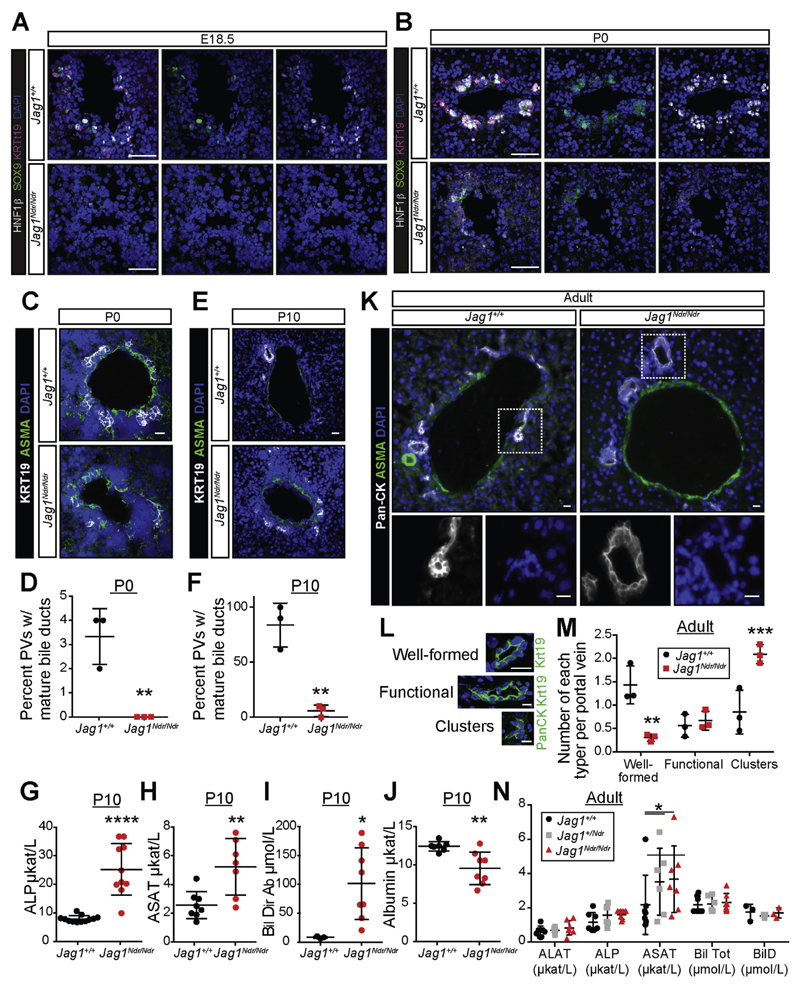
Postnatal Jag1Ndr/Ndr mice display ductopenia, which is rescued in adults. (A, B) HNF1β, SOX9, and KRT19 staining show a marked absence of biliary cells at E18.5 (A) and weak staining at P0 (B) near the hilum in Jag1Ndr/Ndr liver. (C, D) KRT19+ cell clusters appear around ASMA+ periportal regions near the hilum of wild type Jag1+/+ mice at P0, but are absent in Jag1Ndr/Ndr mice. (E, F) By P10, clusters of biliary cells have lumenized to form ducts in Jag1+/+ mice, but not in Jag1Ndr/Ndr mice. Jag1Ndr/Ndr mice display increased (G) alkaline phosphatase (ALP), (H) aspartate aminotransferase (ASAT), (I) direct bilirubin (Bil Dir), and (J) decreased albumin. (K) At adult stages, lumenized bile ducts are present in both Jag1+/+ and Jag1Ndr/Ndr mice, though classification (L) of structures shows (M) significantly more clusters in Jag1Ndr/Ndr mice and fewer well-formed bile ducts. (N) Nevertheless, markers of liver function demonstrate a rescue of bile duct function in adult Jag1Ndr/Ndr mice in most serum chemistry markers. A small difference in aspartate aminotransferase levels persists. Error bars indicate s.d.; *P <.05, **P <.01, ***P <.001, ****P <.0001. Scale bars: (A, B) 50 μm, (C) 20 μm, (I, J) 10 μm.
Figure 3
Figure 3
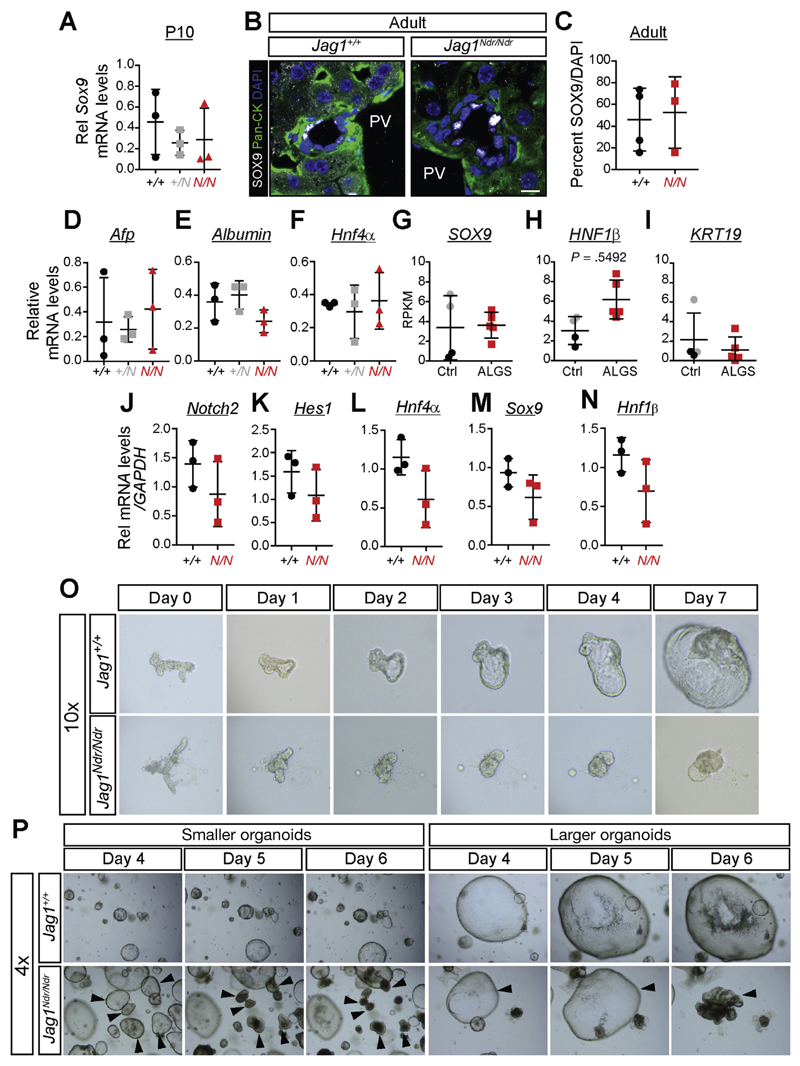
Jag1Ndr/Ndr biliary cells express the expected markers but display structural instability. Sox9 levels are unchanged at P10 at the mRNA level (A), and at adult stages at protein levels (B, C). qPCR for (D) alpha-fetoprotein, (E) albumin, and (F) Hnf4α show no significant differences in Jag1Ndr/Ndr mice at P10. Similarly, RNA sequencing of ALGS livers shows no difference in (G) SOX9, (H) HNF1β, or (I) KRT19 levels. Organoids derived from adult Jag1Ndr/Ndr livers expressed normal levels of (J) Notch2, (K) Hes1, (L) Hnf4α, (M) Sox9, and (N) Hnf1β as assessed by qPCR, but (O) grew slowly and (P) sometimes spontaneously collapsed. Collapse was not related to organoid size because both smaller and larger organoids collapsed. No differences were significant. Scale bar: (B) 10 μm.
Figure 4
Figure 4
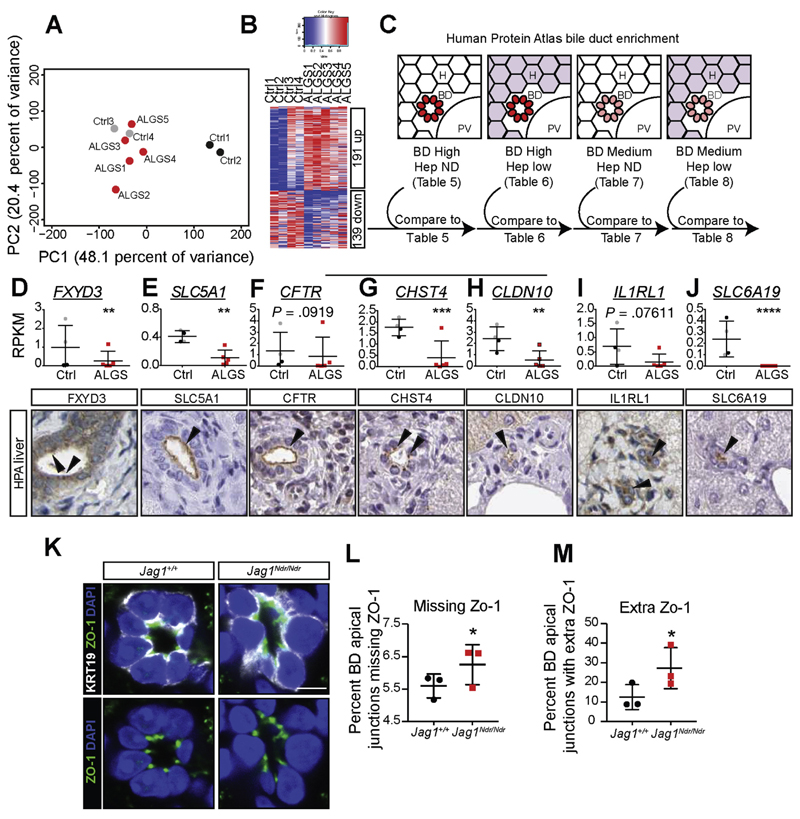
RNA sequencing of ALGS liver reveals a specific decrease in apical markers of biliary cells. (A) Principle component analysis (PCA) of RNA sequencing of liver biopsies from patients with ALGS or control patients. A comparison with non-cholestatic control samples (Ctrl 1 and 2) and with cholestatic control samples (Ctrl 3 and 4) shows that ALGS samples cluster with cholestatic liver samples. (B) Heatmap shows 191 significantly up-regulated and 139 down-regulated genes in ALGS samples. (C) Dysregulated genes were compared with protein lists generated using the HPA (www.proteinatlas.org) for genes with high/medium protein expression in biliary cells, and undetected/low expression in hepatocytes (Supplementary Tables 5–8). This pipeline identified transcripts whose proteins were highly enriched at the apical side of bile ducts, including (D) FXYD3, and (E) SLC5A1. Manual comparison of the top 30 down-regulated genes in ALGS further revealed apically enriched proteins: (F) CFTR, (G) CHST4, (H) CLDN10, (I) IL1RL1, and (J) SLC6A19. (K) TJP1/ZO-1 is not down-regulated but is aberrantly localized, with some junctions (L) missing ZO-1, and other cell junctions with (M) extra ZO1 punctae. Error bars indicate s.d.; **corrected P-value (False Discovery Rate) <.01, ***False Discovery Rate <.001, ****False Discovery Rate <10 -7. Scale bar: 5 μm.
Figure 5
Figure 5
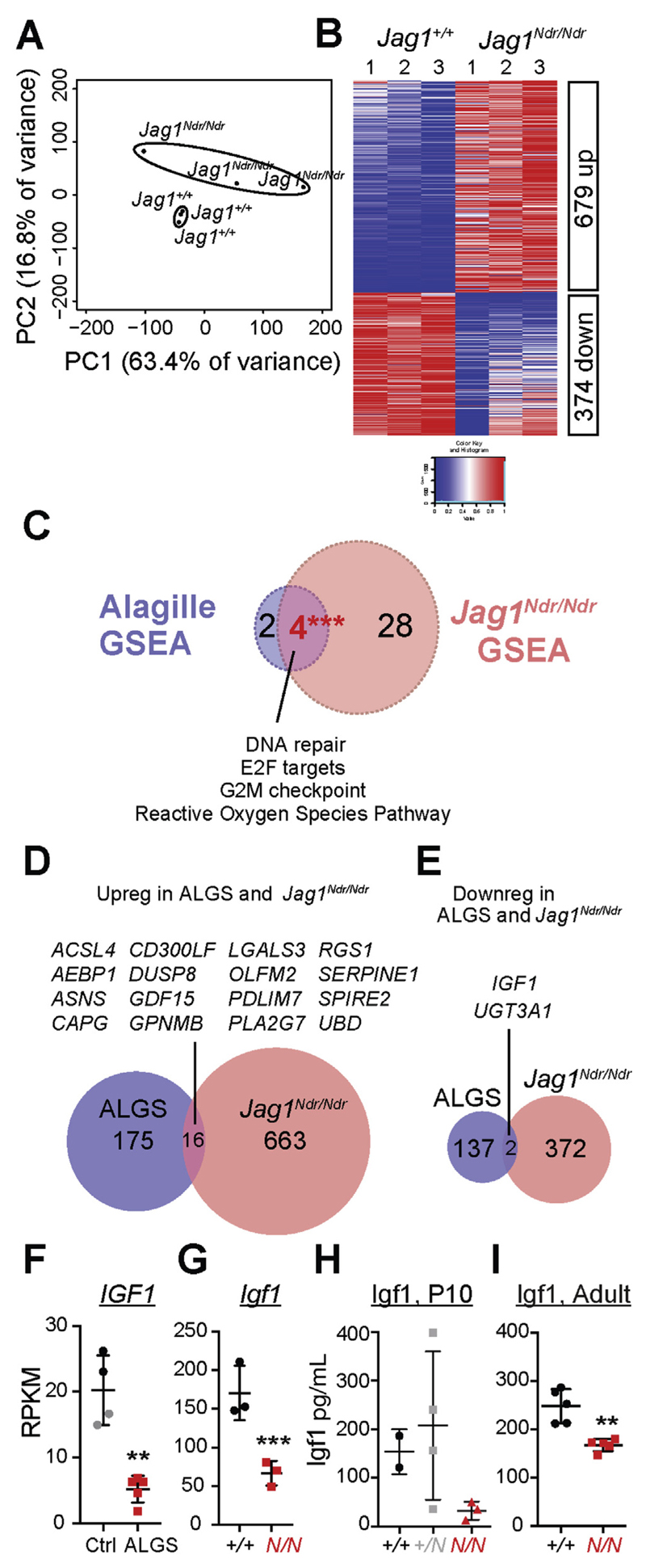
IGF1 is dysregulated in Jag1Ndr/Ndr and Alagille liver. (A) PCA of RNA sequencing reveals that Jag1+/+ and Jag1Ndr/Ndr liver transcriptomes cluster distinctly. (B) Heatmap shows 679 significantly up-regulated and 374 down-regulated genes in Jag1Ndr/Ndr livers. (C) Comparison of Gene Set Enrichment Analyses (GSEA), of livers from Jag1Ndr/Ndr mice and patients with ALGS (Supplementary Tables 12–15) shows extensive overlap. (D) Comparison of significantly dysregulated genes shows (D) 16 genes up-regulated and (E) 2 genes down-regulated in both Jag1Ndr/Ndr mice and ALGS, including Igf1. Igf1 mRNA levels are highly down-regulated in Alagille livers (F) and Jag1Ndr/Ndr livers (G). IGF1 protein levels were confirmed to be down-regulated in serum of (H) P10 and (I) adult mice. Error bars indicate s.d.; **P <.01, ***P <.001. (In F, and G, P-values are corrected P-values).
Figure 6
Figure 6
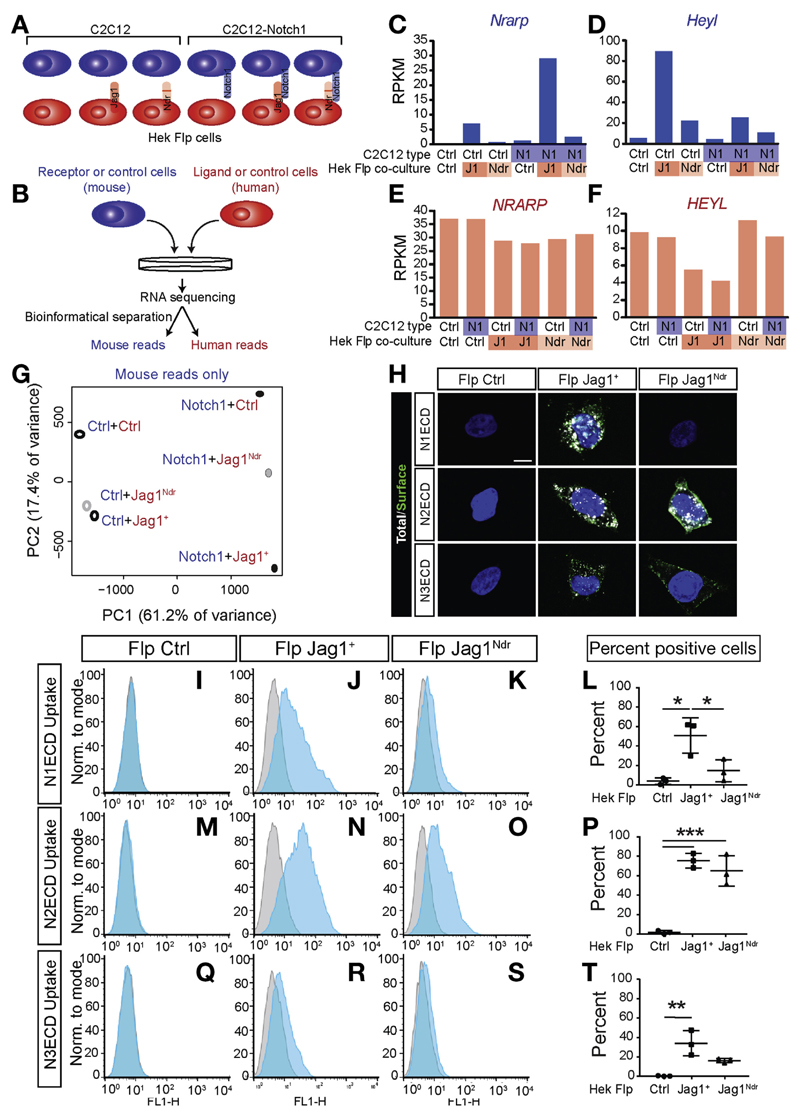
JAG1Ndr is a Notch signaling hypomorph with receptor-selective binding. (A) Scheme depicting co-culture combinations. Control or NOTCH1-overexpressing C2C12 cells (mouse cells, blue) were co-cultured with Flp Ctrl, Flp JAG1+, or Flp JAG1Ndr cells (human cells, red). (B) After 6 hours, RNA was extracted for species-specific RNA sequencing (S3). Bioinformatic analyses separates mouse from human reads. The Notch target genes, Nrarp and Heyl, are (C, D) up-regulated in mouse receptor cells upon simulation with Flp JAG1+ cells, (E, F) but not in human ligand cells. (G) PCA for the mouse transcriptome shows that control and NOTCH1-overexpressing C2C12 cell lines both respond to JAG1+ stimulation with a similar downwards shift, reflecting Notch activation. JAG1Ndr is only capable of inducing part of this response in Notch1-overexpressing C2C12 cells, but behaves similar to JAG1+ in its activation of C2C12 cells. (HT) JAG1Ndr does not bind NOTCH1 but does bind NOTCH2 and NOTCH3. Flp Ctrl, Flp JAG1+, or Flp JAG1Ndr cells were treated with fluorescently tagged extracellular domain of NOTCH1, 2, or 3 (N1-3ECD, white). After 1 hour of uptake, cells were fixed and anti-Fc was used to detect non-endocytosed, cell surface N1-3ECD (green), or cells were subjected to FACS analysis. (H) Flp Ctrl cells do not bind N1-3ECD. Flp JAG1+ cells bind and internalize NOTCH1, 2, and 3. Flp JAG1Ndr cells do not bind NOTCH1, but do bind NOTCH2 and NOTCH3. FACS analysis of N1ECD uptake by (I) Flp Ctrl cells, (J) Flp JAG1+, or (K) Flp JAG1Ndr cells, quantified in (L). FACS analysis of N2ECD uptake by (M) Flp Ctrl cells, (N) Flp JAG1+, or (O) Flp JAG1Ndr cells, quantified in (P). FACS analysis of N3ECD uptake by (Q) Flp Ctrl cells, (R) Flp JAG1+, or (S) Flp JAG1Ndr cells, quantified in (T). Quantifications (L, P, T) show Overton cumulative histogram subtractions. Error bars indicate s.d.; *P <.05, **P <.01, ***P <.001. CG represent results from 1 experiment. Scale bar: (H) 10 μm.
Figure 7
Figure 7
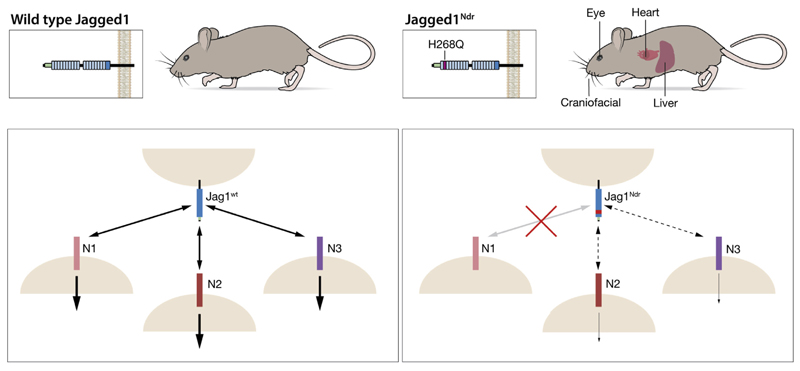
Schematic summary of phenotypes and signaling aberrations in Jag1Ndr/Ndr mice. The location of the JAG1Ndr mutation, organs with phenotypes described here, and the interaction and signaling dysregulation for individual Notch receptors are depicted.

Comment in

References

    1. Mašek J, Andersson ER. The developmental biology of genetic Notch disorders. Development. 2017;144:1743–1763. - PubMed
    1. Grochowski CM, Loomes KM, Spinner NB. Jagged1 (JAG1): structure, expression, and disease associations. Gene. 2016;576:381–384. - PMC - PubMed
    1. Li L, Krantz ID, Deng Y, et al. Alagille syndrome is caused by mutations in human Jagged1, which encodes a ligand for Notch1. Nat Genet. 1997;16:243–251. - PubMed
    1. Oda T, Elkahloun AG, Pike BL, et al. Mutations in the human Jagged1 gene are responsible for Alagille syndrome. Nat Genet. 1997;16:235–242. - PubMed
    1. McDaniell R, Warthen DM, Sanchez-Lara PA, et al. NOTCH2 mutations cause Alagille syndrome, a heterogeneous disorder of the notch signaling pathway. Am J Hum Genet. 2006;79:169–173. - PMC - PubMed

Publication types

MeSH terms