


Health of health care workers in Canadian nursing homes and pediatric hospitals: a cross-sectional study
- PMID: 29162609
- PMCID: PMC5741427
- DOI: 10.9778/cmajo.20170080
Health of health care workers in Canadian nursing homes and pediatric hospitals: a cross-sectional study
Abstract
Background: Poor health of health care workers affects quality of care, but research and health data for health care workers are scarce. Our aim was to compare physical/mental health among health care worker groups 1) within nursing homes and pediatric hospitals, 2) between the 2 settings and 3) with the physical/mental health of the Canadian population.
Methods: Using cross-sectional data collected as part of the Translating Research in Elder Care program and the Translating Research on Pain in Children program, we examined the health of health care workers. In nursing homes, 169 registered nurses, 139 licensed practical nurses, 1506 care aides, 145 allied health care providers and 69 managers were surveyed. In pediatric hospitals, 63 physicians, 747 registered nurses, 155 allied health care providers, 49 nurse educators and 22 managers were surveyed. After standardization of the data for age and sex, we applied analyses of variance and general linear models, adjusted for multiple testing.
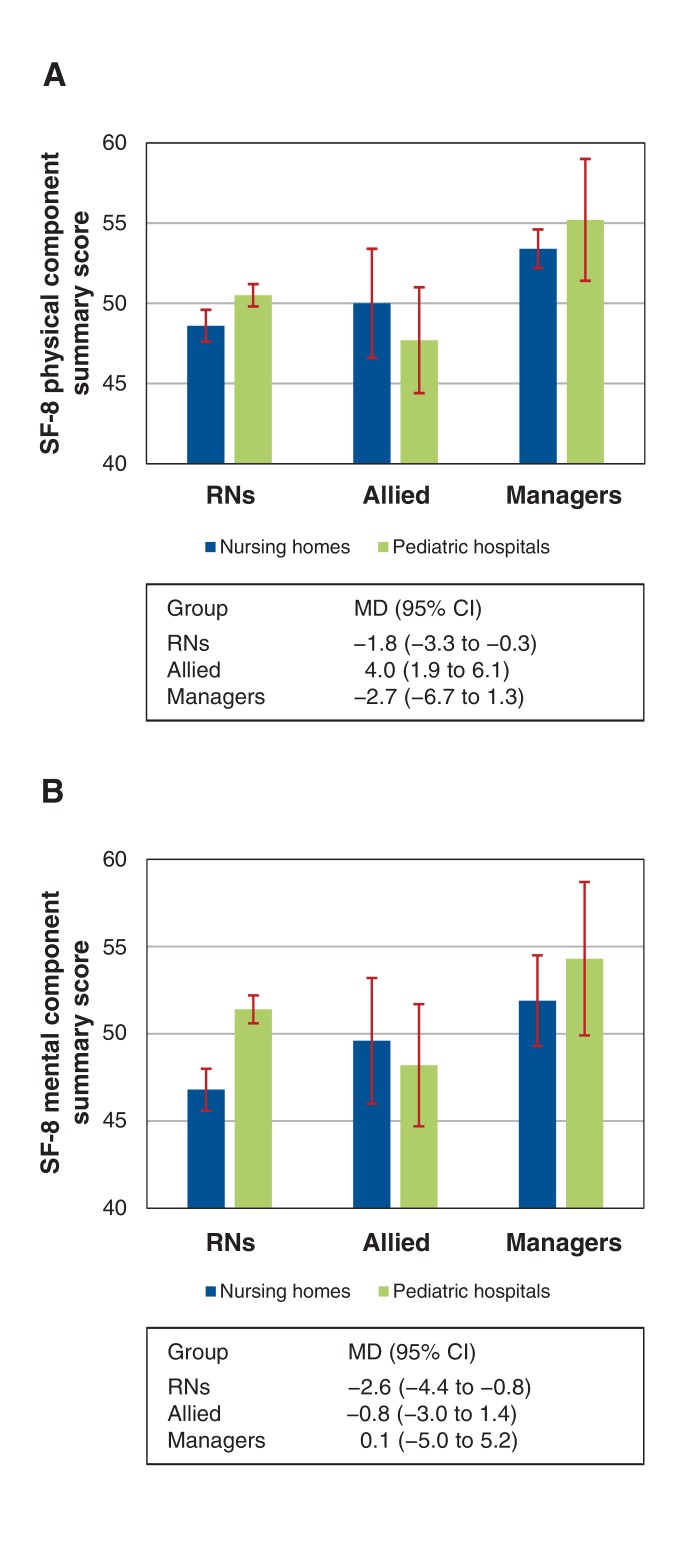
Results: Nursing home workers and registered nurses in pediatric hospitals had poorer mental health than the Canadian population. Scores were lowest for registered nurses in nursing homes (mean difference -4.4 [95% confidence interval -6.6 to -2.6]). Physicians in pediatric hospitals and allied health care providers in nursing homes had better physical health than the general population. We also found important differences in physical/mental health for care provider groups within and between care settings.
Interpretation: Mental health is especially poor among nursing home workers, who care for a highly vulnerable and medically complex population of older adults. Strategies including optimized work environments are needed to improve the physical and mental health of health care workers to ameliorate quality of patient care.
Copyright 2017, Joule Inc. or its licensors.
Conflict of interest statement
Competing interests: None declared.
Figures

References
-
- West CP, Shanafelt TD, Kolars JC. Quality of life, burnout, educational debt, and medical knowledge among internal medicine residents. JAMA. 2011;306:952–60. - PubMed
-
- Schluter PJ, Turner C, Huntington AD, et al. Work/life balance and health: the Nurses and Midwives e-cohort Study. Int Nurs Rev. 2011;58:28–36. - PubMed
-
- Lambert VA, Lambert CE, Ito M. Workplace stressors, ways of coping and demographic characteristics as predictors of physical and mental health of Japanese hospital nurses. Int J Nurs Stud. 2004;41:85–97. - PubMed
-
- Knopp-Sihota JA, Niehaus L, Squires JE, et al. Factors associated with rushed and missed resident care in western Canadian nursing homes: a cross-sectional survey of health care aides. J Clin Nurs. 2015;24:2815–25. - PubMed
-
- Chamberlain SA, Gruneir A, Hoben M, et al. Influence of organizational context on nursing home staff burnout: a cross-sectional survey of care aides in Western Canada. Int J Nurs Stud. 2017;71:60–9. - PubMed
LinkOut - more resources
Full Text Sources
Other Literature Sources
