


Effects of Video Game Training on Measures of Selective Attention and Working Memory in Older Adults: Results from a Randomized Controlled Trial
- PMID: 29163136
- PMCID: PMC5671951
- DOI: 10.3389/fnagi.2017.00354
Effects of Video Game Training on Measures of Selective Attention and Working Memory in Older Adults: Results from a Randomized Controlled Trial
Abstract
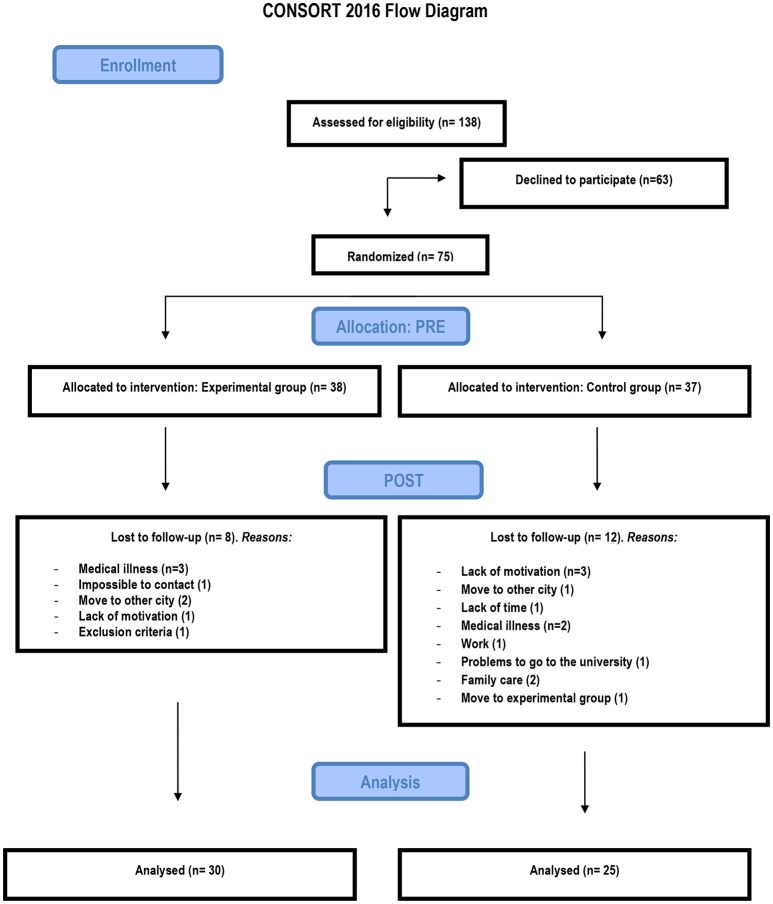
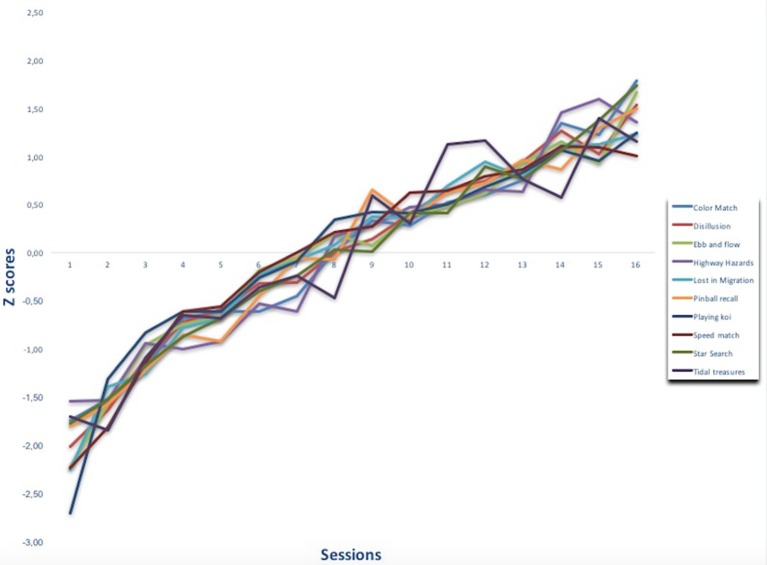
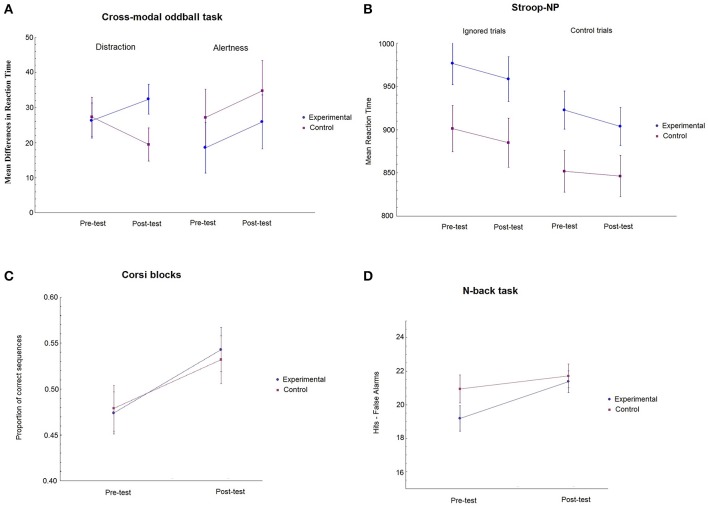
Video game training with older adults potentially enhances aspects of cognition that decline with aging and could therefore offer a promising training approach. Although, previous published studies suggest that training can produce transfer, many of them have certain shortcomings. This randomized controlled trial (RCT; Clinicaltrials.gov ID: NCT02796508) tried to overcome some of these limitations by incorporating an active control group and the assessment of motivation and expectations. Seventy-five older volunteers were randomly assigned to the experimental group trained for 16 sessions with non-action video games from Lumosity, a commercial platform (http://www.lumosity.com/) or to an active control group trained for the same number of sessions with simulation strategy games. The final sample included 55 older adults (30 in the experimental group and 25 in the active control group). Participants were tested individually before and after training to assess working memory (WM) and selective attention and also reported their perceived improvement, motivation and engagement. The results showed improved performance across the training sessions. The main results were: (1) the experimental group did not show greater improvements in measures of selective attention and working memory than the active control group (the opposite occurred in the oddball task); (2) a marginal training effect was observed for the N-back task, but not for the Stroop task while both groups improved in the Corsi Blocks task. Based on these results, one can conclude that training with non-action games provide modest benefits for untrained tasks. The effect is not specific for that kind of training as a similar effect was observed for strategy video games. Groups did not differ in motivation, engagement or expectations.
Keywords: Clinicaltrials. gov ID: NCT02796508; cognitive training; healthy aging; https://clinicaltrials.gov/ct2/show/NCT02796508; selective attention; video games; working memory.
Figures
Comment in
-
Commentary: Effects of Video Game Training on Measures of Selective Attention and Working Memory in Older Adults: Results from a Randomized Controlled Trial.Front Aging Neurosci. 2018 Jan 10;9:442. doi: 10.3389/fnagi.2017.00442. eCollection 2017. Front Aging Neurosci. 2018. PMID: 29377017 Free PMC article. No abstract available.
References
-
- Anguera J. A., Gazzaley A. (2015). Video games, cognitive exercise, and the enhancement of cognitive abilities. Curr. Opin. Behav. Sci. 4, 160–165. 10.1016/j.cobeha.2015.06.002 - DOI
Associated data
LinkOut - more resources
Full Text Sources
Other Literature Sources
Medical
