. 2017 Oct 20:8:2023.
doi: 10.3389/fmicb.2017.02023. eCollection 2017.

Complete Genome Sequence Analysis of Enterobacter sp. SA187, a Plant Multi-Stress Tolerance Promoting Endophytic Bacterium

Affiliations

Complete Genome Sequence Analysis of Enterobacter sp. SA187, a Plant Multi-Stress Tolerance Promoting Endophytic Bacterium

Cristina Andrés-Barrao et al. Front Microbiol. .

Abstract

Enterobacter sp. SA187 is an endophytic bacterium that has been isolated from root nodules of the indigenous desert plant Indigofera argentea. SA187 could survive in the rhizosphere as well as in association with different plant species, and was able to provide abiotic stress tolerance to Arabidopsis thaliana. The genome sequence of SA187 was obtained by using Pacific BioScience (PacBio) single-molecule sequencing technology, with average coverage of 275X. The genome of SA187 consists of one single 4,429,597 bp chromosome, with an average 56% GC content and 4,347 predicted protein coding DNA sequences (CDS), 153 ncRNA, 7 rRNA, and 84 tRNA. Functional analysis of the SA187 genome revealed a large number of genes involved in uptake and exchange of nutrients, chemotaxis, mobilization and plant colonization. A high number of genes were also found to be involved in survival, defense against oxidative stress and production of antimicrobial compounds and toxins. Moreover, different metabolic pathways were identified that potentially contribute to plant growth promotion. The information encoded in the genome of SA187 reveals the characteristics of a dualistic lifestyle of a bacterium that can adapt to different environments and promote the growth of plants. This information provides a better understanding of the mechanisms involved in plant-microbe interaction and could be further exploited to develop SA187 as a biological agent to improve agricultural practices in marginal and arid lands.

Keywords: Indigofera argentea; plant growth-promoting bacteria (PGPB); plant–microbe interaction; root endophytes; salt stress.


Figures
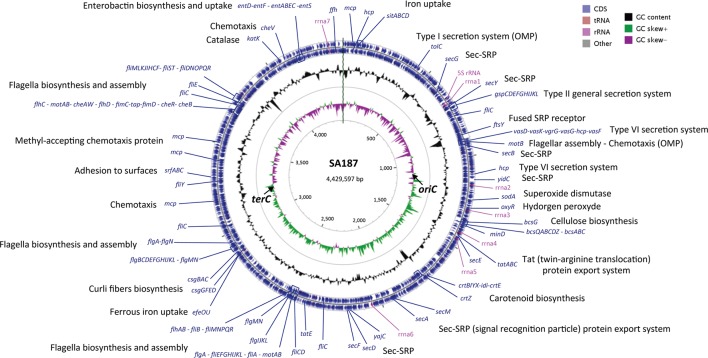
FIGURE 1
FIGURE 1
Genome map of the SA187. The bacterial chromosome is 4.4 Mb in size. The outer concentric circles (blue) include the annotation, location and direction of expression of predicted genes, the middle circle (black) indicates the % GC content, and the inner circle indicates de GC skew [(G–C)/(G+C)] positive (green) and negative (purple). A number of interesting genes are highlighted.
FIGURE 2
FIGURE 2
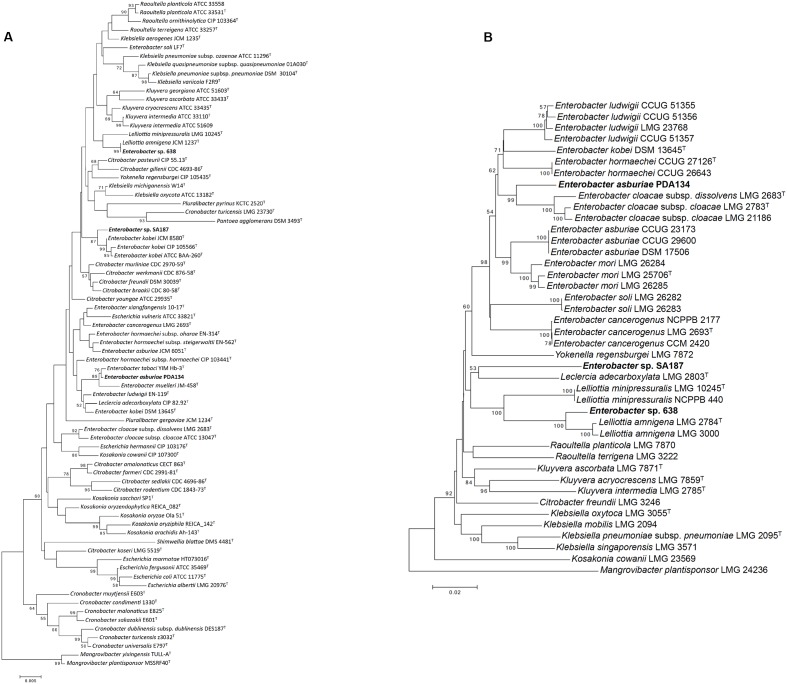
Taxonomic analysis. (A) 16S rRNA based phylogenetic tree. (B) Multilocus sequence analysis (MLSA) based on four housekeeping genes gyrB-rpoB-atpD-infB. The phylogenetic tree was inferred by using the Neighbor-Joining method (Saitou and Nei, 1987), and the optimal tree is shown. The percentage of replicate trees in which the associated taxa clustered together in the bootstrap test (1000 replicates) is shown next to the branches (bootstrap >50 is shown) (Felsenstein, 1985). The tree is drawn to scale, with branch lengths in the same units as those of the evolutionary distances used to infer the phylogenetic tree. The evolutionary distances (number of nucleotide substitutions per site) were computed using the Kimura-2-parameter method (Kimura, 1980). All ambiguous positions were removed for each sequence pair. There was a total of 2,636 positions in the final dataset.
FIGURE 3
FIGURE 3
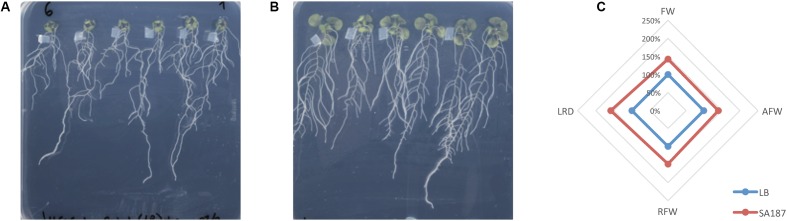
Plant growth promotion under salt stress. (A) Arabidopsis thaliana growing in ½ MS+100 mM NaCl, with no bacterial treatment (–B, control). (B) A. thaliana growing in ½ MS+100 mM NaCl, treated with SA187 bacterialized plug (+B). (C) Radar chart representing the effect of SA187 treatment in the growth of Arabidopsis. AFW, aerial fresh weight; RFW, root fresh weight; FW, total fresh weight; LRD, lateral root density.
FIGURE 4
FIGURE 4
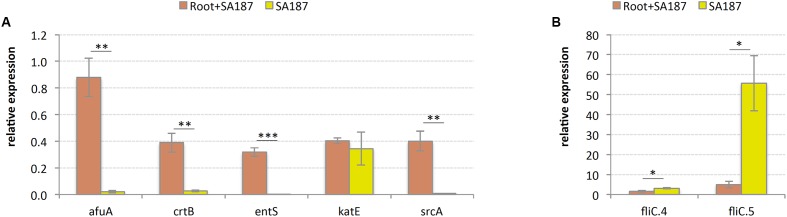
Relative gene expression by RT-qPCR. (A) SA187 genes increasing their expression upon association with Arabidopsis roots. afuA = iron(III) ABC transporter substrate-binding protein, crtB = phytoene synthase, entS = MFS transporter ENTS family enterobactin (siderophore) exporter, katE = catalase, srcA = PTS system, sucrose-specific IIB component. (B) SA187 genes decreasing their expression upon association with Arabidopsis roots. fliC = flagellin. = significant (p < 0.05), ∗∗ = very significant (p < 0.01), ∗∗∗ = extremely significant (p < 0.001).
FIGURE 5
FIGURE 5
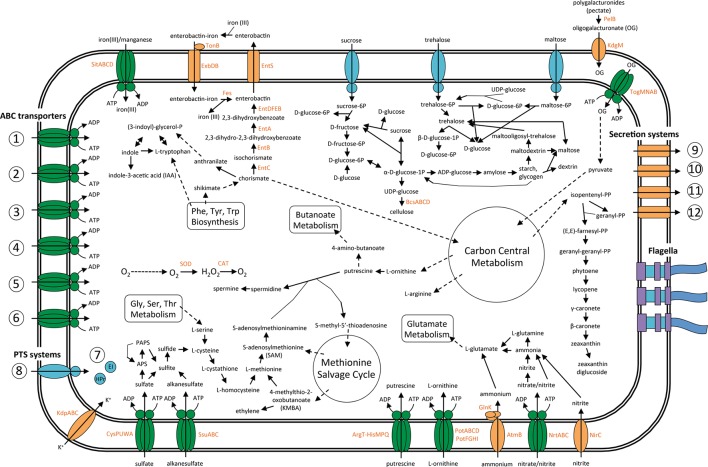
Overview of the metabolism and transport in endophytic bacterium SA187. Predicted pathways involved in plant–microbe interaction, based on the current annotation of the complete genome sequence SA187. Metabolic flow through each pathway is designated by the direction of the arrow connecting two metabolites. Import or export of solutes is designated by the direction of the arrow through the transporter. ABC transporters: (1) Mineral and organic ion transporters: Sulfate, molybdate, nitrate/nitrite, taurine, sulfonate, iron(III), thiamine, spermidine/putrescine, betaine/proline, osmoprotectant; (2) Saccharide, polyol, lipids transporters: Maltose/maltodextrine, L-arabinose, oligogalacturonide, methyl-galactoside, D-xylose, autoinducer-2 (AI-2), rhamnose, ribose, glycerol-3-phosphate, phospholipid, multiple sugar, simple sugar; (3) Phosphate and amino acid transporters: Phosphate, histidine, glutamine, arginine, glutamate/aspartate, general L-amino acid, cysteine, branched-chain amino acid, urea, D-methionine, polar amino acid; (4) Peptide and nickel transporters: Oligopeptide, dipeptide, cationic peptide, nickel, glutathione, peptide/nickel, microcin C; (5) Metallic cation, iron-siderophore, vitamin B12 transporters: Iron-complex transporter, vitamin B12, zinc, manganese/iron; (6) ABC-2 type and other transporters: lipopolysaccharide, lipoprotein-releasing, putative ABC, ABC-2 type. Phosphotranspherase systems (PTS): (7) Enzyme I and phosphocarrier protein (HPr); (8) Enzyme II: Glucose, N-acetyl-glucosamine, maltose/glucose, maltose, sucrose, beta-glucoside, trehalose, alpha-glucoside, fructose, mannitol, 2-O-A-mannosyl-glycerate, cellobiose, glucitol/sorbitol, galactitol, mannose, fructoselysine, ascorbate. Secretion systems: (9) General (Sec-dependent) secretion system, (10) Tat-dependent secretion system, (11) type 2 secretion system (T2SS), (12) type 6 secretion system (T6SS).
FIGURE 6
FIGURE 6
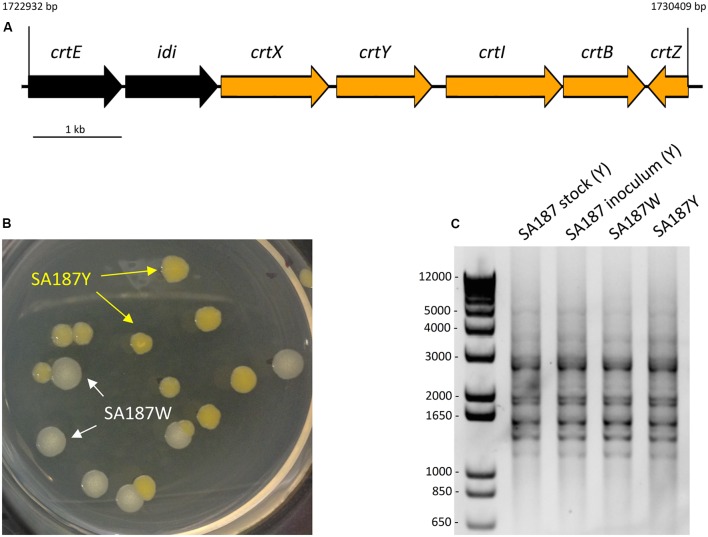
(A) Carotenoid biosynthesis gene cluster. (B) SA187 multi-phenotypic complex. After a certain period of interaction between SA187 and the plant host Arabidopsis, 2 morphologies differing in the pigmentation are observed: yellow (SA187Y) and white (SA187W). (C) (GTG)5-rep-PCR fingerprinting. Genotypic characterization of the SA187Y and SA187W isolates, comparison with the original SA187 stock and the inoculum used for one of the screening experiments. The same amplification pattern shown by the four samples shown in the panel indicates that both phenotypes, yellow and white, are genetically identical.
FIGURE 7
FIGURE 7
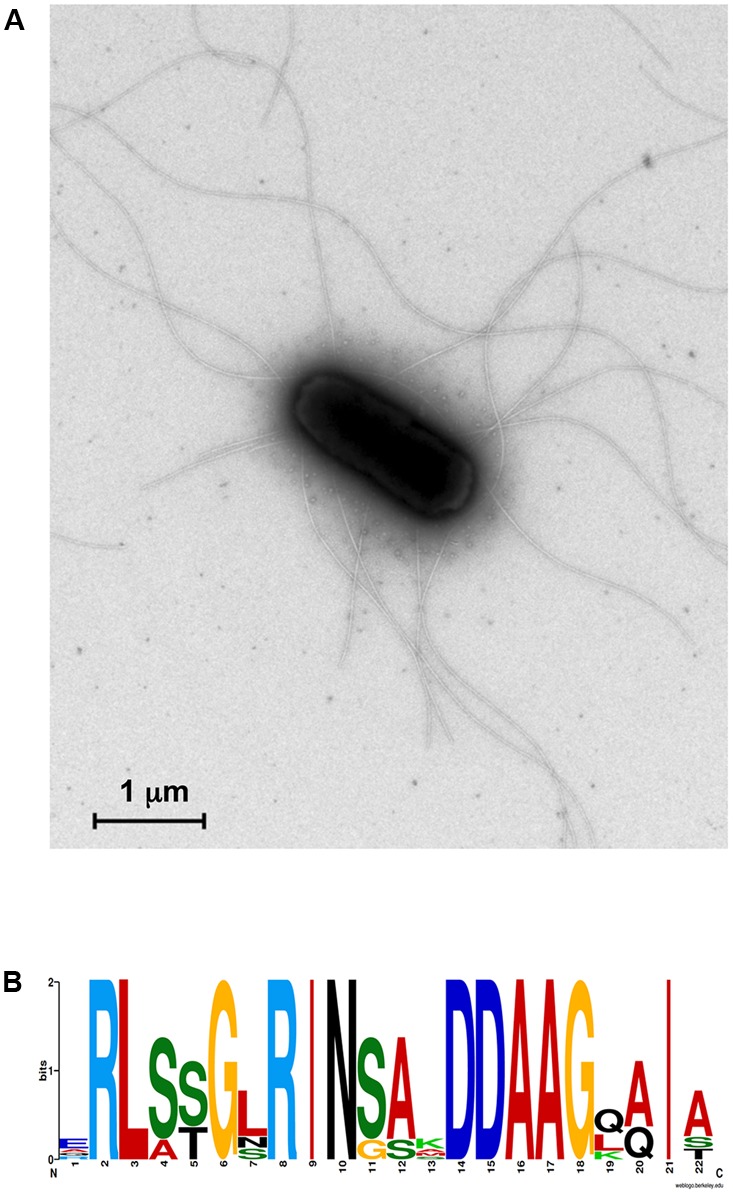
(A) Transmission electron microscopy section of SA187. Bacteria were cultured in LB broth before fixation and negative staining. SA187 shows a high number of peritrichous flagella. (B) Conservation of flg22 motif. The N-terminal of FliC proteins of SA187 shown a highly conserved motif shared with Pseudomonas flg22. Diagram obtained by using WebLogo on-line tool (Crooks et al., 2004).

References

    1. Alam I., Antunes A., Kamau A. A., Ba Alawi W., Kalkatawi M., Stingl U., et al. (2013). INDIGO - INtegrated data warehouse of microbial genomes with examples from the red sea extremophiles. PLOS ONE 8:e82210. 10.1371/journal.pone.0082210 - DOI - PMC - PubMed
    1. Al-Attar S., Westra E. R., van der Oost J., Brouns S. J. (2011). Clustered regularly interspaced short palindromic repeats (CRISPRs): the hallmark of an ingenious antiviral defense mechanism in prokaryotes. Biol. Chem. 392 277–289. 10.1515/BC.2011.042 - DOI - PubMed
    1. Andrés-Barrao C., Saad M. M., Cabello Ferrete E., Bravo D., Chappuis M. L., Ortega Pérez R., et al. (2016). Metaproteomics and ultrastructure characterization of Komagataeibacter spp. involved in high-acid spirit vinegar production. Food Microbiol. 55 112–122. 10.1016/j.fm.2015.10.012 - DOI - PubMed
    1. Azua-Bustos A., González-Silva C. (2014). Biotechnological applications derived from microorganisms of the atacama desert. BioMed Res. Int. 2014:909312. 10.1155/2014/909312 - DOI - PMC - PubMed
    1. Balaji B., O’Connor K., Lucas J. R., Anderson J. M., Csonka L. N. (2005). Timing of induction of osmotically controlled genes in Salmonella enterica serovar Typhimurium, determined with quantitative real-time reverse transcription-PCR. Appl. Environ. Microbiol. 71 8273–8283. 10.1128/aem.71.12.8273-8283.2005 - DOI - PMC - PubMed

LinkOut - more resources