Review
. 2017 Nov 2:8:1442.
doi: 10.3389/fimmu.2017.01442. eCollection 2017.

Nanobody-Based Delivery Systems for Diagnosis and Targeted Tumor Therapy

Affiliations
Review

Nanobody-Based Delivery Systems for Diagnosis and Targeted Tumor Therapy

Yaozhong Hu et al. Front Immunol. .

Abstract

The development of innovative targeted therapeutic approaches are expected to surpass the efficacy of current forms of treatments and cause less damage to healthy cells surrounding the tumor site. Since the first development of targeting agents from hybridoma's, monoclonal antibodies (mAbs) have been employed to inhibit tumor growth and proliferation directly or to deliver effector molecules to tumor cells. However, the full potential of such a delivery strategy is hampered by the size of mAbs, which will obstruct the targeted delivery system to access the tumor tissue. By serendipity, a new kind of functional homodimeric antibody format was discovered in camelidae, known as heavy-chain antibodies (HCAbs). The cloning of the variable domain of HCAbs produces an attractive minimal-sized alternative for mAbs, referred to as VHH or nanobodies (Nbs). Apart from their dimensions in the single digit nanometer range, the unique characteristics of Nbs combine a high stability and solubility, low immunogenicity and excellent affinity and specificity against all possible targets including tumor markers. This stimulated the development of tumor-targeted therapeutic strategies. Some autonomous Nbs have been shown to act as antagonistic drugs, but more importantly, the targeting capacity of Nbs has been exploited to create drug delivery systems. Obviously, Nb-based targeted cancer therapy is mainly focused toward extracellular tumor markers, since the membrane barrier prevents antibodies to reach the most promising intracellular tumor markers. Potential strategies, such as lentiviral vectors and bacterial type 3 secretion system, are proposed to deliver target-specific Nbs into tumor cells and to block tumor markers intracellularly. Simultaneously, Nbs have also been employed for in vivo molecular imaging to diagnose diseased tissues and to monitor the treatment effects. Here, we review the state of the art and focus on recent developments with Nbs as targeting moieties for drug delivery systems in cancer therapy and cancer imaging.

Keywords: drug delivery; intracellular targeting; molecular imaging; nanobody; targeted cancer therapy; type III secretion system.


Figures

Figure 1
Figure 1
Schematic representation of antibodies and their derivatives from conventional and heavy chain-only antibodies. Schematic structure of a monoclonal antibody (central top part) and its derivatives: Fab (right, top), Fv, and scFv (left, top part); and of a HCAb (central, lower part), together with its antigen-binding fragment, known as VHH or nanobody (Nb) (right, lower part). Besides the monovalent format, Nbs have been engineered into bivalent monospecific constructs (lower part, right). Two different Nbs can be fused into (i) a biparatopic construct where each Nb recognizes a different epitope on the same molecule or (ii) a bispecific construct targeting two independent molecules (lower, left part). The fusion of the Nb-based construct with a large molecule (star-like shaped) or with an Nb with specificity for albumin are standard strategies to prolong the half-life of the construct in the bloodstream. The molecular weight of each Ab format is also given.
Figure 2
Figure 2
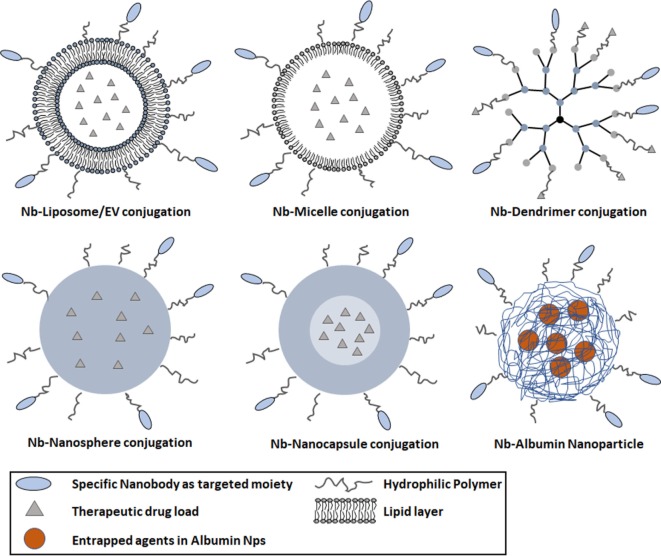
Schematic diagram representing various types of nanoparticles (NPs) decorated with nanobodies (Nbs) for targeted cancer therapy. Commonly used NPs comprise various materials, such as liposomes (100–400 nm), micelles (10–100 nm), dendrimers (3–20 nm), nanospheres (1–100 nm), and nanocapsules (10–1,000 nm). The blue parts of the polymer NP represent the solid hydrophobic polymer matrix with optionally an aqueous core. The nanosphere is composed of a solid polymer matrix, able to encapsulate hydrophobic drugs. The nanocapsule is composed of a spherical polymeric matrix with an aqueous or oily core (light blue part in lower right panel). The poly-ethylene glycol-ylation prolongs the circulation of NPs in the bloodstream; antigen-specific Nbs are conjugated to the surface of NPs for targeting purposes.
Figure 3
Figure 3
Targeted delivery of therapeutic nanoparticles (NPs) to tumor cells. NPs conjugated with nanobodies (Nbs) against tumor-specific targets are injected into the bloodstream. Circulating NPs need to cross the vascular endothelium of the tumor tissue to infiltrate the tumor site. The endothelium of tumors is poorly formed and allows passage of NPs [causing the enhanced permeation–retention (EPR) effect]. NPs that escape the blood vessel still need to diffuse through the dense extracellular matrix to reach relevant target cells embedded deeply within the tissue. Upon arriving at the surface and attachment with the receptor on the surface of the tumor cells, NPs will be internalized via endocytosis (lower right). NPs that are internalized by the cells are conveyed within endosomes, and the release of the active drugs from endosome will exert the antitumor effect (lower left).
Figure 4
Figure 4
Strategies for intracellular tumor targeting. (A) Gene delivery of specific nanoboides (Nbs) against intracellular tumor targets based on lentiviral vectors. The lentivirus displays Nbs directed toward antigen-presenting cells (APCs) such as dendritic cells (DCs). The initial attachment of the virus to the cellular receptor on the surface of APC allows internalization of the viral contents. The viral nucleoprotein core containing the genomic RNA is released into the cytoplasm after entry. Reverse transcription and synthesis of full-length chimeric viral DNA produces an integration-competent nucleoprotein complex that mediates integration of viral DNA into the host cell genome. Integrated chimeric viral DNA serves as a transcription template for the synthesis of tumor-associated antigens that after proteolysis will be presented on MHC to stimulate oncolytic T cells inducing tumor cell death (red arrows). In an alternative approach, the LVs could contain genes encoding Nbs against intracellular tumor markers. The targeting of such LVs to tumor cells could then produce intrabodies (Nbs) that will associate with the intracellular tumor marker to inhibit tumor growth and proliferation (black arrows). (B) Transport of specific Nbs into tumor cells via bacterial type III secretion system (T3S) for intracellular tumor targeting. Gram-negative bacteria use a specialized secretion apparatus known as the T3S system to inject proteins directly into the eukaryotic cells, such as Y. enterocolitica T3S, S. typhimurium T3S, and E. coli T3S. Bacterial proteins that are delivered by a T3S are injected through the eukaryotic cell membrane via a proteinaceous transmembrane channel known as the type III translocon. The schematic components of the T3S nanosyringe are shown and Gram-negative bacteria were engineered to produce antigen-specific Nbs against intracellular tumor markers. The attachment of T3S and tumor cells will facilitate the export of Nb proteins inside tumor cells, such as HeLa cells. These internalized Nbs will block and inhibit the signaling cascades or processes of tumor metastasis, leading to targeted cancer therapy.

References

    1. Baudino TA. Targeted cancer therapy: the next generation of cancer treatment. Curr Drug Discov Technol (2015) 12(1):3–20. 10.2174/1570163812666150602144310 - DOI - PubMed
    1. Scott AM, Wolchok JD, Old LJ. Antibody therapy of cancer. Nat Rev Cancer (2012) 12(4):278–87. 10.1038/nrc3236 - DOI - PubMed
    1. Bhutani D, Vaishampayan UN. Monoclonal antibodies in oncology therapeutics: present and future indications. Expert Opin Biol Ther (2013) 13(2):269–82. 10.1517/14712598.2012.758705 - DOI - PubMed
    1. Elbakri A, Nelson PN, Abu Odeh RO. The state of antibody therapy. Hum Immunol (2010) 71(12):1243–50. 10.1016/j.humimm.2010.09.007 - DOI - PubMed
    1. Oldham RK, Dillman RO. Monoclonal antibodies in cancer therapy: 25 years of progress. J Clin Oncol (2008) 26(11):1774–7. 10.1200/JCO.2007.15.7438 - DOI - PubMed