Review
. 2017 Nov 8:8:1472.
doi: 10.3389/fimmu.2017.01472. eCollection 2017.

Drug Hypersensitivity and Anaphylaxis in Cancer and Chronic Inflammatory Diseases: The Role of Desensitizations

Affiliations
Review

Drug Hypersensitivity and Anaphylaxis in Cancer and Chronic Inflammatory Diseases: The Role of Desensitizations

Mariana Castells. Front Immunol. .

Abstract

Drug allergy is a rising problem in the twenty-first century which affects all populations and races, children, and adults, and for which the recognition, diagnosis, management, and treatment is still not well standardized. Classical and new chemotherapy drugs, monoclonal antibodies (MoAbs), and small molecules to treat cancer and chronic inflammatory diseases are aimed at improving quality of life and life expectancy of patients, but an increasing number of reactions including anaphylaxis precludes their use in targeted populations. Women are more affected by drug allergy and up to 27% of women with ovarian and breast cancer develop carboplatin allergy after multiple cycles of treatment. Carriers of BRCA genes develop drug allergy after fewer exposures and can present with severe reactions, including anaphylaxis. Atopic patients are at increased risk for chemotherapy and MoAbs drug allergy and the current patterns of treatment with recurrent and intermittent drug exposures may favor the development of drug allergies. To overcome drug allergy, desensitization has been developed, a novel approach which provides a unique opportunity to protect against anaphylaxis and to improve clinical outcomes. There is evidence that inhibitory mechanisms blocking IgE/antigen mast cell activation are active during desensitization, enhancing safety. Whether desensitization modulates drug allergic and anaphylactic responses facilitating tolerance is currently being investigated. This review provides insight into the current knowledge of drug allergy and anaphylaxis to cancer and chronic inflammatory diseases drugs, the mechanisms of drug desensitization and its applications to personalized medicine.

Keywords: desensitization; drug allergy; monoclonal antibodies in cancer; platins; taxanes.


Figures
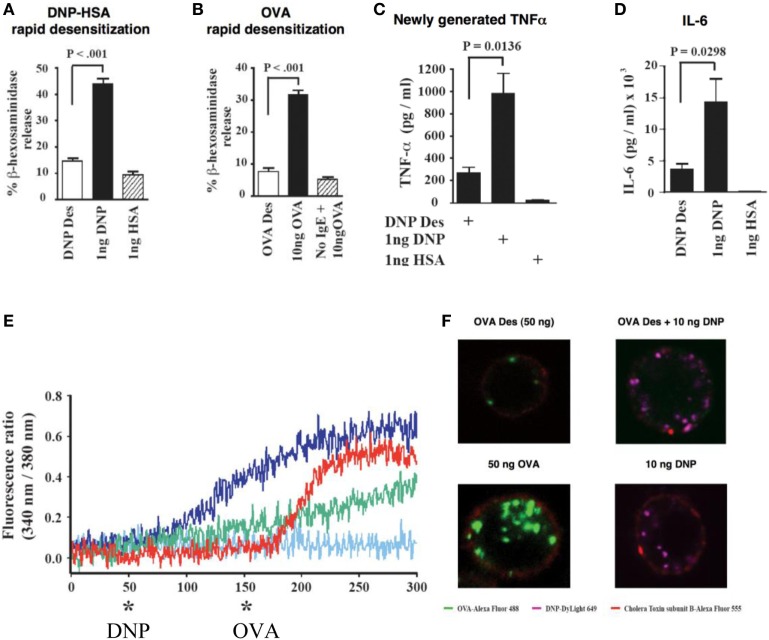
Figure 1
Figure 1
In vitro IgE/antigen mouse mast cells activation and desensitization (13). (A) Desensitization of in vitro DNP-IgE sensitized mouse mast cells with DNP inhibits the release of granule mediators such as beta-hexosaminidase. Instead of one single optimal dose, 11 suboptimal sequential doses are given until reaching the optimal dose. (B) Desensitization of in vitro OVA-IgE sensitized mouse mast cells with OVA inhibits the release of granule mediators such as beta-hexosaminidase. Instead of one single optimal dose, 11 suboptimal sequential doses are given until reaching the optimal dose. (C) Desensitization of in vitro DNP-IgE sensitized mouse mast cell mediators with DNP inhibits the de novo generation of cytokines TNF alpha and IL-6 (D). (E) Calcium entry (blue line) occurs after activation of DNP-IgE sensitized mouse mast cells with DNP but not when cells have been desensitized to DNP (red line, * DNP). Desensitization is specific since cells that were DNP desensitized and OVA-IgE sensitized presented calcium entry after OVA activation (red line, * OVA). (F) Membrane events are modified during desensitization with lack of internalization of desensitized antigens: left panels indicate that OVA desensitization does not present internalization of antigen (upper panel) as opposed to activation (lower panel with green labeled OVA internalized) and right panels indicate that after OVA desensitization another non desensitizing antigen such as DNP can be internalized (upper panel) as seen with activation (lower panel).
Figure 2
Figure 2
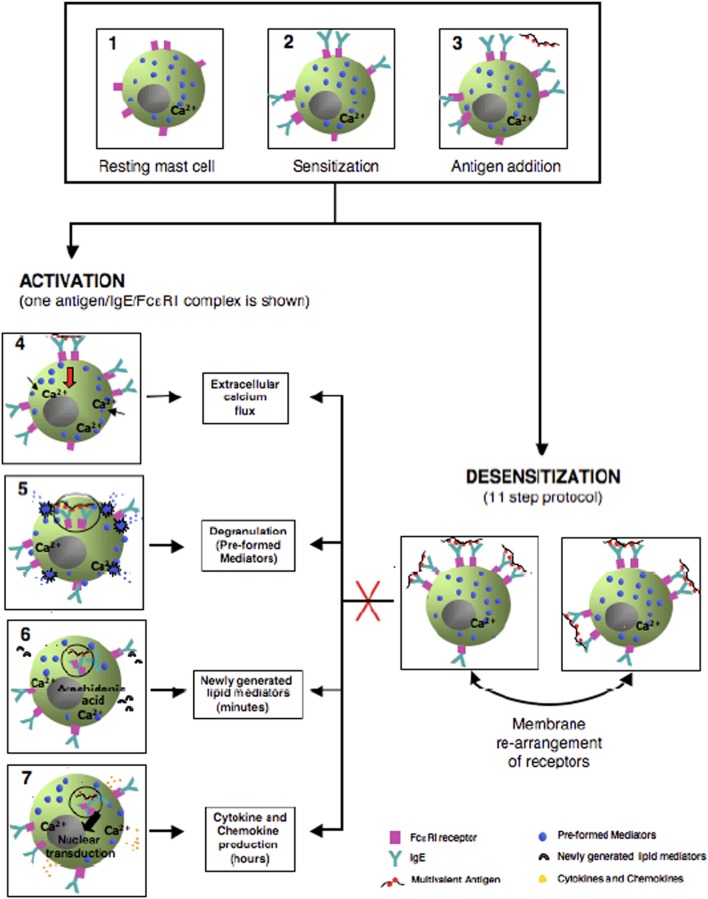
Model of in vitro mouse mast cells activation and desensitization. The left side cartoons provide the steps of antigen/IgE/FceRI activation starting from antigen cross-linking, internalization, calcium entry and release of granule mediators, generation of lipd mediators such as prostaglandins and leukotrienes, and production of late phase cytokines. The right sided panel provides the hypothetical membrane capping and rearrangement occurring during the delivery of sequential suboptimal doses of allergen in desensitization preventing internalization of antigen, calcium entry, and mediators release.
Figure 3
Figure 3
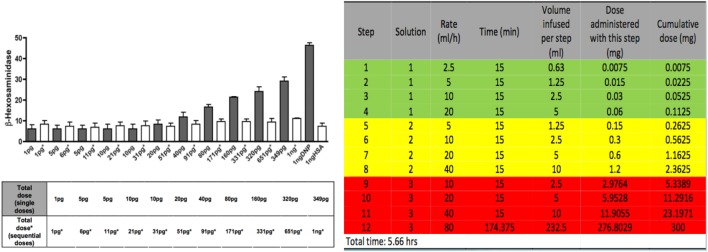
In vitro and in vivo protocols for induction of IgE/antigen desensitization. In the left panel in black, increasing single doses of antigen induce a dose response release of beta-hexosaminidase in vitro mouse mast cells. In white, the same doses given sequentially induce a profound inhibition of the beta -hexosaminidase release. In the right panel, a model of desensitization protocol used for human desensitization in which 3 bags and 12 steps (4 steps per bag) are used to administer sequential doubling doses every 15 min which provides the target dose of 300 mg after 5.66 h when the last step is completed.
Figure 4
Figure 4
Putative mechanism of protection against anaphylaxis during human desensitizations. By delivering the target dose of the drug by small incremental doubling doses (Figure 3), the threshold for anaphylaxis is re-established at each step and never reaches that of the initial triggering dose.
Figure 5
Figure 5
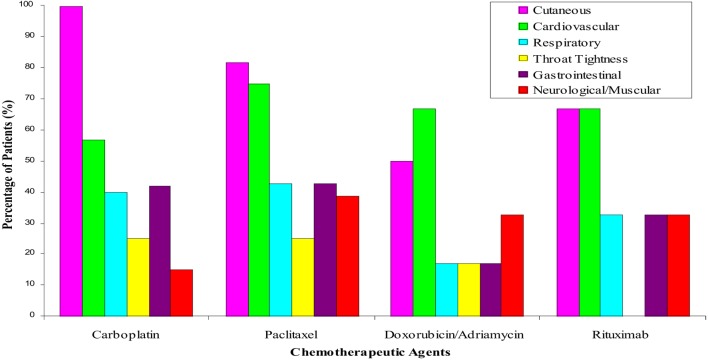
Symptoms and signs of hypersensitivity reactions amendable to desensitization. Carboplatin and other paltins such as cisplatin and oxaliplatin reactions include classical symptoms of anaphylaxis with cutaneous, respiratory, cardiovascular, and gastrointestinal symptoms. Reactions to taxenes including paclitaxel and docetaxel present with pain as a neuromuscular symptoms in up to 4% of the patients. Doxorubicin/adriamycin and other chemotherapies present with sudden onset hypo or hypertension in up to 60% of patients and rituximab and other monoclonal antibodies present with cutaneous and cardiovascular symptoms in 70% of the patients.
Figure 6
Figure 6
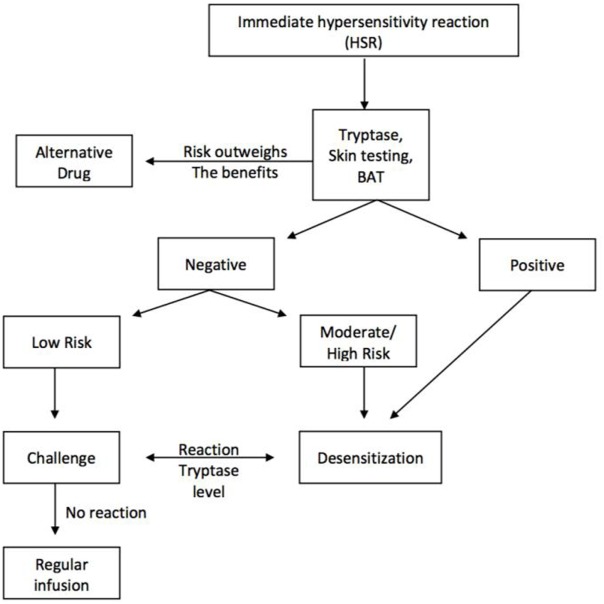
Algorithm for the evaluation of drug hypersensitivity reactions and the role of desensitization for the re-introduction of the first-line medications, when no alternative is available or the alternative does not provide the same benefits or life expectancy as the first line.
Figure 7
Figure 7
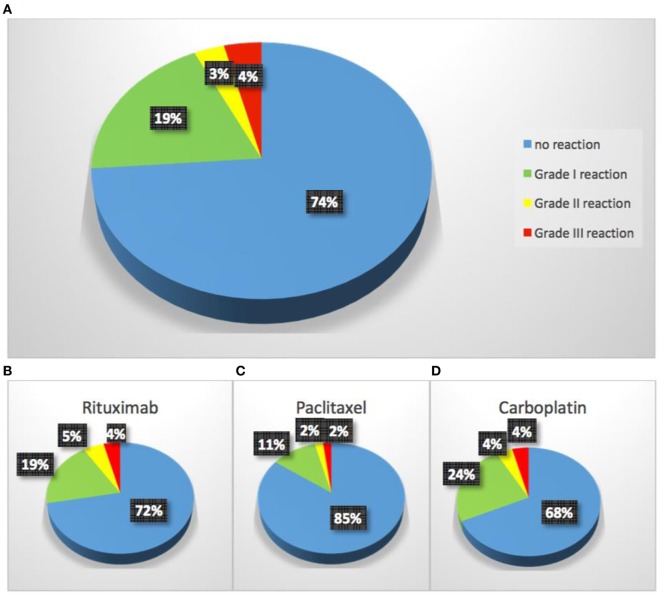
The overall safety of desensitization for common chemotherapy drugs and monoclonal antibodies.
Figure 8
Figure 8
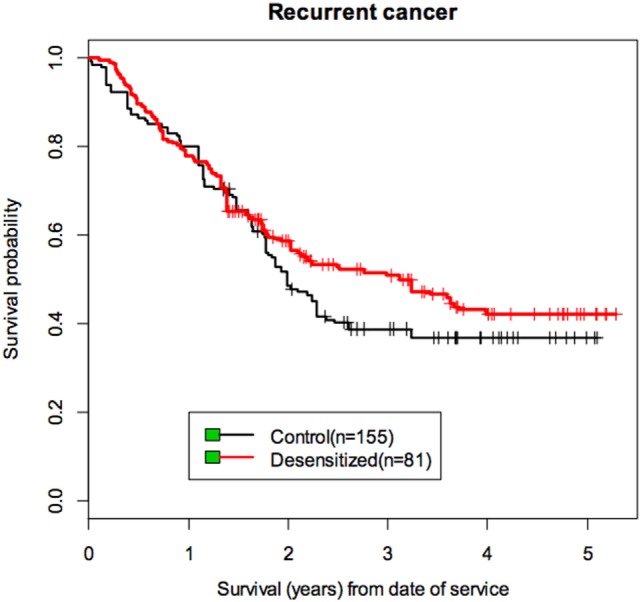
Life expectancy for cancer patients allergic and desensitized to carboplatin and non-allergic to carboplatin [from Sloane et al. (33)]. Allergic and non-allergic ovarian cancer patients treated with carboplatin or carboplatin desensitization presented a similar life expectancy with a non significant advantage for the allergy desensitized patients.

References

    1. Kadoyama K, Kuwahara A, Yamamori M, Brown JB, Sakaeda T, Okuno Y. Hypersensitivity reactions to anticancer agents: data mining of the public version of the FDA adverse event reporting system, AERS. J Exp Clin Cancer Res (2011) 30:93. 10.1186/1756-9966-30-93 - DOI - PMC - PubMed
    1. Sakaeda T, Kadoyama K, Yabuuchi H, Niijima S, Seki K, Shiraishi Y, et al. Platinum agent-induced hypersensitivity reactions: data mining of the public version of the FDA adverse event reporting system, AERS. Int J Med Sci (2011) 8(4):332–8. 10.7150/ijms.8.332 - DOI - PMC - PubMed
    1. Nektaria M, Ekaterini S, Ioannis K, Leonidas M, Muhammad Wasif S. Hypersensitivity reactions associated with platinum antineoplastic agents: a systematic review. Met Based Drugs (2010) 2010 Available from: http://downloads.hindawi.com/journals/mbd/2010/207084.pdf - PMC - PubMed
    1. Markman M. Toxicities of the platinum antineoplastic agents. Expert Opin Drug Saf (2003) 2(6):597–607. 10.1517/14740338.2.6.597 - DOI - PubMed
    1. A fatal anaphylactic reaction to paclitaxel is described, which was preceded by a possible delayed reaction to the initial infusion. Allergy Asthma Proc (2011) 32(1):79. 10.2500/aap.2011.32.3409 - DOI - PubMed

LinkOut - more resources