


Persistent bovine viral diarrhea virus (BVDV) infection in cattle herds
- PMID: 29163643
- PMCID: PMC5674437
Persistent bovine viral diarrhea virus (BVDV) infection in cattle herds
Abstract
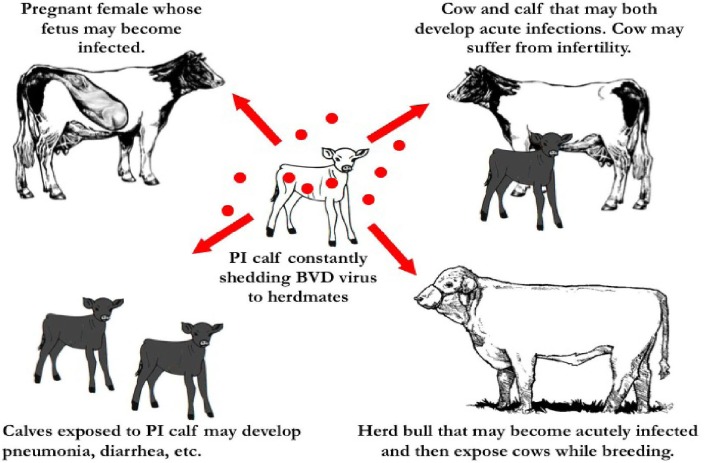
Bovine viral diarrhea virus (BVDV) is a significant pathogen associated with gastrointestinal, respiratory, and reproductive diseases of cattle worldwide. It causes continuous economic losses to the cattle industry primarily due to decreased reproductive performance. The ability of virus to cross the placenta during early pregnancy can result in the birth of persistently infected (PI) calves. Persistently infected animals are generally much more efficient transmitters of BVDV than transiently or acutely infected animals because they are capable of shedding large quantities of virus throughout their lives and are considered the primary reservoirs for BVDV. Due to the nature of viral infections, there is no treatment to fully cure an animal of a viral infection. All control programs which are in use in many countries of the world, mainly depend upon the detection of PI animals, eliminating them and preventing their return into the herds. Detection of PI animals at early stage, particularly soon after birth is of significant benefit to implement BVDV control programs. Available diagnostic tests such as virus isolation (VI), immunohistochemistry (IHC), Antigen-Capture ELISA (ACE), and reverse transcriptase polymerase chain reaction (RT-PCR) are used for detection of PI cattle. Each method to detect BVDV has advantages, disadvantages, and applicability for different diagnostic situations. The reliability of diagnostic tests is optimized by choosing the appropriate sampling strategy on the basis of animal age.
Keywords: Antigen-Capture ELISA; BVD; Immunohistochemistry; Persistent infection; RT-PCR.
Figures
References
-
- Baker JC. The clinical manifestations of BVD infection. Vet. Clin. North Am.: Food Anim. Pract. 1987;11:425–445. - PubMed
-
- Belak S, Ballagi-Pordany A. Experiences on the application of the polymerase chain reaction in a diagnostic laboratory. Mol. Cell. Prob. 1993;7:241–248. - PubMed
-
- Bezek DM, Grohn YT, Dubovi EJ. Effect of acute infection with noncytopathic or cytopathic bovine viral diarrhea virus isolates on bovine platelets. Am. J. Vet. Res. 1994;55:1115–1119. - PubMed
Publication types
LinkOut - more resources
Full Text Sources
Research Materials
Miscellaneous