. 2017 Nov 1;8(11):7403-7411.
doi: 10.1039/c7sc01270e. Epub 2017 Aug 29.

Identification of new quorum sensing autoinducer binding partners in Pseudomonas aeruginosa using photoaffinity probes

Affiliations

Identification of new quorum sensing autoinducer binding partners in Pseudomonas aeruginosa using photoaffinity probes

Y R Baker et al. Chem Sci. .

Abstract

Many bacterial species, including the human pathogen Pseudomonas aeruginosa, employ a mechanism of intercellular communication known as quorum sensing (QS), which is mediated by signalling molecules termed autoinducers. The Pseudomonas Quinolone Signal (PQS) and 2-Heptyl-3H-4-Quinolone (HHQ) are autoinducers in P. aeruginosa, and they are considered important factors in the progress of infections by this clinically relevant organism. Herein, we report the development of HHQ and PQS photoaffinity-based probes for chemical proteomic studies. Application of these probes led to the identification of previously unsuspected putative HHQ and PQS binders, thereby providing new insights into QS at a proteomic level and revealing potential new small molecule targets for virulence attenuation strategies. Notably, we found evidence that PQS binds RhlR, the cognate receptor in the Rhl QS sub-system of P. aeruginosa. This is the first indication of interaction between the Rhl and PQS systems at the protein/ligand level, which suggests that RhlR should be considered a highly attractive target for antivirulence strategies.


Figures
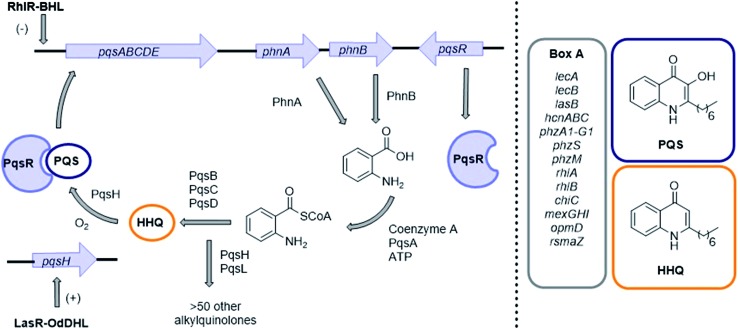
Fig. 1
Fig. 1. PQS signaling in P. aeruginosa. Genes involved in virulence production and regulation at a transcriptional level are highlighted in ‘Box A’ on the right. For a full list of genes under PqsR (also known as MvfR) transcriptional regulation see article by Déziel et al. HHQ also binds PqsR albeit with a 100-fold lower potency than PQS. (–) Represents down-regulation (+) represents positive regulation.
Fig. 2
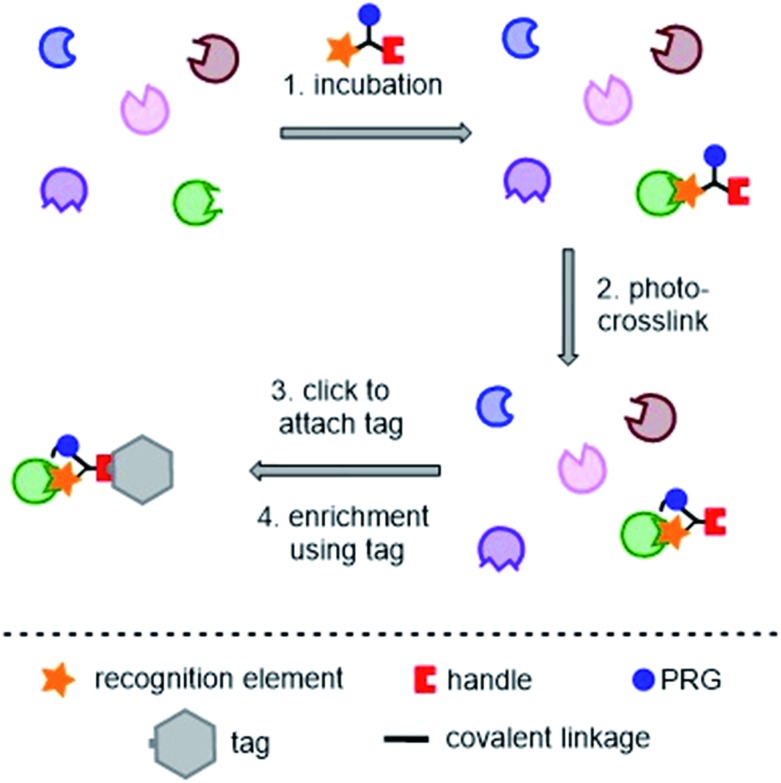
Fig. 2. Typical tandem photoaffinity experiment for target identification. PRG = photoreactive group.
Fig. 3
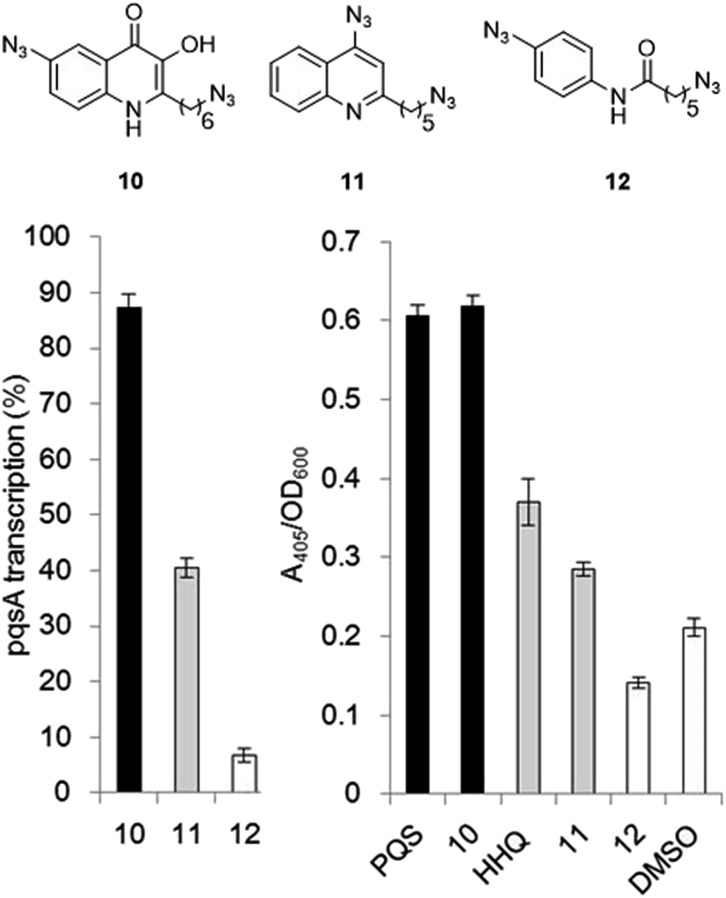
Fig. 3. Comparison of the bioactivity associated with the PQS probe 10, the HHQ probe 11, and the negative control 12 with native PQS and HHQ in stimulating PqsR-dependent transcription from the PqsA promoter (left panel) and in promoting PqsR-independent production of pyoverdine (right panel). Percentage PqsA:LacZ transcription was compared relative to 60 nM PQS for the PQS probe 10 (black bar), and to 1 μM HHQ for the HHQ probe 11 (grey bar) and negative control probe 12. ± Represents standard deviation of three independent biological replicates.
Fig. 4
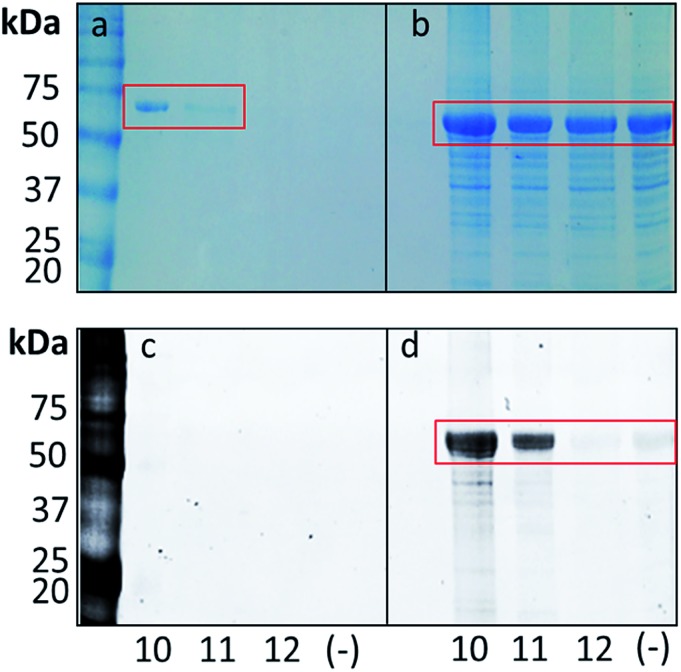
Fig. 4. Selective labelling of over-expressed PqsRLBD in intact E. coli cells by the PQS probe (10), HHQ probe (11) and negative control (12) (left panels). Bead-captured PqsRLBD obtained after UV irradiation of probe-treated cultures, cell lysis, CuAAC reaction with a biotin moiety, and pull-down with streptavidin coated magnetic beads. The panels show an SDS-PAGE gel visualized after (a) Coomassie Brilliant Blue staining or (c) fluorescence imaging (right panels). The panels show images of an SDS-PAGE gel of cell extracts obtained after UV irradiation of probe-treated cultures, cell lysis, and CoAAC-mediated TAMRA labeling. The gels were visualized using (b) Coomassie Brilliant Blue staining and (d) fluorescence imaging. Molecular mass markers are shown. (–) = no probe added. The ∼70 kDa PqsRLBD–MBP band is highlighted by boxing.

References

    1. Walker J. T., Moore G. E. J. Hosp. Infect. 2015;89:324–327. - PubMed
    1. Jannasch O., Kelch B., Adolf D., Tammer I., Lodes U., Weiss G., Lippert H., Mroczkowski P. Surg. Infect. 2015;16:338–345. - PubMed
    1. Jefferies J. M. C., Cooper T., Yam T., Clarke S. C. J. Med. Microbiol. 2012;61:1052–1061. - PubMed
    1. Ramírez-Estrada S., Borgatta B., Rello J. Infect. Drug Resist. 2016;9:7–18. - PMC - PubMed
    1. Talwalkar J. S., Murray T. S. Clin. Chest. Med. 2016;37:69–81. - PubMed

LinkOut - more resources