


Nonoperative Versus Operative Management for the Treatment Degenerative Cervical Myelopathy: An Updated Systematic Review
- PMID: 29164031
- PMCID: PMC5684842
- DOI: 10.1177/2192568217703083
Nonoperative Versus Operative Management for the Treatment Degenerative Cervical Myelopathy: An Updated Systematic Review
Abstract
Study design: Systematic review (update).
Objective: Degenerative cervical myelopathy (DCM) is a progressive degenerative spine disease that is increasingly managed surgically. The objective of this study is to determine the role of nonoperative treatment in the management of DCM by updating a systematic review published by Rhee and colleagues in 2013. The specific aims of this review were (1) to determine the comparative efficacy, effectiveness, and safety of nonoperative and surgical treatment; (2) to assess whether myelopathy severity differentially affects outcomes of nonoperative treatment; and (3) to evaluate whether activities or minor injuries are associated with neurological deterioration.
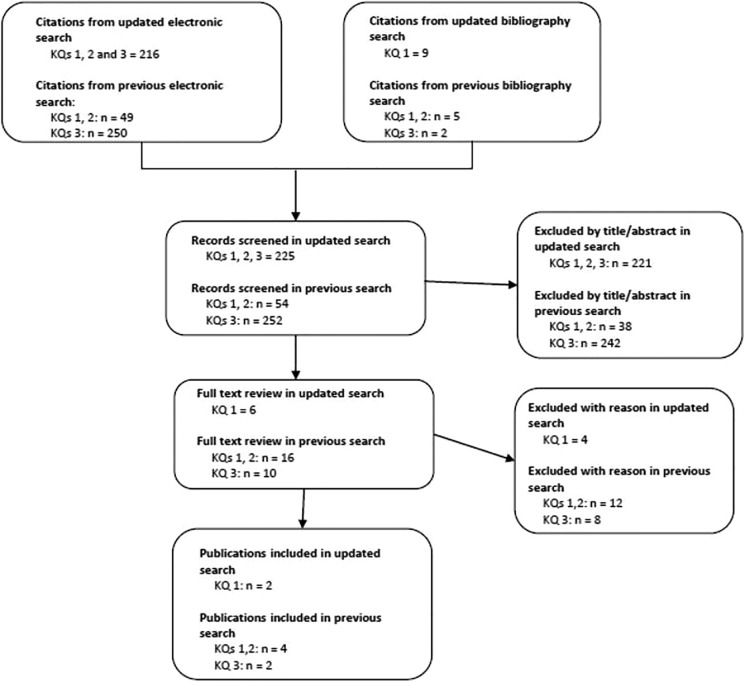
Methods: Methods from the original review were used to search for new literature published between July 20, 2012, and February 12, 2015.
Results: The updated search yielded 2 additional citations that met inclusion criteria and compared the efficacy of conservative management and surgical treatment. Based on a single retrospective cohort, there were no significant differences in posttreatment Japanese Orthopaedic Association (JOA) or Neck Disability Index scores or JOA recovery ratios between patients treated nonoperatively versus operatively. A second retrospective study indicated that the incidence rate of hospitalization for spinal cord injury was 13.9 per 1000 person-years in a nonoperative group compared with 9.4 per 1000 person-years in a surgical group (adjusted hazard ratio = 1.57; 95% confidence interval = 1.11-2.22; P = .011).
Conclusion: Nonoperative management results in similar outcomes as surgical treatment in patients with a modified JOA ≥ 13, single-level myelopathy and intramedullary signal change on T2-weighted magnetic resonance imaging. Furthermore, patients managed nonoperatively for DCM have higher rates of hospitalization for spinal cord injury than those treated surgically. The overall level of evidence for these findings was rated as low.
Keywords: cervical spondylotic myelopathy; degenerative cervical myelopathy; nonoperative management; systematic review.
Conflict of interest statement
Declaration of Conflicting Interests: The author(s) declared no potential conflicts of interest with respect to the research, authorship, and/or publication of this article.
Figures
References
-
- Nouri A, Tetreault L, Singh A, Karadimas SK, Fehlings MG. Degenerative cervical myelopathy: epidemiology, genetics, and pathogenesis. Spine (Phila Pa 1976). 2015;40:E675–E693. - PubMed
-
- Tetreault L, Goldstein CL, Arnold P, et al. Degenerative cervical myelopathy: a spectrum of related disorders affecting the aging spine. Neurosurgery. 2015;77(suppl 4):S51–S67. - PubMed
-
- Rhee JM, Shamji MF, Erwin WM, et al. Nonoperative management of cervical myelopathy: a systematic review. Spine (Phila Pa 1976). 2013;38(22 suppl 1):S55–S67. - PubMed
-
- Gu Y, Chen L, Dong RB, Feng Y, Yang HL, Tang TS. Laminoplasty versus conservative treatment for acute cervical spinal cord injury caused by ossification of the posterior longitudinal ligament after minor trauma. Spine J. 2014;14:344–352. - PubMed
-
- Wu JC, Liu L, Chen YC, Huang WC, Chen TJ, Cheng H. Ossification of the posterior longitudinal ligament in the cervical spine: an 11-year comprehensive national epidemiology study. Neurosurg Focus. 2011;30:E5. - PubMed
Publication types
LinkOut - more resources
Full Text Sources
Other Literature Sources
Miscellaneous
