. 2017 Nov 22;22(11):2036.
doi: 10.3390/molecules22112036.

Action of Monomeric/Gemini Surfactants on Free Cells and Biofilm of Asaia lannensis

Affiliations

Action of Monomeric/Gemini Surfactants on Free Cells and Biofilm of Asaia lannensis

Anna Koziróg et al. Molecules. .

Abstract

We investigated the biological activity of surfactants based on quaternary ammonium compounds: gemini surfactant hexamethylene-1,6-bis-(N,N-dimethyl-N-dodecylammonium bromide) (C6), synthesized by the reaction of N,N-dimethyl-N-dodecylamine with 1,6-dibromohexane, and its monomeric analogue dodecyltrimethylammonium bromide (DTAB). The experiments were performed with bacteria Asaia lannensis, a common spoilage in the beverage industry. The minimal inhibitory concentration (MIC) values were determined using the tube standard two-fold dilution method. The growth and adhesive properties of bacterial cells were studied in different culture media, and the cell viability was evaluated using plate count method. Both of the surfactants were effective against the bacterial strain, but the MIC of gemini compound was significantly lower. Both C6 and DTAB exhibited anti-adhesive abilities. Treatment with surfactants at or below MIC value decreased the number of bacterial cells that were able to form biofilm, however, the gemini surfactant was more effective. The used surfactants were also found to be able to eradicate mature biofilms. After 4 h of treatment with C6 surfactant at concentration 10 MIC, the number of bacterial cells was reduced by 91.8%. The results of this study suggest that the antibacterial activity of the gemini compound could make it an effective microbiocide against the spoilage bacteria Asaia sp. in both planktonic and biofilm stages.

Keywords: Asaia; antibiofilm agent; antimicrobial activity; gemini surfactants; polypropylene.


Conflict of interest statement

The authors declare no conflict of interest.

Figures

Figure 1
Figure 1
The growth of A. lannensis FMW1 in medium with microbiocides (a) hexamethylene- 1,6-bis-(N,N-dimethyl-N-dodecylammonium bromide) (C6) and (b) N-dodecyltrimethylammonium bromide (DTAB). The results are presented after cells treatment by surfactants in the concentration ¼ minimal inhibitory concentration (MIC) (dark grey circle marker), ½ MIC (clear grey triangle marker), MIC (black rhombus marker), and compared with the control sample -without the addition of surfactants (white square marker).
Figure 1
Figure 1
The growth of A. lannensis FMW1 in medium with microbiocides (a) hexamethylene- 1,6-bis-(N,N-dimethyl-N-dodecylammonium bromide) (C6) and (b) N-dodecyltrimethylammonium bromide (DTAB). The results are presented after cells treatment by surfactants in the concentration ¼ minimal inhibitory concentration (MIC) (dark grey circle marker), ½ MIC (clear grey triangle marker), MIC (black rhombus marker), and compared with the control sample -without the addition of surfactants (white square marker).
Figure 2
Figure 2
Effect of gemini C6 (a) and monomeric DTAB (b) surfactants on biofilm formation by A. lannensis FMW1. The results are presented after 1-h cells treatment by surfactants in the concentrations: ¼ MIC (clear grey bar), ½ MIC (dark grey bar), MIC (black bar), and compared to the control sample without surfactants (white bar). * Reduced value of log 10 differed significantly from the control without surfactant.
Figure 2
Figure 2
Effect of gemini C6 (a) and monomeric DTAB (b) surfactants on biofilm formation by A. lannensis FMW1. The results are presented after 1-h cells treatment by surfactants in the concentrations: ¼ MIC (clear grey bar), ½ MIC (dark grey bar), MIC (black bar), and compared to the control sample without surfactants (white bar). * Reduced value of log 10 differed significantly from the control without surfactant.
Figure 3
Figure 3
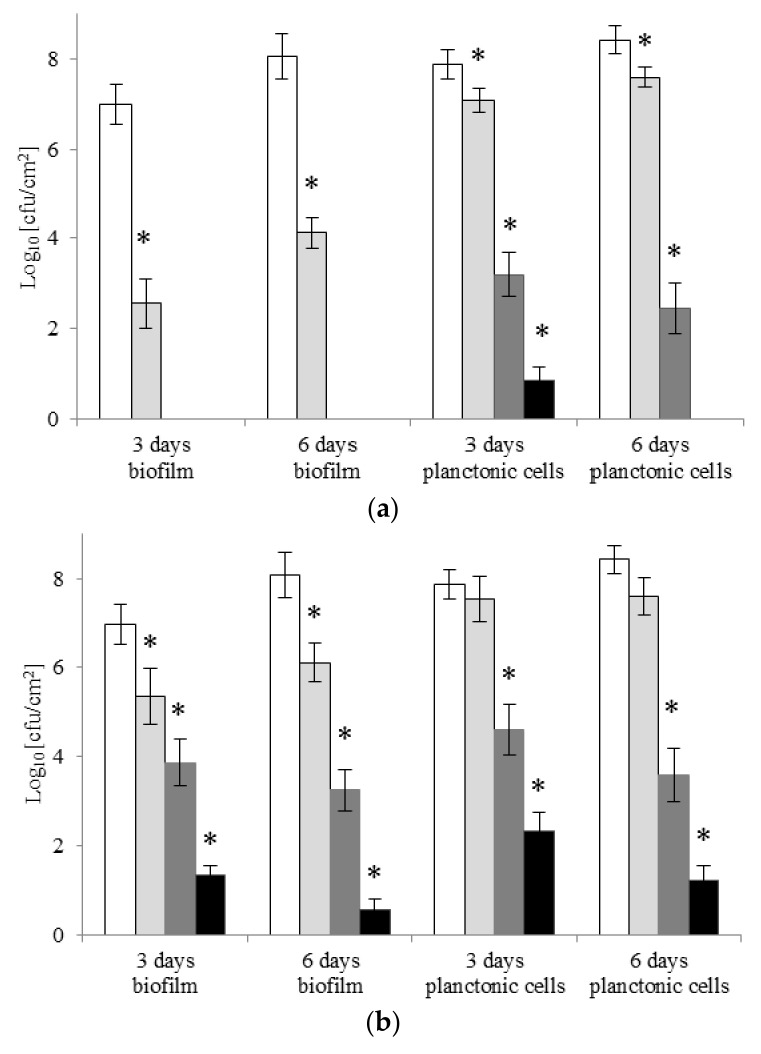
Effect of gemini C6 (a) and monomeric DTAB (b) surfactants on biofilm formation by A. lannensis FMW1. The results are presented for samples with surfactants in the concentration ¼ MIC (clear grey bar), ½ MIC (dark grey bar), MIC (black bar), and compared to the control sample without surfactants (white bar). * Reduced value of log 10 differed significantly from the control without surfactant.
Figure 4
Figure 4
Effect of gemini C6 (a) and monomeric DTAB (b) surfactants on eradication of biofilm formed by A. lannensis FMW1. The results are presented after 1 h (dark grey bar), 4 h (white bar) and 24 h (black bar) treatment by surfactants in the concentration MIC, 2 MIC and 10 MIC, and compared to the control sample (K) without surfactants. * Reduced value of log 10 differed significantly from the control without surfactant (K).
Figure 5
Figure 5
Chemical structure of benzalkonium chloride (N-alkyldimethylbenzylammonium chloride) BAC.

References

    1. Horsáková I., Voldřich M., Čeřovský M., Sedláčková P., Šicnerová P., Ulbrich P. Asaia sp. as a Bacterium Decaying the Packaged Still Fruit Beverages. Czech J. Food Sci. 2009;27:S362–S365.
    1. Kręgiel D., Rygała A., Libudzisz Z. Bakterie z rodzaju Asaia—Nowe zanieczyszczenie smakowych wód mineralnych. Żywność Nauka Technol. Jakość. 2011;75:5–16. (In Polish)
    1. Moore J.E., McCalmont M., Xu J., Millar B.Ch., Heaney N. Asaia sp., an usual spoilage organism of fruit-flavoured bottled water. Appl. Environ. Microbiol. 2002;68:4130–4131. doi: 10.1128/AEM.68.8.4130-4131.2002. - DOI - PMC - PubMed
    1. Sedláčková P., Čeřovský M., Horsáková I., Voldřich M. Cell surface characteristic of Asaia bogorensis- spoilage microorganism of bottled water. Czech J. Food Sci. 2011;29:457–461.
    1. Kręgiel D. Attachment of Asaia lannensis to materials commonly used in beverage industry. Food Control. 2013;32:537–542. doi: 10.1016/j.foodcont.2013.01.037. - DOI

MeSH terms

Substances

LinkOut - more resources