


Effects of total sleep deprivation on divided attention performance
- PMID: 29166387
- PMCID: PMC5699793
- DOI: 10.1371/journal.pone.0187098
Effects of total sleep deprivation on divided attention performance
Abstract
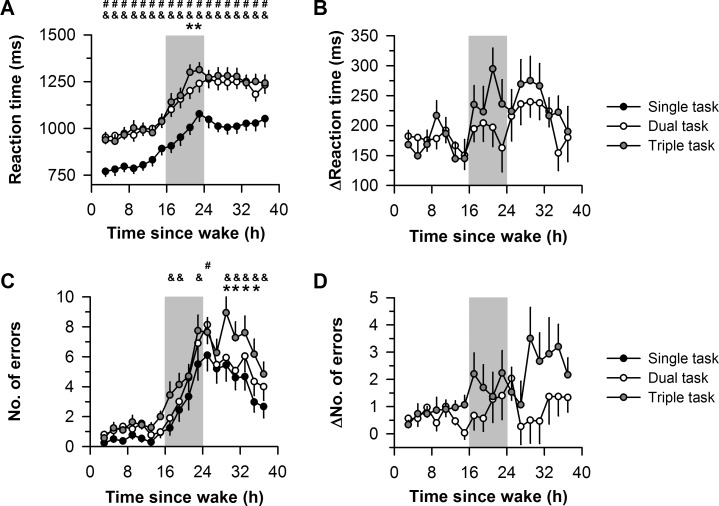
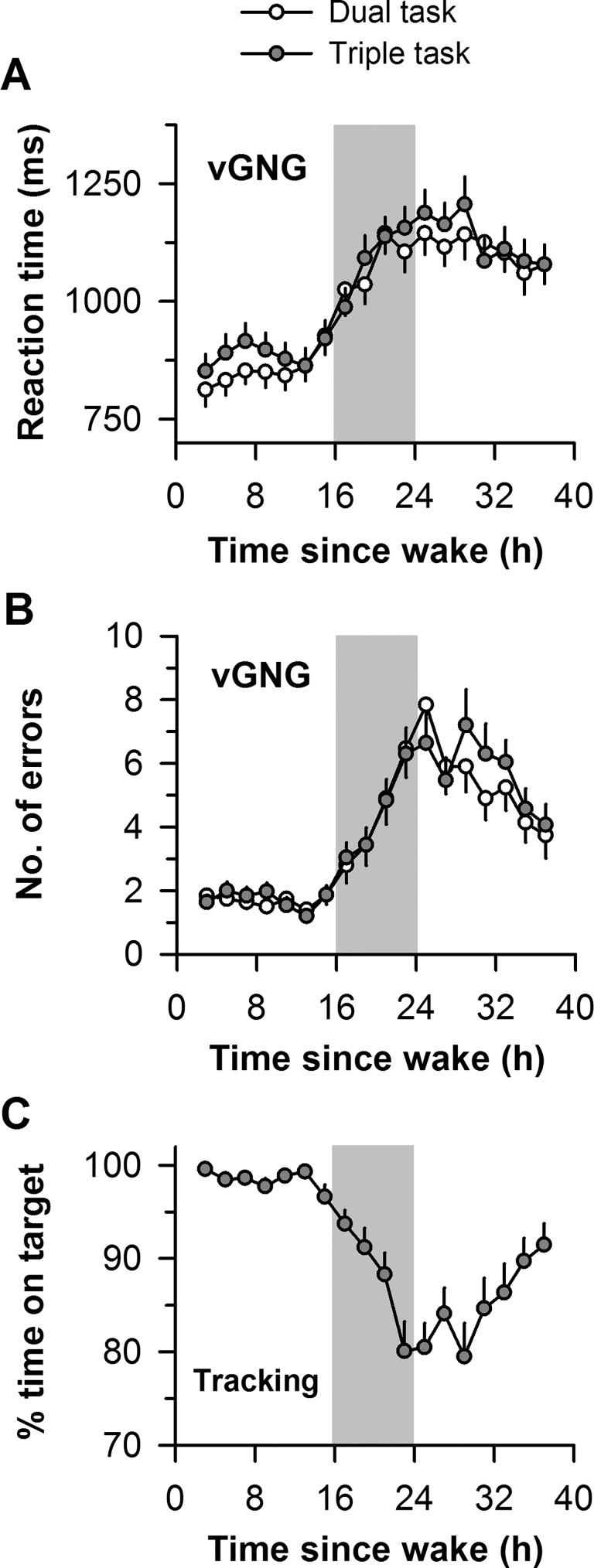
Dividing attention across two tasks performed simultaneously usually results in impaired performance on one or both tasks. Most studies have found no difference in the dual-task cost of dividing attention in rested and sleep-deprived states. We hypothesized that, for a divided attention task that is highly cognitively-demanding, performance would show greater impairment during exposure to sleep deprivation. A group of 30 healthy males aged 21-30 years was exposed to 40 h of continuous wakefulness in a laboratory setting. Every 2 h, subjects completed a divided attention task comprising 3 blocks in which an auditory Go/No-Go task was 1) performed alone (single task); 2) performed simultaneously with a visual Go/No-Go task (dual task); and 3) performed simultaneously with both a visual Go/No-Go task and a visually-guided motor tracking task (triple task). Performance on all tasks showed substantial deterioration during exposure to sleep deprivation. A significant interaction was observed between task load and time since wake on auditory Go/No-Go task performance, with greater impairment in response times and accuracy during extended wakefulness. Our results suggest that the ability to divide attention between multiple tasks is impaired during exposure to sleep deprivation. These findings have potential implications for occupations that require multi-tasking combined with long work hours and exposure to sleep loss.
Conflict of interest statement
Figures
References
-
- Anderson C, Horne JA. Sleepiness enhances distraction during a monotonous task. Sleep. 2006;29(4):573–6. . - PubMed
-
- Lim J, Dinges DF. A meta-analysis of the impact of short-term sleep deprivation on cognitive variables. Psychol Bull. 2010;136(3):375–89. doi: 10.1037/a0018883 ; PubMed Central PMCID: PMC3290659. - DOI - PMC - PubMed
-
- Pilcher JJ, Huffcutt AI. Effects of sleep deprivation on performance: a meta-analysis. Sleep. 1996;19(4):318–26. . - PubMed
-
- Fischer R, Plessow F. Efficient multitasking: parallel versus serial processing of multiple tasks. Front Psychol. 2015;6:1366 doi: 10.3389/fpsyg.2015.01366 ; PubMed Central PMCID: PMC4561751. - DOI - PMC - PubMed
-
- Kahneman D. Attention divided among inputs In: Kahneman D, editor. Attention and Effort. Englewood Cliffs, New Jersey: Prentice-Hall, Inc.; 1973. p. 136–55.
MeSH terms
LinkOut - more resources
Full Text Sources
Other Literature Sources
