EpiFloripa Aging cohort study: methods, operational aspects, and follow-up strategies
- PMID: 29166443
- PMCID: PMC5697918
- DOI: 10.11606/S1518-8787.2017051006776
EpiFloripa Aging cohort study: methods, operational aspects, and follow-up strategies
Abstract
Objective: To describe the sample plan, operational aspects, and strategies used in the 2009/2010 and 2013/2014 EpiFloripa Aging Study.
Methods: The EpiFloripa Aging is a population-based longitudinal study with 1,705 older adults (60 years or more) living in the municipality of Florianópolis, State of Santa Catarina, Brazil, in 2009/2010 (baseline). The research was conducted with a face-to-face interviews, organized into blocks of identification, socioeconomic, mental health, health and life habits, global functionality, falls, physical activity, morbidities, use of health services, use of medications, food, oral health, and violence, evaluated in the first (2009/2010) and in the second wave (2013/2014). Additionally, in the second wave, we investigated the issue of discrimination and quality of life.
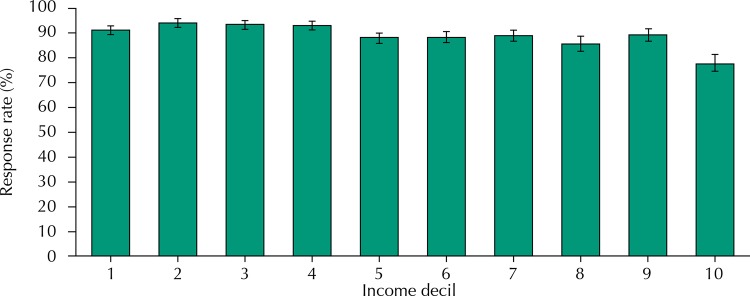
Results: The response rate of the first wave was 89.2% (n = 1,705). The baseline sample, with predominance of women (63.9%), was similar to the 2010 Census regarding age for women and slightly different for younger men. In the second wave, 1,197 participants were interviewed (response rate of 70.3%). Follow-up losses were only observed for the variable age group (p = 0.003), and predominantly for those aged 80 years or more. Mortality data linkage and active search for participants were used as a follow-up strategies.
Conclusions: This study used strategies that were able to help locate the participants and maintain adherence, which ensured a good response rate during investigations.
OBJETIVO: Descrever o plano amostral, aspectos operacionais e estratégias utilizadas no Estudo EpiFloripa Idoso 2009/2010 e 2013/2014.
MÉTODOS: O EpiFloripa Idoso é um estudo de base populacional com 1.705 idosos (60 anos ou mais) residentes no município de Florianópolis, SC, em 2009/2010 (linha de base). A investigação foi realizada por meio de entrevista face a face, organizada nos blocos de identificação, geral (características socioeconômicas), saúde mental, saúde e hábitos de vida, funcionalidade global, quedas, atividade física, morbidades, uso de serviços de saúde, uso de medicamentos, alimentação, saúde bucal e violência, avaliados na primeira (2009/2010) e na segunda onda (2013/2014). Adicionalmente, na segunda onda, investigou-se a temática de discriminação e qualidade de vida.
RESULTADOS: A taxa de resposta na primeira onda foi de 89,2% (n = 1.705). A amostra da linha de base, com predomínio de mulheres (63,9%), foi semelhante ao Censo 2010 em relação à idade nas mulheres e ligeiramente diferente nos homens mais jovens. Na segunda onda, 1.197 participantes foram entrevistados (taxa de resposta de 70,3%). Houve perda de seguimento somente para a variável faixa etária (p=0,003), principalmente naqueles com 80 anos ou mais. Utilizou-se como estratégias de seguimento o relacionamento de dados e a busca ativa.
CONCLUSÕES: O presente estudo utilizou estratégias que conseguiram auxiliar na localização dos participantes e manutenção da aderência, o que garantiu boa taxa de resposta durante as investigações.
Conflict of interest statement
Figures
References
-
- Almeida OP. Mini exame dos estado mental e o diagnóstico de demência no Brasil. Arq Neuro Psiquiatr. 1998;56(3B):605–612. https://doi.org/10.1590/S0004-282X1998000400014. - DOI - PubMed
-
- Babor TF, Higgins-Biddle JC, Saunders JB, Monteiro MG. AUDIT: the alcohol use disorders identification test: guidelines for use in primary health care. 2. Geneva: World Health Organization; 2001. http://apps.who.int/iris/bitstream/10665/67205/1/WHO_MSD_MSB_01.6a.pdf.
-
- Bastos JL, Faerstein E, Celeste RK, Barros AJD. Explicit discrimination and health: development and psychometric properties of an assessment instrument. Rev Saude Publica. 2012;46(2):269–278. https://doi.org/10.1590/S0034-89102012000200009. - DOI - PubMed
-
- Benedetti TRB, Antunes PC, Rodriguez-Añez CR, Mazo GZ, Petroski EL. Reproducibility and validity of the International Physical Activity Questionnaire (IPAQ) in elderly men. Rev Bras Med Esporte. 2007;13(1):11–16. https://doi.org/10.1590/S1517-86922007000100004. - DOI
-
- Camargos FFO, Dias RC, Dias JMD, Freire MTE. Adaptação transcultural e avaliação das propriedades psicométricas da Falls Efficacy Scale-International em idosos brasileiros (FES-I-BRASIL) Rev Bras Fisioter. 2010;14(3):237–243. https://doi.org/10.1590/S1413-35552010000300010. - DOI - PubMed
MeSH terms
LinkOut - more resources
Full Text Sources
Other Literature Sources
Medical