


Mortality patterns and risk among older men and women with intellectual disability: a Swedish national retrospective cohort study
- PMID: 29166873
- PMCID: PMC5700486
- DOI: 10.1186/s12877-017-0665-3
Mortality patterns and risk among older men and women with intellectual disability: a Swedish national retrospective cohort study
Abstract
Background: Sweden has closed all institutions and imposed legislation to ensure service and support for individuals with intellectual disability (ID). Understanding mortality among older individuals with ID is essential to inform development of health promotion and disease control strategies. We investigated patterns and risk of mortality among older adults with ID in Sweden.
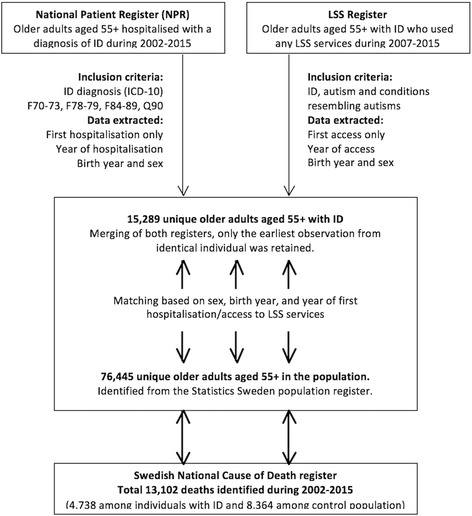
Methods: This retrospective cohort study compared older adults aged 55 years and older with ID with a control population. Participants were followed during 2002-2015 or death, and censored if they moved out of Sweden. Individuals with ID were identified from two national registers: one covering all specialist health-care visits (out-patient visits and hospitalisation) and the other covering people accessing social/support services. Individuals with ID (n = 15,289) were matched with a control population by sex, birth year, and year of first hospitalisation/out-patient visit/access to LSS services. Cause-of-death data were recorded using International Classification of Diseases, Tenth Revision. Cox proportional hazards regression were conducted to assess if overall and cause-specific mortality rate among individuals with ID was higher than in the Swedish population.
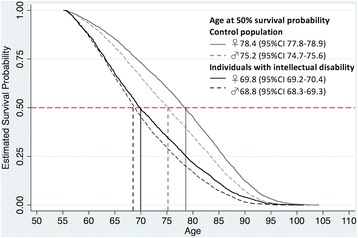
Results: The overall mortality rate among individuals with ID was 2483 per 100,000 people compared with 810 in the control population. Among those who died, more individuals with ID were younger than 75 years and unmarried. Leading causes of death among individuals with ID were circulatory diseases (34%), respiratory diseases (17%) and neoplasms (15%). Leading causes of death in a sub-sample with Down syndrome (DS) were respiratory diseases (37%), circulatory diseases (26%) and mental/behavioural disorders (11%). Epilepsy and pneumonitis were more common among individuals with ID than controls. Alzheimer's disease was common in the control population and individuals with DS, but not among those with ID when DS was excluded. Individuals with ID had a higher overall mortality risk (hazard ratio [HR] 4.1, 95% confidence interval [CI] 4.0-4.3) and respiratory disease death risk (HR 12.5, 95% CI 10.9-14.2) than controls.
Conclusion: Older adults with ID in Sweden carry a higher mortality risk compared with the general population, mainly attributable to respiratory, nervous and circulatory diseases. Care for this group, particularly during the terminal stage of illness, needs to be tailored based on understanding of their main health problem.
Keywords: Cause of death; Intellectual disability; Mortality risk; Retrospective cohort study; Sweden.
Conflict of interest statement
Authors’ information
NN (MD, MPH, PhD, Prof.) is a physician and epidemiologist specialising in global health, ageing, and chronic disease epidemiology. EFW (RN, PhD) has considerable work experience in the care of individuals with ID, and her dissertation and postdoctoral research is focused on ID. GA (RN, PhD, Prof.) has considerable experience in research regarding disability, ID and healthcare for the elderly and adults.
Ethics approval and consent to participate
The study was approved by the Regional Ethical Review Board in Lund (diary no 2013/15 and 2016/414). The National Board of Health and Welfare and Statistics Sweden provided access to the data following separate secrecy reviews in 2014 and 2016. This study is part of the project ‘Older persons with intellectual disability and healthy aging’, which used anonymised datasets.
Data in the present study are based on anonymised information drawn from three official national registrars maintained by The National Board of Health and Welfare and Statistics Sweden. These authorities provide anonymised information to individual researchers for research purposes after the study has been vetted and approved by the Regional Ethical Review Board, according to Swedish ethical review regulations. Because of the requirement for anonymised data, individuals could not be asked for consent to participate; instead active refusal of participation was applied. Information about the planned study was published in the national newspaper ‘Dagens Nyheter’ and UNIK, the magazine of the Swedish National Association for Persons with Intellectual Disability (print run of 22,000 copies). The target audience for the UNIK magazine are mainly members (people with ID) and their families. There were two versions of the advertisement, one of which was easy-to-read text. The advertisement presented the study and contained information on how to contact the research manager (GA) by phone, email or mail to opt out of the study. The research manager (GA) was responsible for contacting the national registrars to ensure those who opted out were excluded before the registrars provided any data to the research manager.
Consent for publication
Not applicable.
Competing interests
The authors declare that they have no competing interests.
Publisher’s Note
Springer Nature remains neutral with regard to jurisdictional claims in published maps and institutional affiliations.
Figures
References
MeSH terms
Grants and funding
LinkOut - more resources
Full Text Sources
Other Literature Sources
