


Flow-mediated dilation stimulated by sustained increases in shear stress: a useful tool for assessing endothelial function in humans?
- PMID: 29167121
- PMCID: PMC5899264
- DOI: 10.1152/ajpheart.00534.2017
Flow-mediated dilation stimulated by sustained increases in shear stress: a useful tool for assessing endothelial function in humans?
Abstract
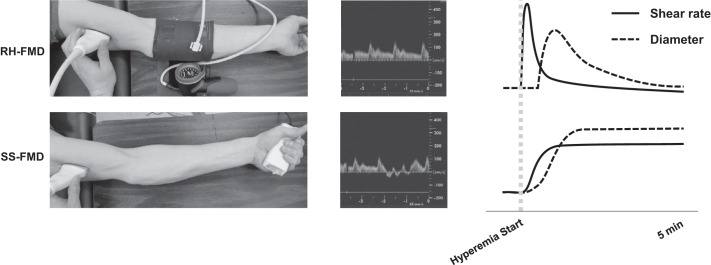
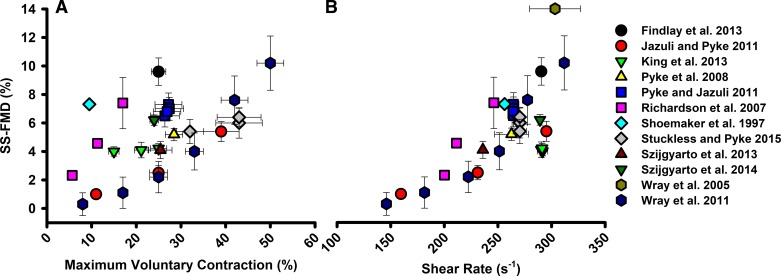
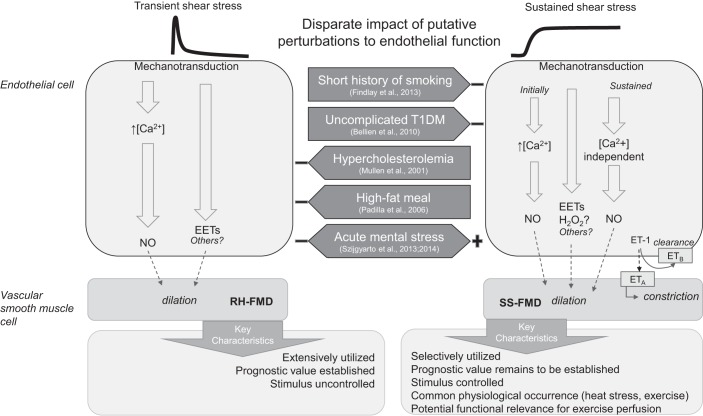
Investigations of human conduit artery endothelial function via flow-mediated vasodilation (FMD) have largely been restricted to the reactive hyperemia (RH) technique, wherein a transient increase in shear stress after the release of limb occlusion stimulates upstream conduit artery vasodilation (RH-FMD). FMD can also be assessed in response to sustained increases in shear stress [sustained stimulus (SS)-FMD], most often created with limb heating or exercise. Exercise in particular creates a physiologically relevant stimulus because shear stress increases, and FMD occurs, during typical day-to-day activity. Several studies have identified that various conditions and acute interventions have a disparate impact on RH-FMD versus SS-FMD, sometimes with only the latter demonstrating impairment. Indeed, evidence suggests that transient (RH) and sustained (SS) shear stress stimuli may be transduced via different signaling pathways, and, as such, SS-FMD and RH-FMD appear to offer unique insights regarding endothelial function. The present review describes the techniques used to assess SS-FMD and summarizes the evidence regarding 1) SS-FMD as an index of endothelial function in humans, highlighting comparisons with RH-FMD, and 2) potential differences in shear stress transduction and vasodilator production stimulated by transient versus sustained shear stress stimuli. The evidence suggests that SS-FMD is a useful tool to assess endothelial function and that further research is required to characterize the mechanisms involved and its association with long-term cardiovascular outcomes. NEW & NOTEWORTHY Sustained increases in peripheral conduit artery shear stress, created via distal skin heating or exercise, provide a physiologically relevant stimulus for flow-mediated dilation (FMD). Sustained stimulus FMD and FMD stimulated by transient, reactive hyperemia-induced increases in shear stress provide distinct assessments of conduit artery endothelial function.
Keywords: endothelium; exercise; flow-mediated dilation; nitric oxide; shear stress.
Figures
References
-
- Bellien J, Iacob M, Gutierrez L, Isabelle M, Lahary A, Thuillez C, Joannides R. Crucial role of NO and endothelium-derived hyperpolarizing factor in human sustained conduit artery flow-mediated dilatation. Hypertension 48: 1088–1094, 2006. doi:10.1161/01.HYP.0000246672.72188.bd. - DOI - PubMed
Publication types
MeSH terms
LinkOut - more resources
Full Text Sources
Other Literature Sources
Medical
