Proteinopathies and OXPHOS dysfunction in neurodegenerative diseases
- PMID: 29167179
- PMCID: PMC5716291
- DOI: 10.1083/jcb.201709172
Proteinopathies and OXPHOS dysfunction in neurodegenerative diseases
Erratum in
-
Correction: Proteinopathies and OXPHOS dysfunction in neurodegenerative diseases.J Cell Biol. 2018 Jan 2;217(1):429. doi: 10.1083/JCB.20170917212192017c. Epub 2017 Dec 21. J Cell Biol. 2018. PMID: 29269424 Free PMC article. No abstract available.
Abstract
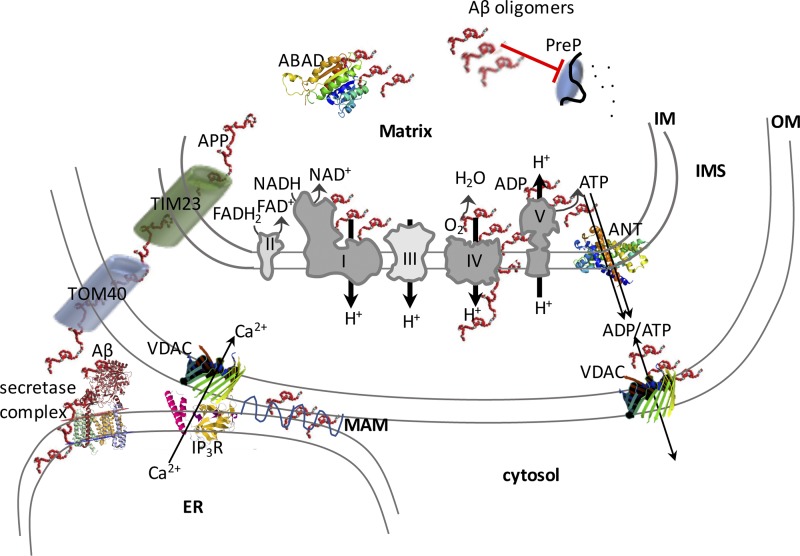
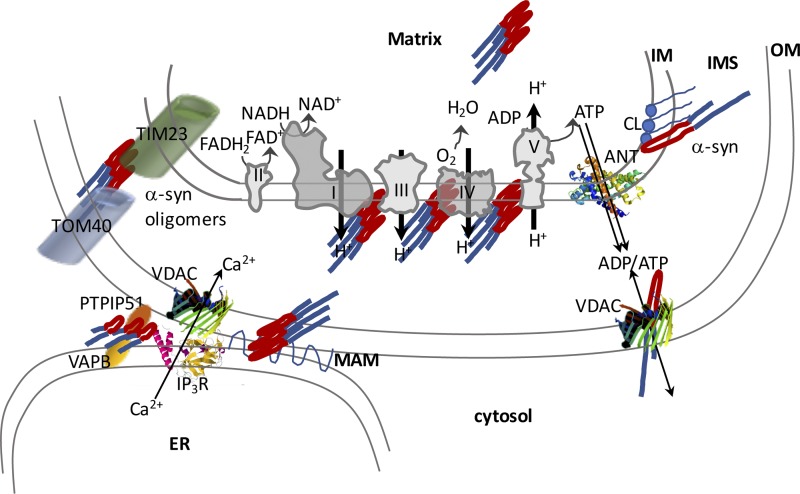
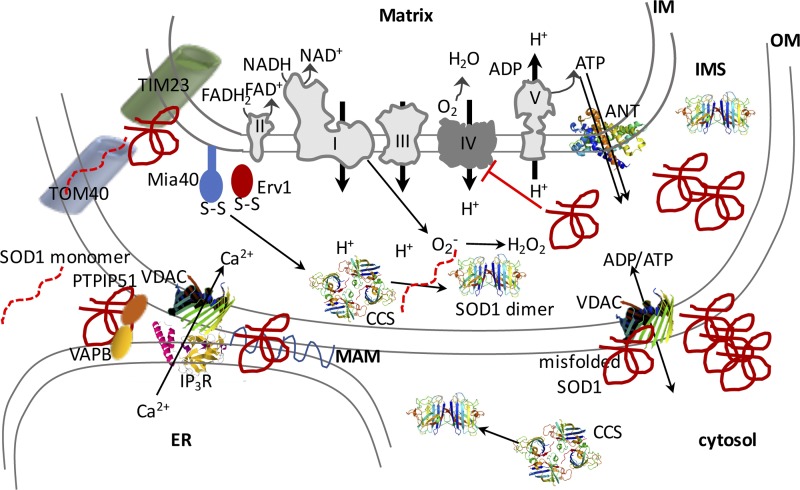
Mitochondria participate in essential processes in the nervous system such as energy and intermediate metabolism, calcium homeostasis, and apoptosis. Major neurodegenerative diseases are characterized pathologically by accumulation of misfolded proteins as a result of gene mutations or abnormal protein homeostasis. Misfolded proteins associate with mitochondria, forming oligomeric and fibrillary aggregates. As mitochondrial dysfunction, particularly of the oxidative phosphorylation system (OXPHOS), occurs in neurodegeneration, it is postulated that such defects are caused by the accumulation of misfolded proteins. However, this hypothesis and the pathological role of proteinopathies in mitochondria remain elusive. In this study, we critically review the proposed mechanisms whereby exemplary misfolded proteins associate with mitochondria and their consequences on OXPHOS.
© 2017 Kawamata and Manfredi.
Figures
References
-
- Abu-Hamad S., Kahn J., Leyton-Jaimes M.F., Rosenblatt J., and Israelson A.. 2017. Misfolded SOD1 Accumulation and Mitochondrial Association Contribute to the Selective Vulnerability of Motor Neurons in Familial ALS: Correlation to Human Disease. ACS Chem. Neurosci. 18:2225–2234. 10.1021/acschemneuro.7b00140 - DOI - PubMed
-
- Alavian K.N., Beutner G., Lazrove E., Sacchetti S., Park H.A., Licznerski P., Li H., Nabili P., Hockensmith K., Graham M., et al. . 2014. An uncoupling channel within the c-subunit ring of the F1FO ATP synthase is the mitochondrial permeability transition pore. Proc. Natl. Acad. Sci. USA. 111:10580–10585. 10.1073/pnas.1401591111 - DOI - PMC - PubMed
-
- Area-Gomez E., Del Carmen Lara Castillo M., Tambini M.D., Guardia-Laguarta C., de Groof A.J., Madra M., Ikenouchi J., Umeda M., Bird T.D., Sturley S.L., and Schon E.A.. 2012. Upregulated function of mitochondria-associated ER membranes in Alzheimer disease. EMBO J. 31:4106–4123. 10.1038/emboj.2012.202 - DOI - PMC - PubMed
Publication types
MeSH terms
Substances
Grants and funding
LinkOut - more resources
Full Text Sources
Other Literature Sources
Medical
Research Materials