


Growth of Focal Nodular Hyperplasia is Not a Reason for Surgical Intervention, but Patients Should be Referred to a Tertiary Referral Centre
- PMID: 29167952
- PMCID: PMC5895671
- DOI: 10.1007/s00268-017-4335-6
Growth of Focal Nodular Hyperplasia is Not a Reason for Surgical Intervention, but Patients Should be Referred to a Tertiary Referral Centre
Abstract
Background: When a liver lesion diagnosed as focal nodular hyperplasia (FNH) increases in size, it may cause doubt about the initial diagnosis. In many cases, additional investigations will follow to exclude hepatocellular adenoma or malignancy. This retrospective cohort study addresses the implications of growth of FNH for clinical management.
Methods: We included patients diagnosed with FNH based on ≥2 imaging modalities between 2002 and 2015. Characteristics of patients with growing FNH with sequential imaging in a 6-month interval were compared to non-growing FNH.
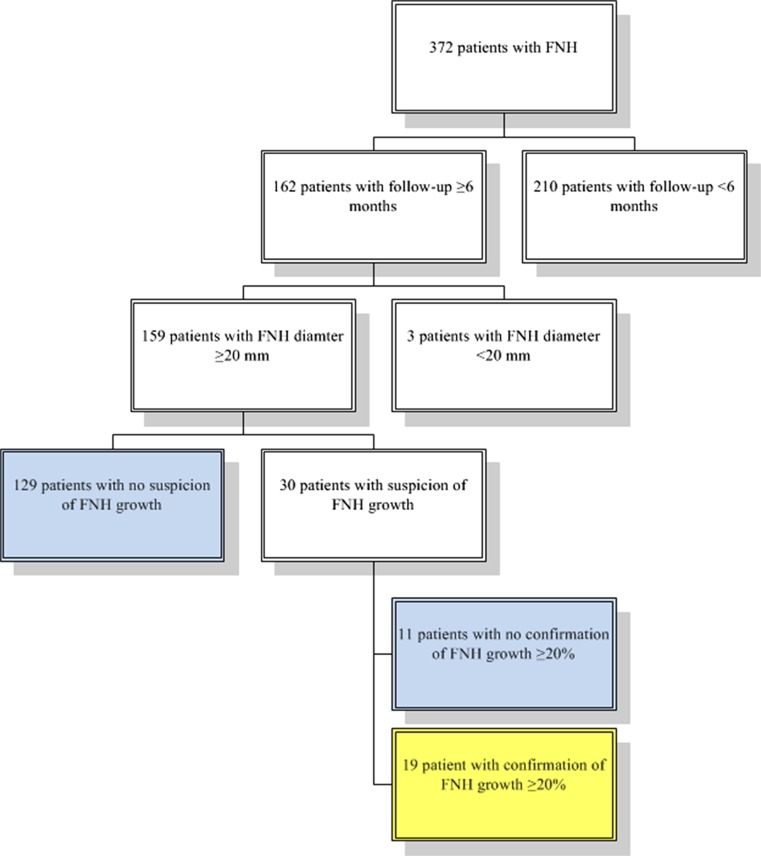
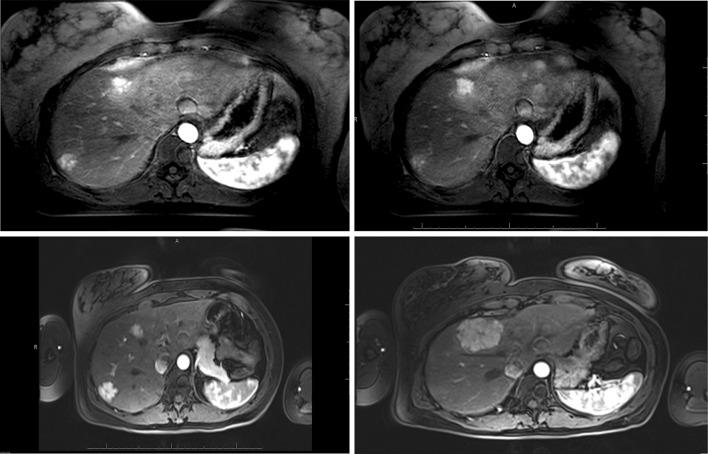
Results: Growth was reported in 19/162 (12%) patients, ranging from 21 to 200%. Resection was performed in 4/19 growing FNHs; histological examination confirmed FNH in all patients. In all 15 conservatively treated patients, additional imaging confirmed FNH diagnosis. No adverse outcomes were reported. No differences were found in characteristics and presentation of patients with growing or non-growing FNH.
Conclusion: This study confirms that FNH may grow significantly without causing symptoms. A significant increase in size should not have any implications on clinical management if confident diagnosis by imaging has been established by a tertiary benign liver multidisciplinary team. Liver biopsy is only indicated in case of doubt after state-of-the-art imaging. Resection is deemed unnecessary if the diagnosis is confirmed by multiple imaging modalities in a tertiary referral centre.
Conflict of interest statement
None.
Figures

References
-
- Mathieu D, Vilgrain V, Mahfouz AE, et al. Benign liver tumors. Magn Reson Imaging Clin N Am. 1997;5:255–288. - PubMed
MeSH terms
LinkOut - more resources
Full Text Sources
Other Literature Sources
