. 2018 May;218(3):1106-1126.
doi: 10.1111/nph.14909. Epub 2017 Nov 23.

N-terminomics reveals control of Arabidopsis seed storage proteins and proteases by the Arg/N-end rule pathway

Affiliations

N-terminomics reveals control of Arabidopsis seed storage proteins and proteases by the Arg/N-end rule pathway

Hongtao Zhang et al. New Phytol. 2018 May.

Abstract

The N-end rule pathway of targeted protein degradation is an important regulator of diverse processes in plants but detailed knowledge regarding its influence on the proteome is lacking. To investigate the impact of the Arg/N-end rule pathway on the proteome of etiolated seedlings, we used terminal amine isotopic labelling of substrates with tandem mass tags (TMT-TAILS) for relative quantification of N-terminal peptides in prt6, an Arabidopsis thaliana N-end rule mutant lacking the E3 ligase PROTEOLYSIS6 (PRT6). TMT-TAILS identified over 4000 unique N-terminal peptides representing c. 2000 protein groups. Forty-five protein groups exhibited significantly increased N-terminal peptide abundance in prt6 seedlings, including cruciferins, major seed storage proteins, which were regulated by Group VII Ethylene Response Factor (ERFVII) transcription factors, known substrates of PRT6. Mobilisation of endosperm α-cruciferin was delayed in prt6 seedlings. N-termini of several proteases were downregulated in prt6, including RD21A. RD21A transcript, protein and activity levels were downregulated in a largely ERFVII-dependent manner. By contrast, cathepsin B3 protein and activity were upregulated by ERFVIIs independent of transcript. We propose that the PRT6 branch of the pathway regulates protease activities in a complex manner and optimises storage reserve mobilisation in the transition from seed to seedling via control of ERFVII action.

Keywords: Arabidopsis thaliana; TAILS; N-end rule; N-terminomics; cruciferin; protease; quantitative proteomics; tandem mass tag (TMT).


Figures

Figure 1
Figure 1
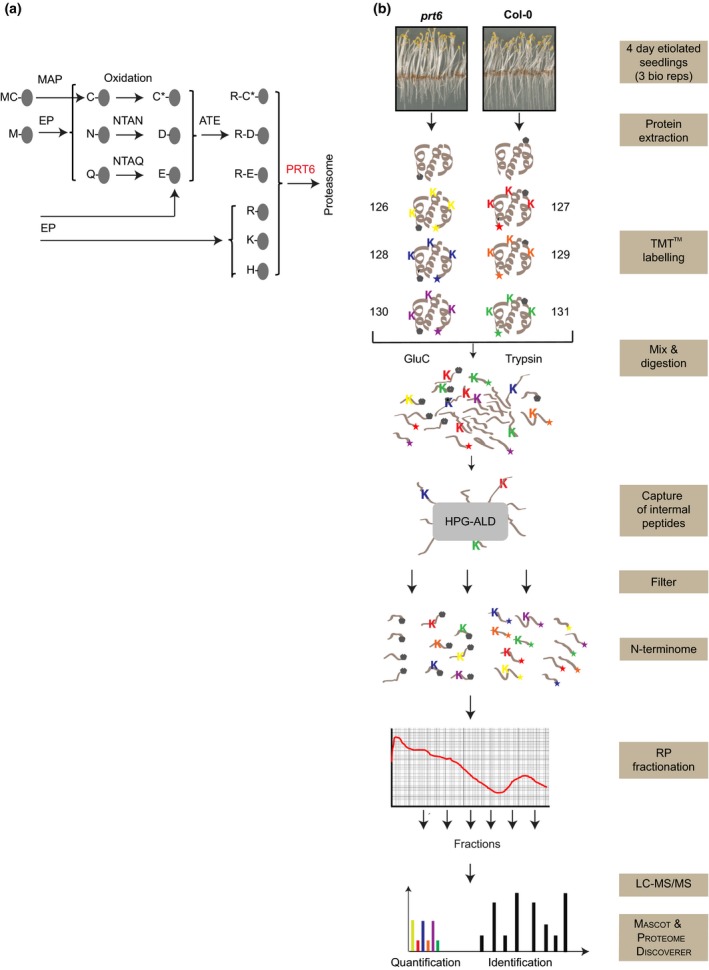
Identification and quantitation of N‐terminal peptides with TMT™‐TAILS. (a) The PRT6 branch of the Arg/N‐end rule. Substrates are generated by the action of endopeptidases (EP) or by methionine aminopeptidase (MAP)‐dependent excision of Met1 from proteins initiating Met‐Cys. PRT6, PROTEOLYSIS6 E3 ligase; ATE, arginyl tRNA transferase; NTAN1, asparagine‐specific N‐terminal amidase; NTAQ1, glutamine‐specific N‐terminal amidase. Amino acids are indicated with single letter codes; C*, oxidised cysteine. (b) Schematic representation of the TAILS workflow. Primary amines of proteins with free N‐termini (star) and lysine (K) side‐chain amines of proteins were labelled with 6‐plex TMT reagents (three biological replicates per genotype). After combining labelled samples from WT and prt6‐5 plants, the sample was divided into two, proteins were digested with either GluC or trypsin, and internal peptides were removed via hyperbranched polyglycerol aldehyde (HPG‐ALD) polymer binding of the free N‐terminal amine group. The unbound peptides (highly enriched for N‐terminal peptides) were fractionated by reversed‐phase (RP) chromatography, then analysed by high‐accuracy LCMS/MS. Mascot and ProteomeDiscoverer™ were used for protein identification and quantification. Grey pentagons represent naturally blocked (acetylated) N‐termini.
Figure 2
Figure 2
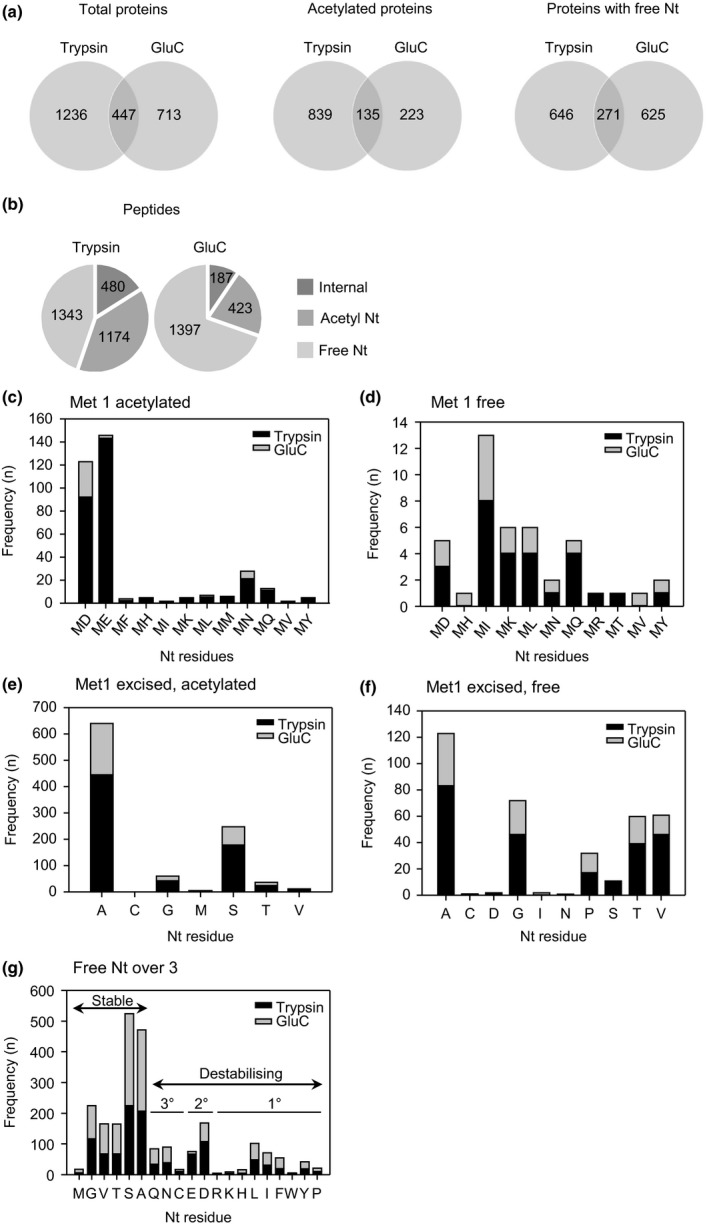
Analysis of protein groups and N‐terminal peptides identified by TMT™‐TAILS. Peptides were enriched by TMTTAILS, using two different proteases, trypsin and GluC. (a) Venn diagrams showing overlap in protein groups identified with the N‐terminal peptide datasets from two different proteases. (b) Numbers of unique peptides with location information identified in different categories (free N‐terminal (Nt), acetylated Nt and non‐Nt (internal) peptides) following enrichment by TAILS. When an N‐terminal peptide matched to more than one protein group, positional information was derived for the master protein defined by ProteomeDiscoverer. (c) Analysis of first and second residues of Nt peptides with Met 1 acetylated. (d) Analysis of first and second residues of Nt peptides with free Met 1. (e) Nt peptides resulting from N‐terminal methionine excision followed by Nt acetylation. (f) Free Nt peptides resulting from N‐terminal methionine excision. (g) Occurrence of different Nt‐amino acid residues in free Nt peptides which initiate at amino acid residues ≥ 3, relative to the protein encoded by the published open reading frame (ORF). Met, Gly, Val, Thr, Ser and Ala are stabilising residues. Primary, secondary and tertiary destabilising residues are indicated on the graph.
Figure 3
Figure 3
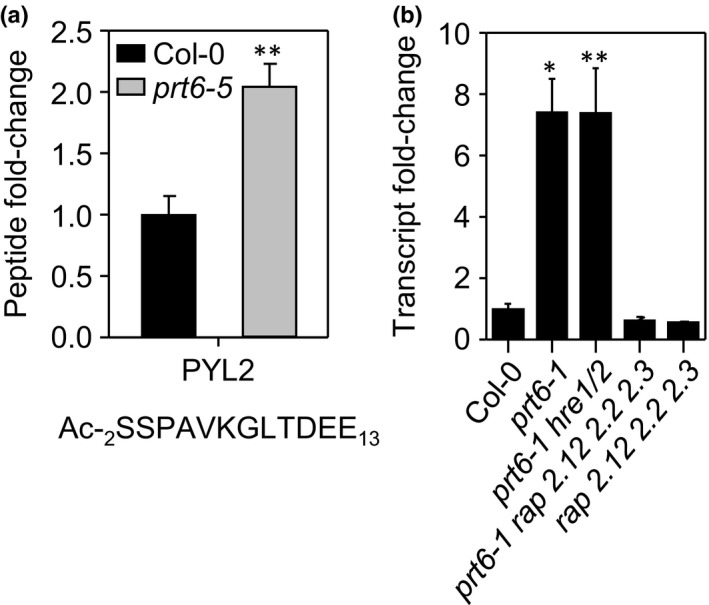
Abscisic acid (ABA) receptor component, PYL2, is regulated by the Arg/N‐end rule in an ERF‐dependent manner in etiolated Arabidopsis thaliana seedlings. (a) Relative abundance of Nt peptide corresponding to amino acids 2–13 of PYL2 in Col‐0 and prt6‐5. (b) PYL2 transcript abundance in single and combination N‐end rule and erfVII mutants, relative to Col‐0. Values are means ± SE (= 3); *, < 0.05; **, < 0.01.
Figure 4
Figure 4
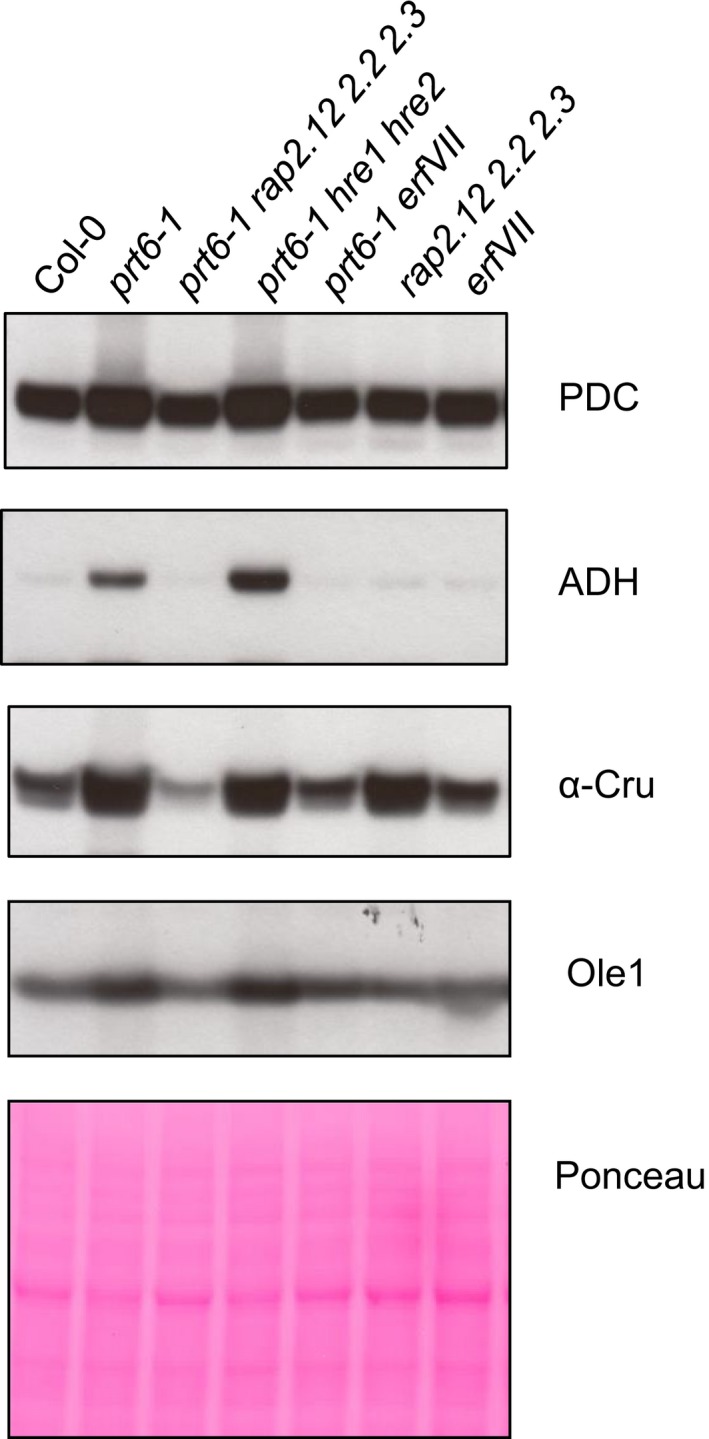
Increased abundance of proteins in prt6 seedlings requires RAP‐type ERFVII transcription factors. Proteins were extracted from 4‐d‐old etiolated seedlings of Arabidopsis thaliana N‐end rule and erfVII combination mutants and subjected to immunoblotting (25 µg per lane) with antisera towards pyruvate decarboxylase (PDC), alcohol dehydrogenase (ADH), cruciferin α subunit (α‐Cru) and oleosin1 (Ole1). Representative of three independent experiments.
Figure 5
Figure 5
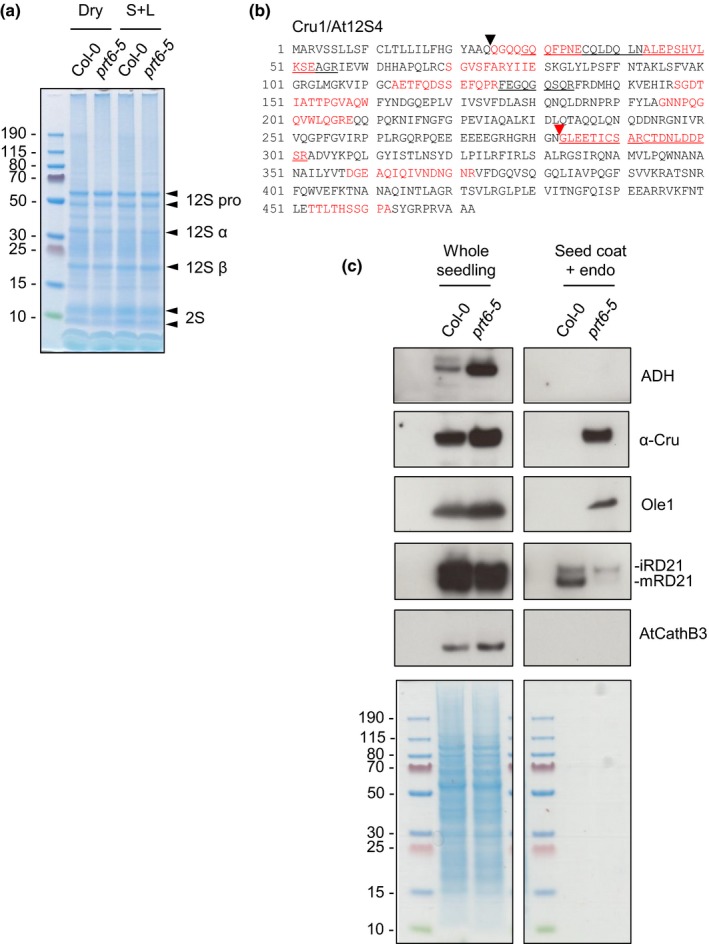
Mobilisation of 12S seed storage proteins is impaired in prt6 endosperm. (a) Quick Coomassie blue‐stained gel of proteins extracted from dry and germinating Arabidopsis thaliana seeds (protein extracted from five seeds was loaded in each lane). Dry, dry seed; S + L, seeds after 48 h of stratification on agar plus 6 h of light. The arrows indicate positions of the 12S cruciferin pro‐protein (pro), α and β subunits, and 2S albumins (napins). (b) Amino acid sequence of CRU1/At12S4; peptides identified by TMT™‐TAILS are indicated in red and/or underlined (some peptide sequences overlap). Black arrow indicates Nt of the α‐subunit generated by removal of residues 1–24; red arrow indicates Nt of the β‐subunit generated by proteolytic processing. (c) Immunoblots of 4‐d‐old seedlings, with endosperm and seed coat attached (loading equivalent to eight seedlings) and 15 dissected endosperms plus seed coat, probed with antisera towards alcohol dehydrogenase (ADH), cruciferin α subunit (α‐Cru), oleosin 1 (Ole1), RD21A (identifies both intermediate and mature forms, iRD21 and mRD21, respectively) and AtCathB3. The panel below shows the corresponding Quick Commassie blue‐stained gel; positions of molecular weight markers (kDa) are indicated to the left of the panel.
Figure 6
Figure 6
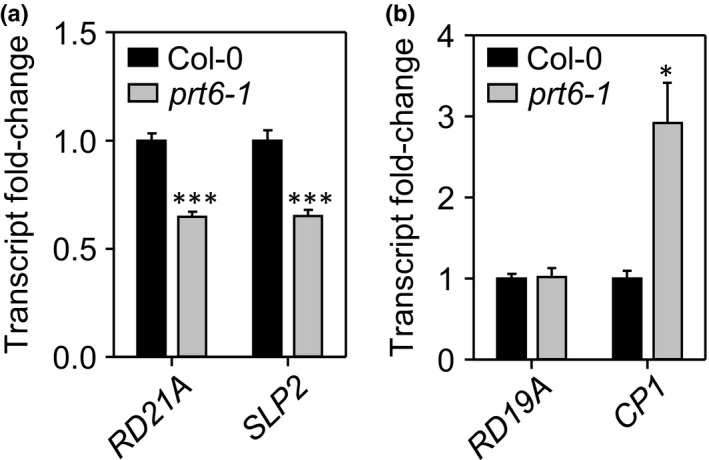
Quantification of protease transcripts in Col‐0 and prt6 seedlings. RTqPCR analysis of (a) RD21A and SLP2, and (b) RD19A and CP1 in 4‐d‐old etiolated Arabidopsis thaliana seedlings of Col‐0 and prt6‐1. Values are means ± SE (= 4); *, < 0.05; ***, < 0.001.
Figure 7
Figure 7
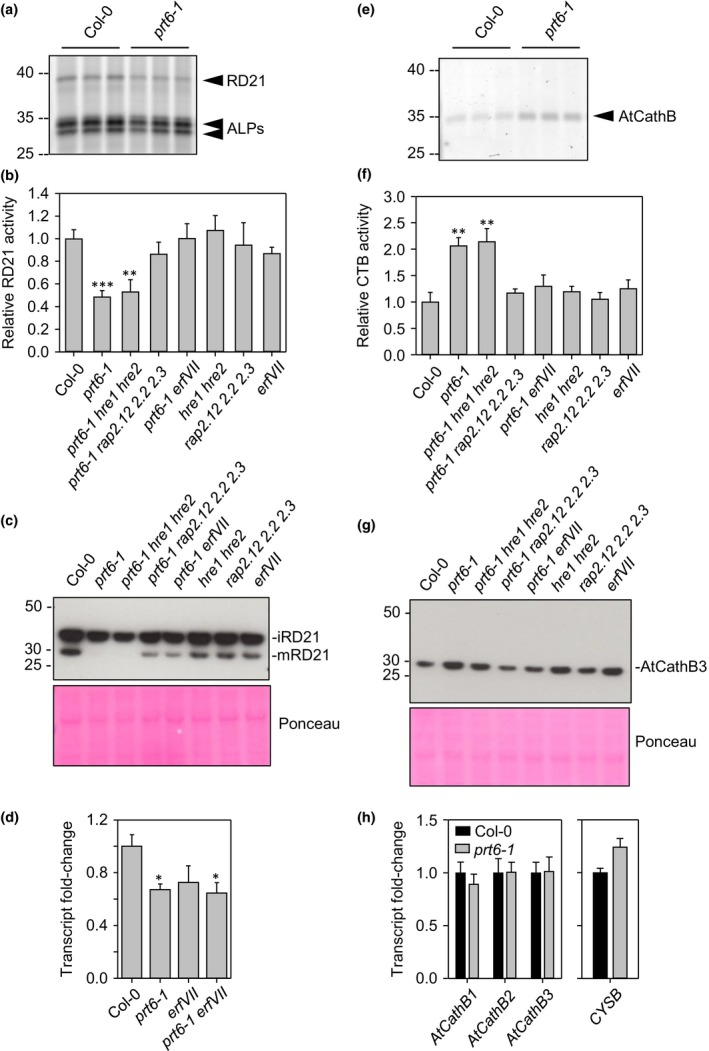
Differential regulation of proteases by the Arg/N‐end rule pathway. Activities, protein and RTqPCR analysis of selected Arabidopsis thaliana proteases. (a, e) Activity‐based protein profiling of 4‐d‐old etiolated seedlings of N‐end rule and erfVII combination mutants. (a) Probe FY01 labels RD21A and aleurin‐like proteases (ALPs); (e) probe JOGDA1 labels cathepsin B (AtCathB). Each lane represents a biological replicate; positions of molecular weight markers (kDa) are shown to the left of each panel. (b, f) Quantification of (b) RD21A signal and (f) AtCathB signal; values are means ± SE (= 3). (c, g) Immunoblots probed with antisera raised to (c) RD21A and (g) AtCathB3; protein extracts from equal numbers of 4‐d‐old etiolated seedlings were loaded in each lane; positions of molecular weight markers (kDa) are shown to the left of each panel. (d, h) RTqPCR analysis of (d) RD21A, and (h) AtCathB1‐3 and CYSB in etiolated seedlings of Col‐0 and prt6‐1. Values are means ± SE (= 4); *, < 0.05; **, < 0.01; ***, < 0.001.

Comment in

References

    1. Abbas M, Berckhan S, Rooney DJ, Gibbs DJ, Vicente Conde J, Sousa Correia C, Bassel GW, Marín‐de la Rosa N, León J, Alabadí D et al 2015. Oxygen sensing coordinates photomorphogenesis to facilitate seedling survival. Current Biology 25: 1483–1488. - PMC - PubMed
    1. Bachmair A, Finley D, Varshavsky A. 1986. In vivo half‐life of a protein is a function of its amino‐terminal residue. Science 234: 179–186. - PubMed
    1. Baud S, Dubreucq B, Miquel M, Rochat C, Lepinie L. 2008. Storage reserve accumulation in Arabidopsis: metabolic and developmental control of seed filling. Arabidopsis Book 6: e0113. - PMC - PubMed
    1. Bienvenut WV, Sumpton D, Martinez A, Lilla S, Espagne C, Meinnel T, Giglione C. 2012. Comparative large scale characterization of plant versus mammal proteins reveals similar and idiosyncratic N‐α‐acetylation features. Molecular & Cellular Proteomics: MCP 11: 1–14. - PMC - PubMed
    1. Biniossek ML, Schilling O. 2012. Enhanced identification of peptides lacking basic residues by LC‐ESI‐MS/MS analysis of singly charged peptides. Proteomics 12: 1303–1309. - PubMed

Publication types