


Differential distribution of Y-chromosome haplotypes in Swiss and Southern European goat breeds
- PMID: 29170508
- PMCID: PMC5701018
- DOI: 10.1038/s41598-017-15593-1
Differential distribution of Y-chromosome haplotypes in Swiss and Southern European goat breeds
Abstract
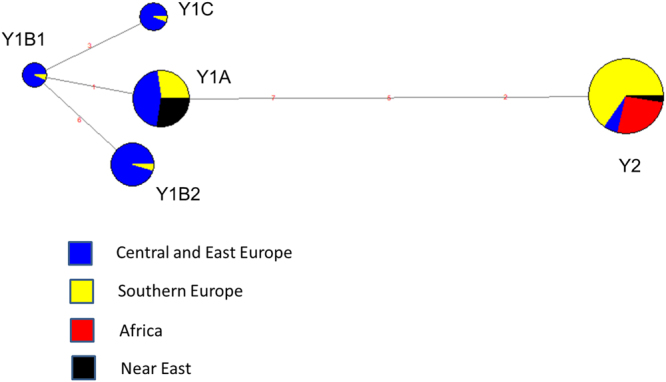
The analysis of Y-chromosome variation has provided valuable clues about the paternal history of domestic animal populations. The main goal of the current work was to characterize Y-chromosome diversity in 31 goat populations from Central Eastern (Switzerland and Romania) and Southern Europe (Spain and Italy) as well as in reference populations from Africa and the Near East. Towards this end, we have genotyped seven single nucleotide polymorphisms (SNPs), mapping to the SRY, ZFY, AMELY and DDX3Y Y-linked loci, in 275 bucks from 31 populations. We have observed a low level of variability in the goat Y-chromosome, with just five haplotypes segregating in the whole set of populations. We have also found that Swiss bucks carry exclusively Y1 haplotypes (Y1A: 24%, Y1B1: 15%, Y1B2: 43% and Y1C: 18%), while in Italian and Spanish bucks Y2A is the most abundant haplotype (77%). Interestingly, in Carpathian goats from Romania the Y2A haplotype is also frequent (42%). The high Y-chromosome differentiation between Swiss and Italian/Spanish breeds might be due to the post-domestication spread of two different Near Eastern genetic stocks through the Danubian and Mediterranean corridors. Historical gene flow between Southern European and Northern African goats might have also contributed to generate such pattern of genetic differentiation.
Conflict of interest statement
The authors declare that they have no competing interests.
Figures
References
Publication types
MeSH terms
LinkOut - more resources
Full Text Sources
Other Literature Sources
Research Materials
