


Transanal hemorrhoidal dearterialization (THD) for hemorrhoidal disease: a single-center study on 1000 consecutive cases and a review of the literature
- PMID: 29170839
- PMCID: PMC5830492
- DOI: 10.1007/s10151-017-1726-5
Transanal hemorrhoidal dearterialization (THD) for hemorrhoidal disease: a single-center study on 1000 consecutive cases and a review of the literature
Erratum in
-
Correction to: Transanal hemorrhoidal dearterialization (THD) for hemorrhoidal disease: a single-center study on 1000 consecutive cases and a review of the literature.Tech Coloproctol. 2018 Mar;22(3):253. doi: 10.1007/s10151-018-1765-6. Tech Coloproctol. 2018. PMID: 29492831 Free PMC article.
Abstract
Background: The transanal hemorrhoidal dearterialization (THD) Doppler procedure is a minimally invasive technique to treat symptomatic hemorrhoids. The aim of the study was to assess the clinical efficacy and the satisfaction of patients in a large series treated with THD and to review the relevant literature.
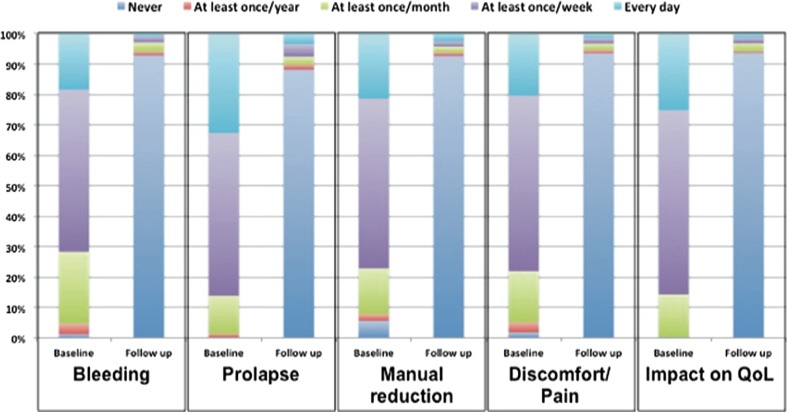
Methods: In this retrospective, single-institution, study consecutive patients with grade 2, 3, or 4 hemorrhoidal disease were treated with the THD Doppler procedure. Dearterialization was performed in all cases and mucopexy in case of prolapse. The dearterialization procedure evolved from "proximal artery ligation" to "distal Doppler-guided dearterialization." Follow-up was scheduled at 15 days, 1, 3, 12 months, and once a year thereafter. Complications were recorded. Clinical efficacy was assessed comparing both frequency of symptoms and disease grading (Goligher's classification) at baseline versus last follow-up. Uni-/multivariate analysis evaluated factors affecting the outcome.
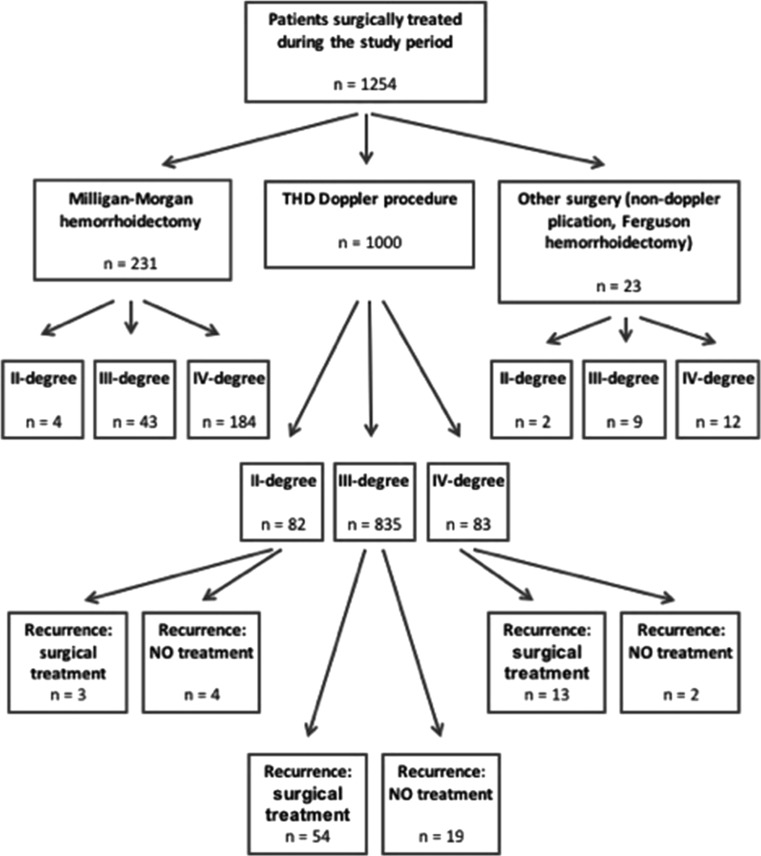
Results: There were 1000 patients (619 men; mean age: 48.6 years, range 19-88 years). Acute postoperative bleeding was observed in 14 patients (1.4%), pain/tenesmus in 31 patients (3.1%), and urinary retention in 23 patients (2.3%). At mean follow-up duration of 44 ± 29 months, the symptomatic recurrence rate was 9.5% (95 patients; bleeding in 12 (1.2%), prolapse in 46 (4.6%), and bleeding and prolapse in 37 (3.7%) patients). The recurrence rate was 8.5, 8.7, and 18.1% in patients with grade 2, 3, and 4 hemorrhoids, respectively. Seventy out of 95 patients with recurrence needed surgery (reoperation rate: 7.0%). At final follow-up and taking into account the reoperations, 95.7% of patients had no hemorrhoidal disease on examination. Younger age, grade 4 disease, and high artery ligation affected the outcome negatively.
Conclusions: Our results show that the THD Doppler procedure is safe and effective in patients with hemorrhoidal disease and associated with low morbidity and recurrence rates and a high rate percentage of treatment success.
Keywords: Hemorrhoids; Mucopexy; Surgical management hemorrhoidal disease; Transanal hemorrhoidal dearterialization.
Conflict of interest statement
Conflict of interest
Carlo Ratto was, for 1 year, a member of the THD Advisory Board; no personal salary was received. The other authors declare that they have no conflict of interest.
Ethical approval
All procedures performed in this study involving human participants were in accordance with the ethical standards of the institutional and/or national research committee and with the 1964 Helsinki declaration and its later amendments or comparable ethical standards.
Informed consent
Informed consent was obtained from all individual participants included in the study.
Figures
Comment in
-
A single-centre study on 1000 consecutive cases of transanal haemorrhoidal dearterialization.Tech Coloproctol. 2018 Mar;22(3):247-248. doi: 10.1007/s10151-017-1740-7. Epub 2017 Dec 28. Tech Coloproctol. 2018. PMID: 29285683 No abstract available.
-
Reply to correspondence by Smart and Watson.Tech Coloproctol. 2018 Mar;22(3):249-250. doi: 10.1007/s10151-018-1763-8. Epub 2018 Feb 22. Tech Coloproctol. 2018. PMID: 29470679 No abstract available.
References
-
- Morinaga K, Hasuda K, Ikeda T. A novel therapy for internal hemorrhoids: ligation of the hemorrhoidal artery with a newly devised instrument (Moricorn) in conjunction with a Doppler flowmeter. Am J Gastroenterol. 1995;90:610–613. - PubMed
Publication types
MeSH terms
LinkOut - more resources
Full Text Sources
Other Literature Sources
Medical
