


Risk of cancer death by comorbidity severity and use of adjuvant chemotherapy among women with locoregional breast cancer
- PMID: 29174187
- PMCID: PMC11119002
- DOI: 10.1016/j.jgo.2017.11.004
Risk of cancer death by comorbidity severity and use of adjuvant chemotherapy among women with locoregional breast cancer
Abstract
Objectives: To examine the associations of comorbidity and chemotherapy with breast cancer- and non-breast cancer-related death.
Materials and methods: Included were women with invasive locoregional breast cancer diagnosed in 2004 from seven population-based cancer registries. Data were abstracted from medical records and verified with treating physicians when there were inconsistencies and missing information on cancer treatment. Comorbidity severity was quantified using the Adult Comorbidity Evaluation 27. Treatment guideline concordance was determined by comparing treatment received with the National Comprehensive Cancer Network guidelines. Kaplan-Meier method and multivariable Cox proportional hazards regressions were employed for statistical analyses.
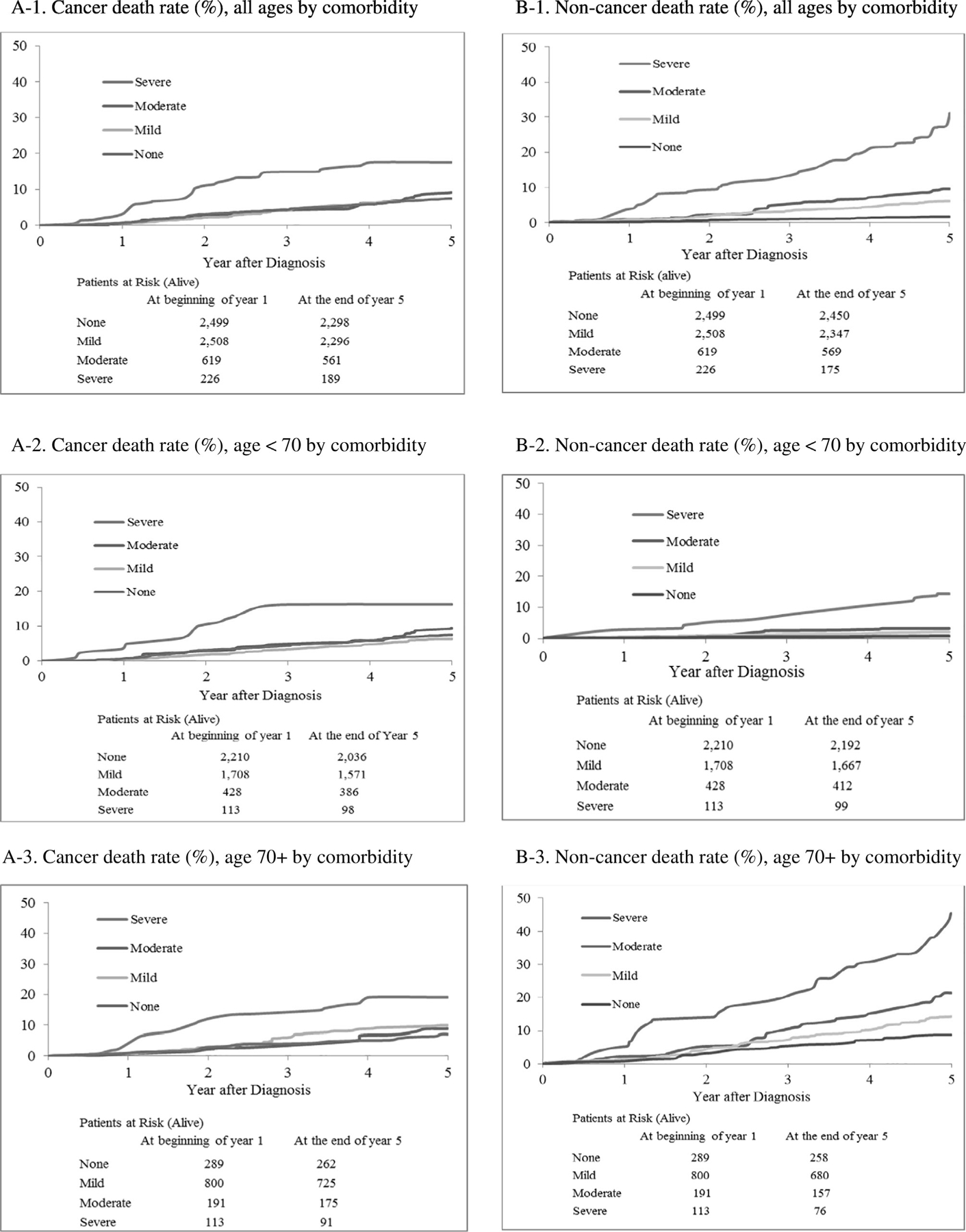
Results: Of 5852 patients, 76% were under 70years old and 69% received guideline concordant adjuvant chemotherapy. Comorbidity was more prevalent in women age 70 and older (79% vs. 51%; p<0.001). After adjusting for tumor characteristics and treatment, severe comorbidity burden was associated with significantly higher cancer-related mortality in older patients (Hazard Ratio [HR]=2.38, 95% CI 1.08-5.24), but not in younger patients (HR=1.78, 95% CI 0.87-3.64). Among patients receiving guideline adjuvant chemotherapy, cancer-related mortality was significantly higher in older patients (HR=2.35, 95% CI 1.52-3.62), and those with severe comorbidity (HR=3.79, 95% CI 1.72-8.33).
Conclusions: Findings suggest that, compared to women with no comorbidity, patients with breast cancer age 70 and older with severe comorbidity are at increased risk of dying from breast cancer, even after adjustment for adjuvant chemotherapy and other tumor and treatment differences. This information adds to risk-benefit discussions and emphasizes the need for further study of the role for adjuvant chemotherapy in these patient groups.
Keywords: Adjuvant chemotherapy; Age; Breast cancer; Comorbidity; Risk–benefit; Survival.
Copyright © 2017 Elsevier Ltd. All rights reserved.
Conflict of interest statement
Conflict of Interest/Disclosures
Dr. Kimmick has served on speakers boards and been a consultant for AstraZeneca, Pfizer, and Novartis and has had research funding from AstraZeneca, Pfizer, and Roche. Dr. Anderson has had research funding from AstraZeneca and Roche. None of the other authors have financial interests, activities, relationships, or affiliations that would pose a conflict of interest with the content of this manuscript.
Figures
References
-
- Wu X, Richardson LC, Kahn AR, Fulton JP, Cress RD, Shen T, et al. Survival difference between non-Hispanic black and non-Hispanic white women with localized breast cancer: the impact of guideline-concordant therapy. J Natl Med Assoc 2008;100 (5):490–8. - PubMed
-
- Louwman WJ, Janssen-Heijnen ML, Houterman S, Voogd AC, van der Sangen MJ, Nieuwenhuijzen GA, et al. Less extensive treatment and inferior prognosis for breast cancer patient with comorbidity: a population-based study. Eur J Cancer 2005;41 (5):779–85. - PubMed
-
- Land LH, Dalton SO, Jorgensen TL, Ewertz M. Comorbidity and survival after early breast cancer. A review. Crit Rev Oncol Hematol 2012;81(2):196–205. - PubMed
-
- Berglund A, Wigertz A, Adolfsson J, Ahlgren J, Fornander T, Warnberg F, et al. Impact of comorbidity on management and mortality in women diagnosed with breast cancer. Breast Cancer Res Treat 2012;135(1):281–9. - PubMed
-
- Braithwaite D, Tammemagi CM, Moore DH, Ozanne EM, Hiatt RA, Belkora J, et al. Hypertension is an independent predictor of survival disparity between African-American and white breast cancer patients. Int J Cancer 2009;124(5):1213–9. - PubMed
Publication types
MeSH terms
Grants and funding
LinkOut - more resources
Full Text Sources
Other Literature Sources
Medical
