


Pro-tobacco advertisement exposure among African American smokers: An ecological momentary assessment study
- PMID: 29174665
- PMCID: PMC5916503
- DOI: 10.1016/j.addbeh.2017.10.015
Pro-tobacco advertisement exposure among African American smokers: An ecological momentary assessment study
Abstract
Introduction: Many African Americans live in communities with a disproportionately high density of tobacco advertisements compared to Whites. Some research indicates that point-of-sale advertising is associated with impulse purchases of cigarettes and smoking. Ecological Momentary Assessment (EMA) can be used to examine associations between tobacco advertisement exposure and smoking variables in the natural environment.
Methods: Non-treatment seeking African American smokers were given a mobile device for 2weeks (N=56). They were prompted four times per day and responded to questions about recent exposure to tobacco advertisements. Participants were also asked to indicate the number of cigarettes smoked, and if they made any purchase, or an impulse purchase, since the last assessment. Linear mixed models (LMMs) analyzed between- and within-subject associations between exposure and outcomes.
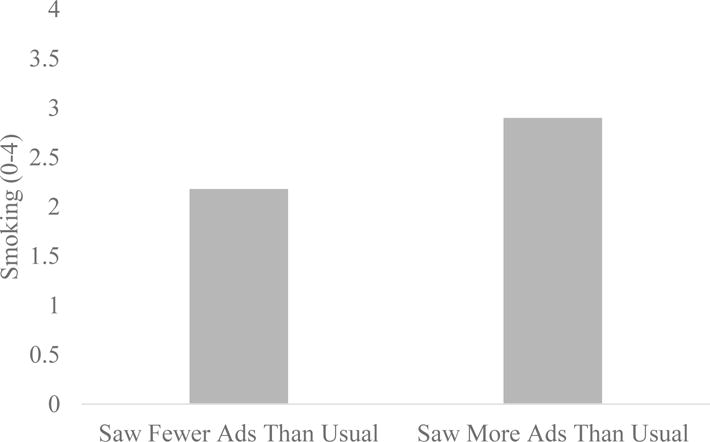
Results: Participants reported seeing at least one advertisement on 33% of assessments. Of those assessments, they reported seeing menthol advertisements on 87% of assessments. Between-subject analyses revealed that participants who on average saw more advertisements were generally more likely to report purchasing cigarettes and to purchase cigarettes on impulse. Within-subject analyses revealed that when an individual participant reported seeing more advertisements than usual they were more likely to have reported purchasing cigarettes, making an impulse purchase and smoking more cigarettes during the same period, but not the subsequent time period.
Conclusions: Many African American smokers are frequently exposed to pro-tobacco marketing. Advertisement exposure is cross-sectionally associated with impulse purchases and smoking. Future research should assess prospective associations in more detail.
Keywords: African Americans; Ecological momentary assessment; Minority health; Tobacco; Tobacco advertising.
Published by Elsevier Ltd.
Conflict of interest statement
Figures
References
-
- Ahluwalia JS, Okuyemi K, Nollen N, Choi WS, Kaur H, Pulvers K, Mayo MS. The effects of nicotine gum and counseling among African American light smokers: a 2× 2 factorial design. Addiction. 2006;101(6):883–891. - PubMed
-
- Benowitz NL, Jacob P, Hall S, Tsoh J, Ahijevych K, Jarvis M, Henningfield J. Biochemical verification of tobacco use and cessation. Nicotine and Tobacco Research. 2002;4(2):149–159. - PubMed
-
- Bettigole C, Farley TA. Retail Stores and the Fight Against Tobacco—Following the Money. JAMA Internal Medicine. 2016;176(10):1520–1521. - PubMed
Publication types
MeSH terms
Grants and funding
LinkOut - more resources
Full Text Sources
Other Literature Sources
Medical
Research Materials
