. 2017 Nov 27;12(11):e0188593.
doi: 10.1371/journal.pone.0188593. eCollection 2017.

Minimal 2'-O-methyl phosphorothioate linkage modification pattern of synthetic guide RNAs for increased stability and efficient CRISPR-Cas9 gene editing avoiding cellular toxicity

Affiliations

Minimal 2'-O-methyl phosphorothioate linkage modification pattern of synthetic guide RNAs for increased stability and efficient CRISPR-Cas9 gene editing avoiding cellular toxicity

Megan Basila et al. PLoS One. .

Abstract

Since its initial application in mammalian cells, CRISPR-Cas9 has rapidly become a preferred method for genome engineering experiments. The Cas9 nuclease is targeted to genomic DNA using guide RNAs (gRNA), either as the native dual RNA system consisting of a DNA-targeting CRISPR RNA (crRNA) and a trans-activating crRNA (tracrRNA), or as a chimeric single guide RNA (sgRNA). Entirely DNA-free CRISPR-Cas9 systems using either Cas9 protein or Cas9 mRNA and chemically synthesized gRNAs allow for transient expression of CRISPR-Cas9 components, thereby reducing the potential for off-targeting, which is a significant advantage in therapeutic applications. In addition, the use of synthetic gRNA allows for the incorporation of chemical modifications for enhanced properties including improved stability. Previous studies have demonstrated the utility of chemically modified gRNAs, but have focused on one pattern with multiple modifications in co-electroporation with Cas9 mRNA or multiple modifications and patterns with Cas9 plasmid lipid co-transfections. Here we present gene editing results using a series of chemically modified synthetic sgRNA molecules and chemically modified crRNA:tracrRNA molecules in both electroporation and lipid transfection assessing indel formation and/or phenotypic gene knockout. We show that while modifications are required for co-electroporation with Cas9 mRNA, some modification patterns of the gRNA are toxic to cells compared to the unmodified gRNA and most modification patterns do not significantly improve gene editing efficiency. We also present modification patterns of the gRNA that can modestly improve Cas9 gene editing efficiency when co-transfected with Cas9 mRNA or Cas9 protein (> 1.5-fold difference). These results indicate that for certain applications, including those relevant to primary cells, the incorporation of some, but not all chemical modification patterns on synthetic crRNA:tracrRNA or sgRNA can be beneficial to CRISPR-Cas9 gene editing.


Conflict of interest statement

Competing Interests: All authors were employees of GE Healthcare Dharmacon, Inc. This does not alter our adherence to PLOS ONE policies on sharing data and materials. Please note that we are now part of Horizon Discovery. Because our work was performed while part of GE Healthcare Dharmacon, Inc, we have kept our affiliation and appended it to reflect our current ownership.

Figures

Fig 1
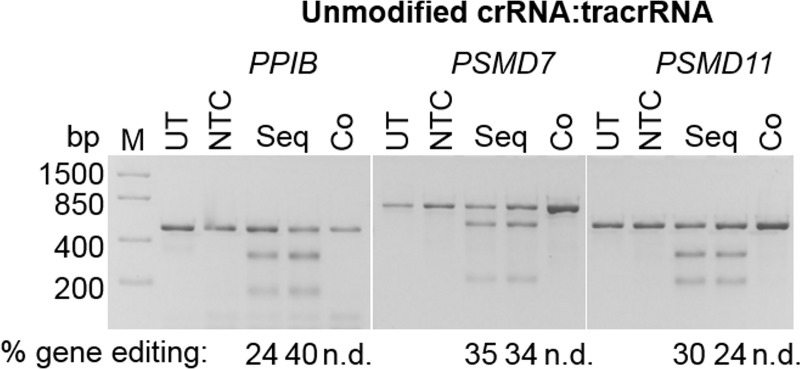
Fig 1. Unmodified crRNA:tracrRNA require a sequential electroporation method with Cas9 mRNA for gene editing.
Sequential electroporation involves electroporation of Cas9 mRNA, followed 6 hours later by electroporation of synthetic guide RNA and harvested 2–3 days later for analysis. With a co-electroporation method, both Cas9 mRNA and synthetic guide RNA are delivered into cells at the same time, then harvested 2–3 days later. No detectable (n.d.) gene editing was observed with unmodified synthetic crRNA:tracrRNA in co-electroporation (Co) with Cas9 mRNA into K-562 cells for three gene targets, but resulted in a significant increase when with sequential electroporation (Seq, duplicate samples). UT = Untreated, NTC = Non-targeting control, M = DNA ladder.
Fig 2
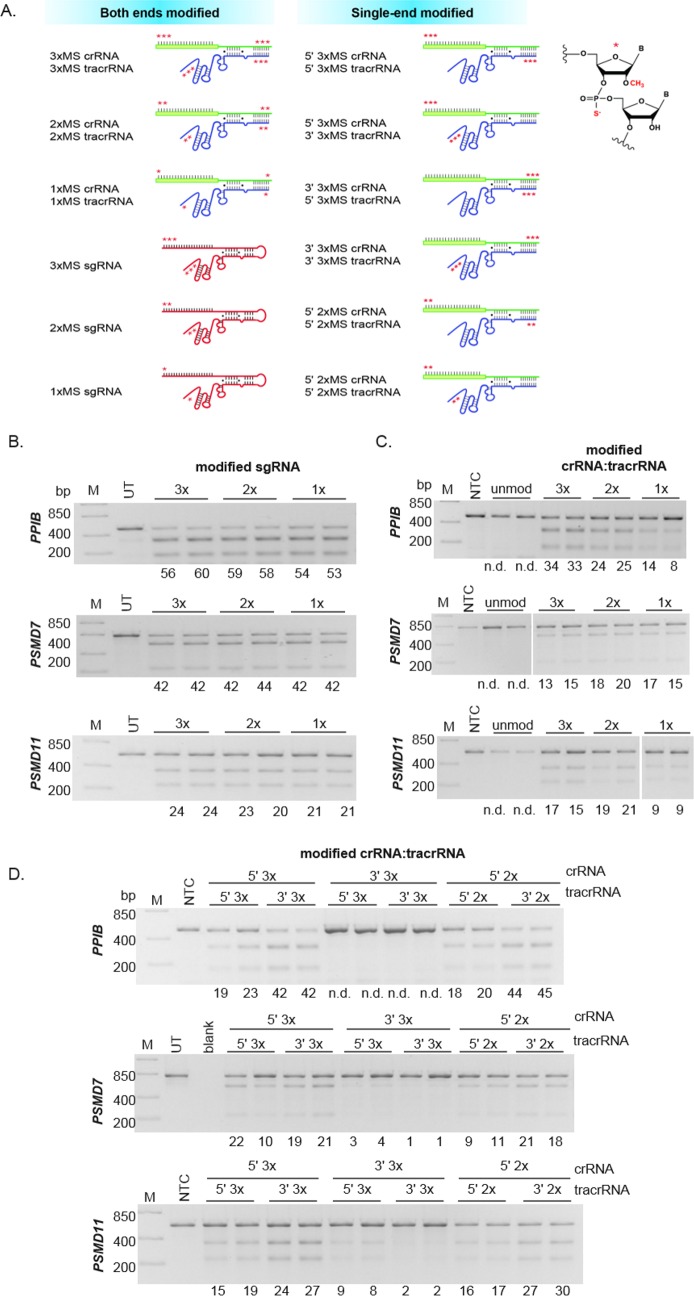
Fig 2. Minimal modification of guide RNA improves stability to increase gene editing efficiency with Cas9 mRNA in co-electroporation.
A. Modification patterns of synthetic sgRNA (100-mer), crRNA (42-mer) and tracrRNA (74-mer) with one to three 2’-O-methyl modifications with 3’ phosphorothioate linkages (MS, denoted with red *). 1x-3xMS modifications were added to both ends of crRNA, tracrRNA and sgRNA (left column) or the 5’ or 3’ end of crRNA and tracrRNA (right column) and tested in the different combinations shown. Unmodified and modified synthetic guide RNAs targeting genes PPIB, PSMD7 and PSMD11 were co-electroporated with Cas9 mRNA into K-562 cells (duplicate samples shown; B-D). B. Co-electroporation of Cas9 mRNA and 1x-3xMS-modified synthetic sgRNA all showed similar levels of gene editing as estimated from a DNA mismatch detection assay. C. Unmodified (unmod) crRNA:tracrRNA produced no detectable (n.d.) editing for any of the gene targets, while 1x-3xMS-modified crRNA and tracrRNA had detectable, but varying, levels of gene editing efficiencies. D. Single-end modifications on crRNA and tracrRNA indicated that modification of the 5’ end of crRNA is important for stability for efficient gene editing. The numbers under each gel image are percentage of gene editing. UT = Untreated; NTC = Non-targeting control, M = DNA ladder.
Fig 3
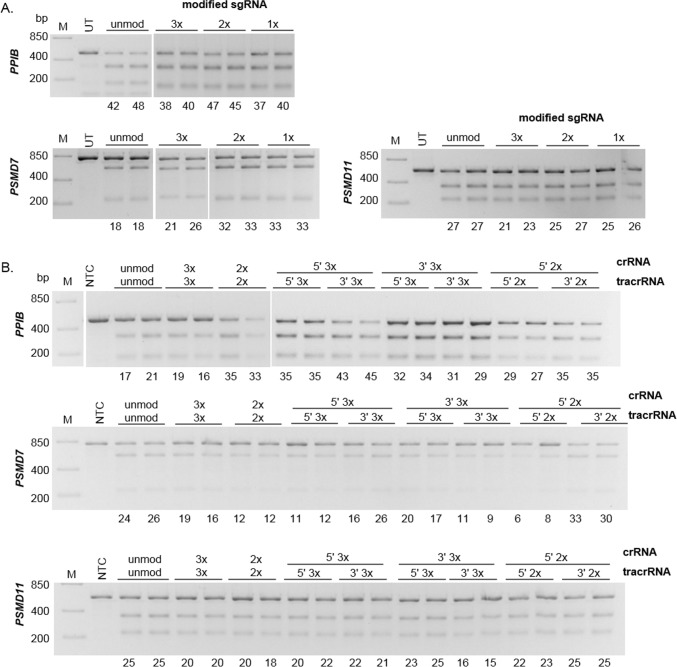
Fig 3. Addition of MS modifications on guide RNAs may improve gene editing efficiency with Cas9 protein in co-electroporation of RNPs.
Cas9 protein and unmodified or modified synthetic guide RNAs targeting PPIB, PSMD7 and PSMD11 were complexed and delivered as RNPs into K-562 cells using co-electroporation (duplicate samples shown). A. For most modification patterns, similar gene editing efficiencies were detected with both ends modified sgRNA when compared to unmodified (unmod) sgRNA; only one gene (PSMD7) showed increased (1.8-fold) gene editing with 1x-2xMS modifications. B. Co-electroporation of both ends and single-end modified crRNA:tracrRNA for genes PSMD7 and PSMD11 with Cas9 protein did not result in consistent increase or decrease in gene editing efficiencies compared to unmodified, but increased gene editing with some modification patterns targeting PPIB. The numbers under each gel image are percentage of gene editing. UT = Untreated, NTC = Non-targeting control, M = DNA ladder.
Fig 4
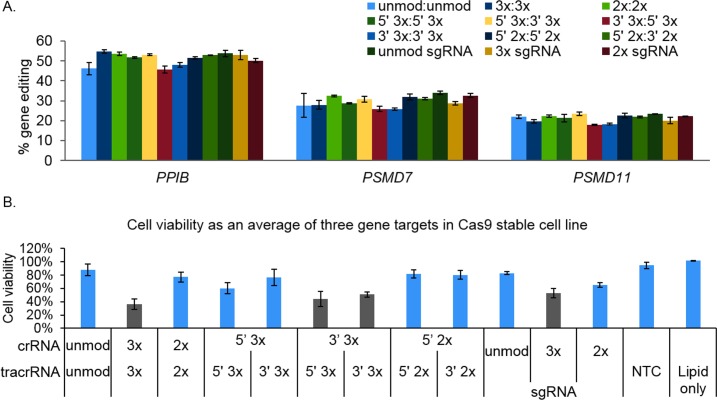
Fig 4. MS modifications of guide RNA produce similar gene editing efficiency to unmodified when lipid transfected into a stably expressing Cas9 cell line and some modification patterns are toxic to cells.
A. Gene editing efficiency of unmodified (unmod) and modified crRNA:tracrRNA or sgRNA showed similar levels of gene editing efficiencies (< 1.5-fold difference) for each gene when transfected into a stably expressing Cas9 U2OS cell line. Error bars are representative of biological triplicates. B. Average cell viability of unmodified or modified guide RNAs for all three genes resulted in a significant decrease in cell viability (< 60%) for some modification patterns (gray bars). NTC = Non-targeting control. Error bars are representative of the average of all three genes with the same modification pattern over two (PPIB) or three (PSMD7 and PSMD11) independent experiments.
Fig 5
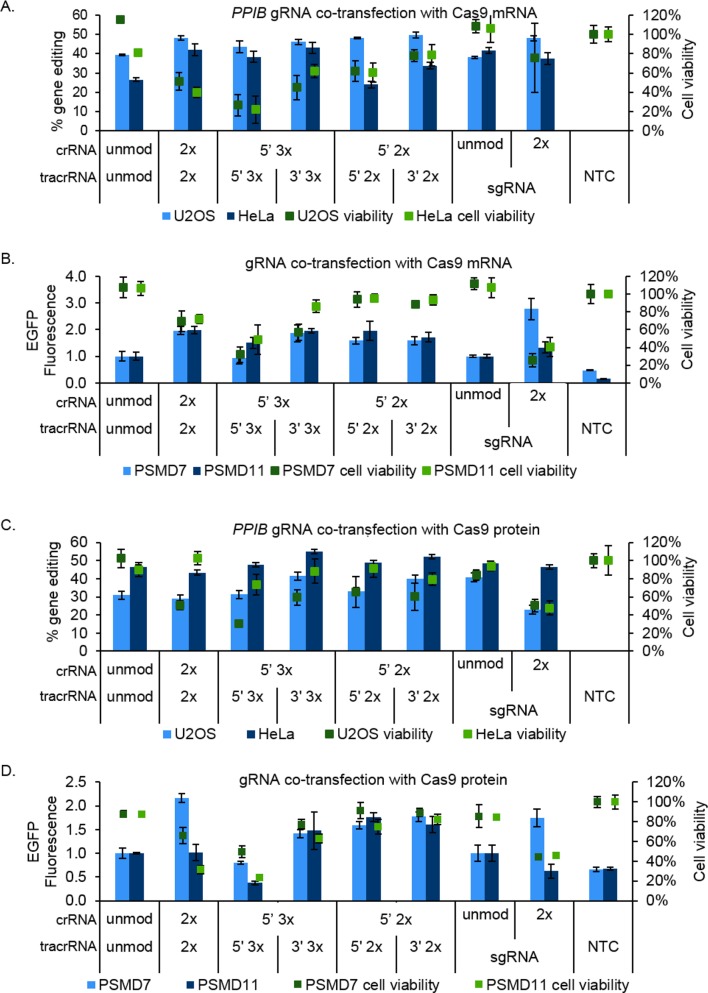
Fig 5. Modest improvement of gene editing efficiency with some MS-modified gRNAs was observed using Cas9 mRNA and Cas9 protein in lipid co-transfections.
Unmodified (unmod) and modified guide RNAs were co-transfected with Cas9 mRNA (A and B) or Cas9 protein (C and D). Gene editing efficiencies were estimated for PPIB-targeting guide RNAs in U2OS cells (light blue bars) and HeLa cells (dark blue bars; A and C). Functional gene knockout was quantified using a phenotypic analysis with PSMD7- (light blue bars) or PSMD11- (dark blue bars) targeting guide RNAs in a Ubi-EGFP U2OS cell line (B and D). Cell viability was assessed for each lipid transfection experiment: U2OS cells (dark green boxes) and HeLa cells (light green boxes; A and C) and PSMD7 (dark green boxes) and PSMD11 (light green boxes; B and D). NTC = Non-targeting control. Error bars representative of biological triplicates.

References

    1. Jinek M, Chylinski K, Fonfara I, Hauer M, Doudna JA, Charpentier E. A programmable dual-RNA-guided DNA endonuclease in adaptive bacterial immunity. Science. 2012. August;337(6096):816–21. doi: 10.1126/science.1225829 - DOI - PMC - PubMed
    1. Cong L, Ran FA, Cox D, Lin S, Barretto R, Habib N, et al. Multiplex Genome Engineering Using CRISPR/Cas Systems. Science. 2013. February 15;339(6121):819–23. doi: 10.1126/science.1231143 - DOI - PMC - PubMed
    1. Mali P, Yang L, Esvelt KM, Aach J, Guell M, DiCarlo JE, et al. RNA-guided human genome engineering via Cas9. Science. 2013. February;339(6121):823–6. doi: 10.1126/science.1232033 - DOI - PMC - PubMed
    1. Jinek M, East A, Cheng A, Lin S, Ma E, Doudna J. RNA-programmed genome editing in human cells. Weigel D, editor. Elife. 2013;2:e00471 doi: 10.7554/eLife.00471 - DOI - PMC - PubMed
    1. Karvelis T, Gasiunas G, Miksys A, Barrangou R, Horvath P, Siksnys V. crRNA and tracrRNA guide Cas9-mediated DNA interference in Streptococcus thermophilus. RNA Biol. 2013;10(5):841–51. doi: 10.4161/rna.24203 - DOI - PMC - PubMed