Review
. 2017 Nov 10:8:1541.
doi: 10.3389/fimmu.2017.01541. eCollection 2017.

The Dynamic Interplay between HIV-1, SAMHD1, and the Innate Antiviral Response

Affiliations
Review

The Dynamic Interplay between HIV-1, SAMHD1, and the Innate Antiviral Response

Jenna M Antonucci et al. Front Immunol. .

Abstract

The innate immune response constitutes the first cellular line of defense against initial HIV-1 infection. Immune cells sense invading virus and trigger signaling cascades that induce antiviral defenses to control or eliminate infection. Professional antigen-presenting cells located in mucosal tissues, including dendritic cells and macrophages, are critical for recognizing HIV-1 at the site of initial exposure. These cells are less permissive to HIV-1 infection compared to activated CD4+ T-cells, which is mainly due to host restriction factors that serve an immediate role in controlling the establishment or spread of viral infection. However, HIV-1 can exploit innate immune cells and their cellular factors to avoid detection and clearance by the host immune system. Sterile alpha motif and HD-domain containing protein 1 (SAMHD1) is the mammalian deoxynucleoside triphosphate triphosphohydrolase responsible for regulating intracellular dNTP pools and restricting the replication of HIV-1 in non-dividing myeloid cells and quiescent CD4+ T-cells. Here, we review and analyze the latest literature on the antiviral function of SAMHD1, including the mechanism of HIV-1 restriction and the ability of SAMHD1 to regulate the innate immune response to viral infection. We also provide an overview of the dynamic interplay between HIV-1, SAMHD1, and the cell-intrinsic antiviral response to elucidate how SAMHD1 modulates HIV-1 infection in non-dividing immune cells. A more complete understanding of SAMHD1's role in the innate immune response to HIV-1 infection may help develop stratagems to enhance its antiviral effects and to more efficiently block HIV-1 replication and avoid the pathogenic result of viral infection.

Keywords: HIV-1; infection; innate immunity; myeloid cells; sterile alpha motif and HD-domain containing protein 1.


Figures
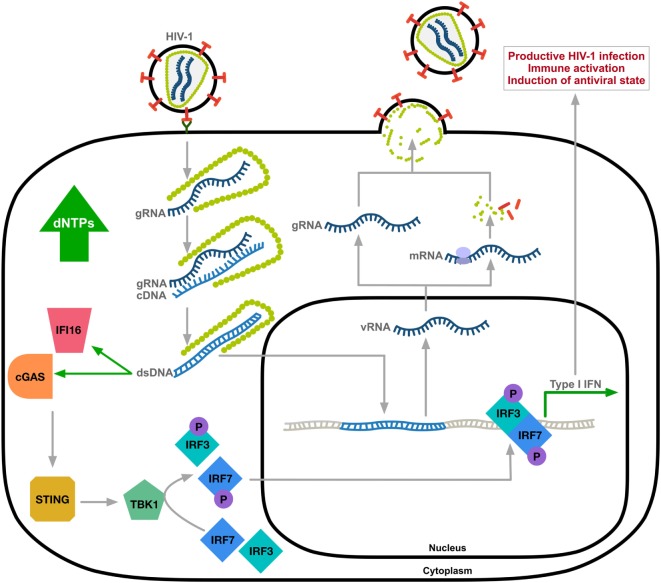
Figure 1
Figure 1
Innate immune sensing of HIV-1 DNA. HIV-1 undergoes uncoating through the interaction between viral capsid and host factors (31, 32). Reverse transcribed HIV-1 DNA, mainly abortive transcripts, activates cytosolic DNA sensors IFI16 and cyclic GMP-AMP synthase (cGAS) resulting in TANK-binding kinase 1 (TBK1)-mediated phosphorylation and nuclear translocation of hetero-or-homo dimers of interferon regulatory factor-3 (IRF3) and IRF7 and induction of type-I IFN response. Expression of ISGs allows for immune activation and the induction of an antiviral state of the cell. gRNA, HIV-1 genomic RNA; cDNA, complementary DNA; vRNA, viral RNA; dsDNA, double-stranded DNA; STING, stimulator of IFN genes; the letter P indicates phosphorylation.
Figure 2
Figure 2
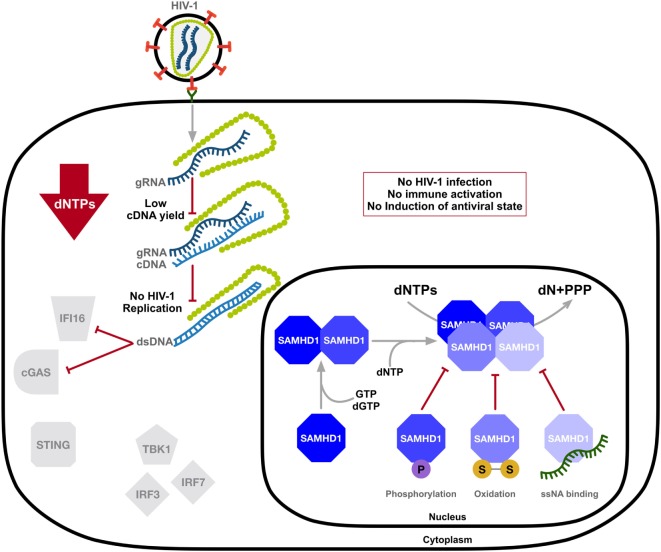
SAMHD1 negatively regulates the innate immune sensing of HIV-1 DNA. SAMHD1 blocks HIV-1 infection through intracellular dNTP depletion, thus preventing the accumulation of viral DNA accessible to sensing by IFI16 and cyclic GMP-AMP synthase (cGAS) and the activation of the type-I interferon (IFN-I) response. The dNTPase activity of SAMHD1 is structurally regulated. Consecutive binding of dGTP/GTP and any dNTP to two allosteric sites provokes formation of the catalytically active tetramer, which can be destabilized by phosphorylation, oxidation, or the binding of single-stranded nucleic acids (ssNAs). dN, deoxynucleosides; PPPs, triphosphate; two linked letters S indicate the disulfide bond.

References

    1. McNab F, Mayer-Barber K, Sher A, Wack A, O’Garra A. Type I interferons in infectious disease. Nat Rev Immunol (2015) 15:87–103. 10.1038/nri3787 - DOI - PMC - PubMed
    1. Chan YK, Gack MU. Viral evasion of intracellular DNA and RNA sensing. Nat Rev Microbiol (2016) 14:360–73. 10.1038/nrmicro.2016.45 - DOI - PMC - PubMed
    1. Gao D, Wu J, Wu YT, Du F, Aroh C, Yan N, et al. Cyclic GMP-AMP synthase is an innate immune sensor of HIV and other retroviruses. Science (2013) 341:903–6. 10.1126/science.1240933 - DOI - PMC - PubMed
    1. Jakobsen MR, Bak RO, Andersen A, Berg RK, Jensen SB, Tengchuan J, et al. IFI16 senses DNA forms of the lentiviral replication cycle and controls HIV-1 replication. Proc Natl Acad Sci U S A (2013) 110:E4571–80. 10.1073/pnas.1311669110 - DOI - PMC - PubMed
    1. Takeuchi O, Akira S. Pattern recognition receptors and inflammation. Cell (2010) 140:805–20. 10.1016/j.cell.2010.01.022 - DOI - PubMed