. 2017 Sep 25;3(10):e000134.
doi: 10.1099/mgen.0.000134. eCollection 2017 Oct.

Genome-guided identification of novel head-to-tail cyclized antimicrobial peptides, exemplified by the discovery of pumilarin

Affiliations

Genome-guided identification of novel head-to-tail cyclized antimicrobial peptides, exemplified by the discovery of pumilarin

Auke J van Heel et al. Microb Genom. .

Abstract

The need for novel antibiotics in an era where antimicrobial resistance is on the rise, and the number of new approved antimicrobial drugs reaching the market is declining, is evident. The underused potential of post-translationally modified peptides for clinical use makes this class of peptides interesting candidates. In this study, we made use of the vast amounts of available genomic data and screened all publicly available prokaryotic genomes (~3000) to identify 394 novel head-to-tail cyclized antimicrobial peptides. To verify these in silico results, we isolated and characterized a novel antimicrobial peptide from Bacillus pumilus that we named pumilarin. Pumilarin was demonstrated to have a circular structure and showed antimicrobial activity against several indicator strains, including pathogens.

Keywords: annotation; antimicrobial peptide; bacteriocin; circular peptide; genome-mining.


Figures
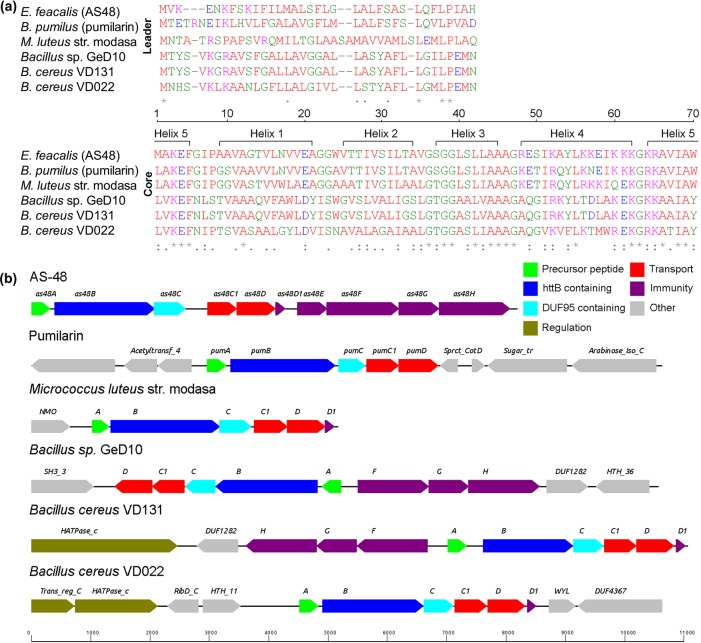
Fig. 1.
Fig. 1.
(a) Alignment of peptides identified with bagel3 that show similarity to enterocin AS-48 (top, leader peptides; bottom, core peptides). Pumilarin was identified in silico in B. pumilus B4107, B. pumilus BA06 BA_1113 (NZ_AMDH01000012.1, WP_017358050.1), B. pumilus S-1 scaffold28 (NZ_JH137674.1, WP_017358050.1), Bacillus sp. M 2–6 strain KACC 16563 241_9 (leader T2A) (NZ_AJWW01000009.1, WP_008342549.1). An asterisk (*) indicates a single, fully conserved residue. A colon (:) indicates conservation within groups of residues with strongly similar properties. A period (.) indicates conservation within groups of residues with weakly similar properties. (b) Gene clusters responsible for the production of (putative) head-to-tail cyclized peptides. Image created using Genome2d (http://genome2d.molgenrug.nl). Genes are named according to the AS-48 nomenclature, other names that are indicated are the pfam names of the pfam domains with the best hits.
Fig. 2.
Fig. 2.
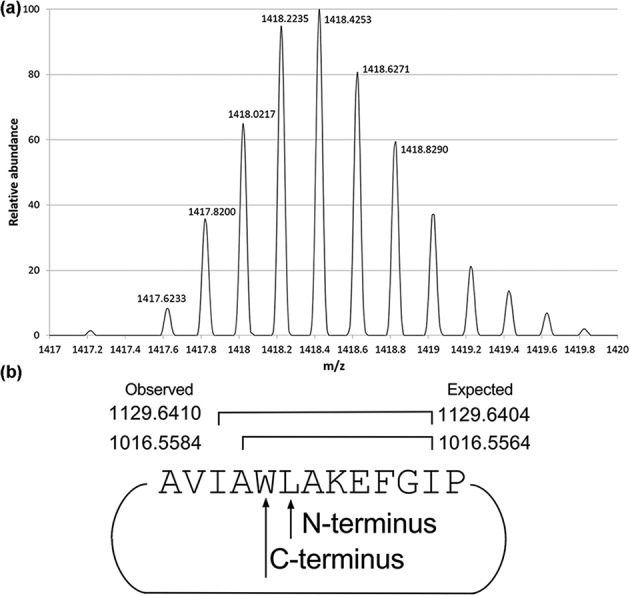
(a) The exact mass determination of pumilarin shown here is the (most prevalent) five times charged (since the difference between the isotope peaks in m/z is 0.2) variant. The theoretical mass of the protein is 7083.0694 (7105−18 the mass that is lost during cyclization), which is in line with the observed mass 7083.0768 [1417.6233×5 (five times charged)=7088.9−(5×1.00794)=7083.0768]. (b) Observed fragments connecting the N- and C-termini. The active purified protein pumilarin was further analysed by MS/MS. After the first MS step, pumilarin was selected and subsequently fragmented by CID and the mass of the resulting fragments was recorded in the second MS step. Depicted here are the observed fragments that contain the N- and C-termini of the antimicrobial protein in line with the circular nature of the compound (for full spectra see Tables S3 and S4; https://figshare.com/s/d318500f36414b4ccfe5).

References

    1. Arnison PG, Bibb MJ, Bierbaum G, Bowers AA, Bugni TS, et al. Ribosomally synthesized and post-translationally modified peptide natural products: overview and recommendations for a universal nomenclature. Nat Prod Rep. 2013;30:108–160. doi: 10.1039/C2NP20085F. - DOI - PMC - PubMed
    1. Maqueda M, Sánchez-Hidalgo M, Fernández M, Montalbán-López M, Valdivia E, et al. Genetic features of circular bacteriocins produced by gram-positive bacteria. FEMS Microbiol Rev. 2008;32:2–22. doi: 10.1111/j.1574-6976.2007.00087.x. - DOI - PubMed
    1. Gabrielsen C, Brede DA, Nes IF, Diep DB. Circular bacteriocins: biosynthesis and mode of action. Appl Environ Microbiol. 2014;80:6854–6862. doi: 10.1128/AEM.02284-14. - DOI - PMC - PubMed
    1. Alvarez-Sieiro P, Montalbán-López M, Mu D, Kuipers OP. Bacteriocins of lactic acid bacteria: extending the family. Appl Microbiol Biotechnol. 2016;100:2939–2951. doi: 10.1007/s00253-016-7343-9. - DOI - PMC - PubMed
    1. Montalbán-López M, Sánchez-Hidalgo M, Cebrián R, Maqueda M. Discovering the bacterial circular proteins: bacteriocins, cyanobactins, and pilins. J Biol Chem. 2012;287:27007–27013. doi: 10.1074/jbc.R112.354688. - DOI - PMC - PubMed

Publication types