Review
. 2017 Oct;33(5):358-366.
doi: 10.1159/000480383. Epub 2017 Oct 20.

Theranostics of Neuroendocrine Tumors

Affiliations
Review

Theranostics of Neuroendocrine Tumors

Sze Ting Lee et al. Visc Med. 2017 Oct.

Abstract

Somatostatin receptor positron emission tomography/computed tomography using 68Ga-labeled somatostatin analogs is the mainstay for the evaluation of receptor status in neuroendocrine tumors (NETs). This translates towards better therapy options, with increasing evidence of peptide receptor radionuclide therapy (PRRT) as the treatment of choice for advanced or progressive NETs. There are benefits in progression-free and overall survival as well as a significant improvement in clinical condition. In patients with progressive NETs, fractionated, personalized PRRT results in good therapeutic responses with no significant severe hematological and/or renal toxicity, thus improving quality of life.

Keywords: Diagnosis; Neuroendocrine tumor, NET; Peptide receptor radionuclide therapy, PRRT; Positron emission tomography/computed tomography, PET/CT; Theranostics.


Figures
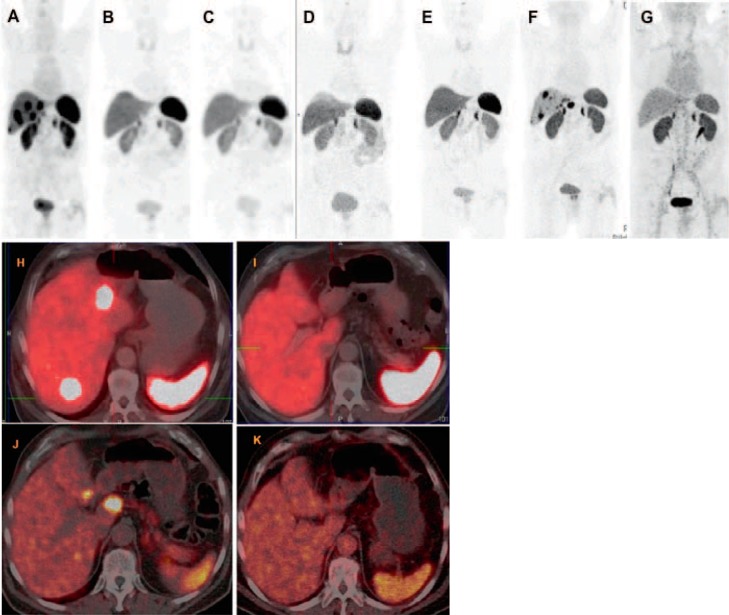
Fig. 1
Fig. 1
80-year-old male patient with grade I (Ki67 2%) well-differentiated, non-functioning neuroendocrine neoplasm at the rectosigmoid junction with extensive bilobar liver metastasis, diagnosed 6 years before, initial tumor stage cT3 pNx pM1 (HEP) stage IV, and immunohistochemical expression of chromogranin, synaptophysin, and somatostatin receptor (SSTR) IIa (in 60%). The first symptom at diagnosis was diarrhea with sonographic suspicion of liver metastases. Liver biopsy (performed at another hospital) demonstrated poorly differentiated adenocarcinoma; however, the primary tumor could not be detected by colonoscopy. Ga-68 SSTR positron emission tomography/computed tomography (PET/CT) identified an intensely SSTR-positive tumor at the rectosigmoid junction with multiple receptor-expressing hepatic metastases (maximum size 2 cm). There was no demonstrable glucose hypermetabolism in any of the tumor masses. Before referral to our center, the patient underwent systemic chemotherapy with FOLFOX and Avastin in addition to therapy with Sandostatin. There was progressive disease with continual increase in size of the liver metastases (to 3 and 3.4 cm 3 and 9 months after initiation of chemotherapy, respectively). Three cycles of Lu-177-based peptide receptor radionuclide therapy (PRRT) were administered (also based on a review of the histopathology which revealed neuroendocrine tumors), leading to a very good response with complete remission of the liver metastases and a significant decrease in the size (on CT) and SSTR expression (PET/CT) of the primary tumor. The patient was regularly followed up, i.e. every 9–12 months, with Ga-68 SSTR PET/CT. He had a progression-free interval of 4 years after which there were new SSTR-positive liver metastases. A second phase of PRRT (consisting of the 4th and 5th cycles) was administered, resulting again in an excellent response to PRRT with complete regression of the hepatic metastases. A–G PET maximum intensity projection images of Ga-68 SSTR PET/CT; H–K fused transverse PET/CT images; A, H before PRRT; B, K 4 months after the 3rd PRRT cycle; C–E 12, 24 and 36 months, respectively, after 3rd cycle of PRRT; F, J 48 months after the 3rd PRRT cycle a new hepatic progression was demonstrated; G, K once again complete remission of the liver metastases after a second phase of PRRT (4th and 5th cycles).
Fig. 2
Fig. 2
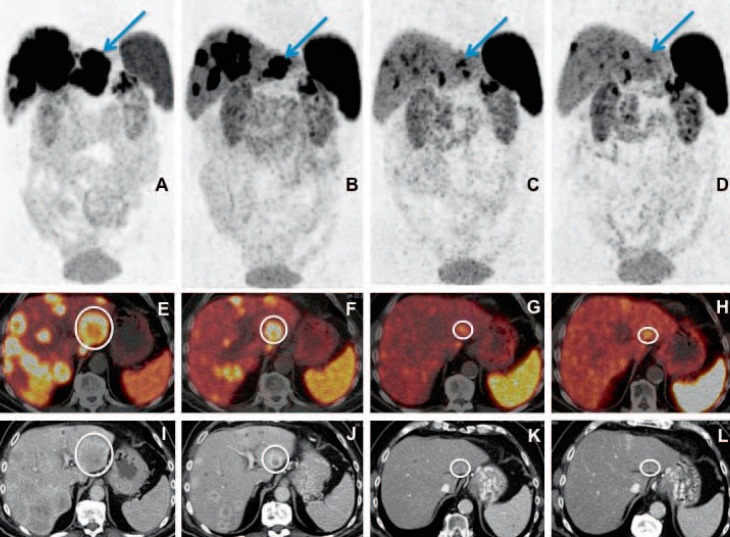
Well-differentiated, functioning neuroendocrine neoplasm G2 (Ki67 10%) of the pancreatic tail (glucagonoma) with extensive hepatic metastases (initial tumor stage IV) in a 72-year-old patient. Partial remission of disease after 4 cycles of DUO peptide receptor radionuclide therapy (PRRT) (first cycle with Y-90 and then successively using Lu-177) on Ga-68 somatostatin receptor positron emission tomography/computed tomography (PET/CT), according to both molecular and morphological imaging criteria with a significant decrease in number, size, and uptake of the multiple liver metastases as well as regression of the primary tumor in the pancreas. A–D Maximum intensity projection images of PET; E–H fused transverse PET/CT images; I–L contrast-enhanced CT images in transverse view; A, E, I PET/CT before PRRT; B, F, J PET/CT after 2 cycles of PRRT; C, G, K PET/CT 4 months after the 4th cycle of PRRT; D, H, L PET/CT 1 year after the 4th cycle of PRRT. A continuing significant decrease in size and uptake of the target lesion in segment 3 of the liver (marked by arrow in the top row and by a circle in the transverse PET/CT images) is demonstrated here after 2 and 4 PRRT cycles, as well as a further reduction in uptake (delayed response) on PET/CT 1 year after PRRT (D, H, L).
Fig. 3
Fig. 3
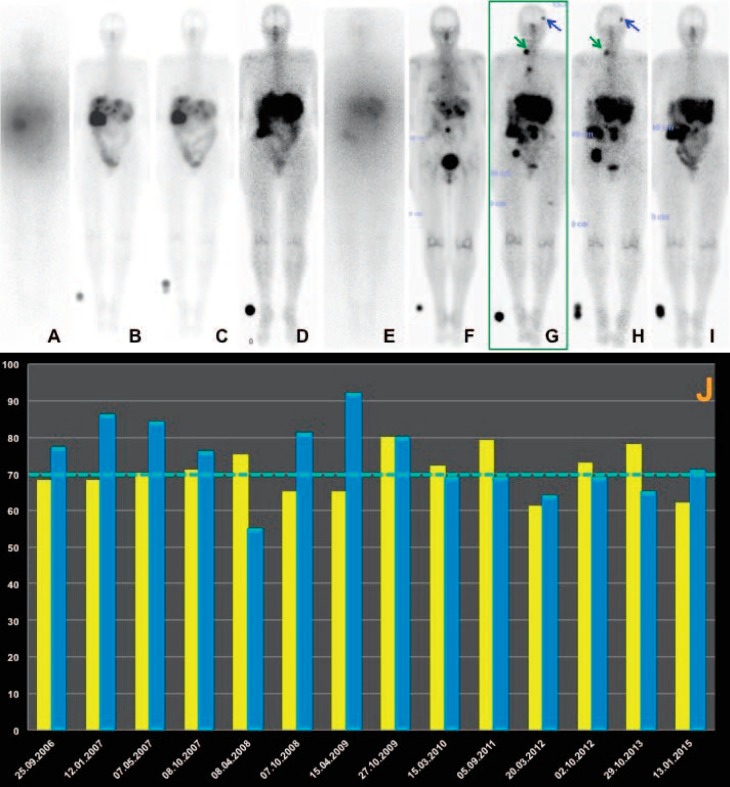
65-year-old patient with metastatic non-functioning pancreatic neuroendocrine tumor first diagnosed in 2006; status after laparotomy, appendectomy, and resection of metastases, 6 courses of chemotherapy with capecitabine, right hemihepatectomy, cholecystectomy, and adhesiolysis. A total of 9 cycles of DUO peptide receptor radionuclide therapy (PRRT) (A–I whole-body post-therapy scans in anterior view after 1–9 cycles, respectively) were administered over a period of almost 9 years. The first treatment phase (September 2006 until April 2008) consisted of 5 cycles, while the second phase (6th cycle) took place in November 2009, the third phase (7th cycle) in September 2011, the fourth phase (8th cycle) in July 2013, and the fifth phase (9th cycle) in February 2015. J There was no demonstrable significant renal toxicity over 9 years; i.e., the stable tubular extraction rate was determined by Tc-99m MAG3 scintigraphy (yellow graphs) and glomerular filtration rate, both given in percent (the dotted line indicates the normal limit, i.e. 70%), and was derived from using Tc-99m DTPA (blue graphs) with the single plasma sample method. In A the first and in E the fifth PRRT cycle Y-90 was used (the post-therapy scans appear hazy due to the poorer resolution of the Bremsstrahlung imaging), as compared to Lu-177 in the other cycles (B–D, F–I). Complete regression of the brain metastasis (blue arrow) and the right supraclavicular lymph node metastasis (green arrow) after the 7th and 8th PRRT cycle, as demonstrated in the post-therapy scan after the 9th PRRT cycle (I).

References

    1. Bosman FT, Carneiro F, Hruban RH, Theise ND. Lyon: IARC Press; 2010. WHO Classification of Tumors of the Digestive System.
    1. Phan AT, Öberg K, Choi J, et al. North American Neuroendocrine Tumor Society (NANETS) NANETS consensus guideline for the diagnosis and management of neuroendocrine tumors: well-differentiated neuroendocrine tumors of the thorax (includes lung and thymus) Pancreas. 2010;39:784–798. - PubMed
    1. Severi S, Grassi I, Nicolini S, et al. Peptide receptor radionuclide therapy in the management of gastrointestinal neuroendocrine tumors: efficacy profile, safety, and quality of life. Onco Targets Ther. 2017;10:551–557. - PMC - PubMed
    1. Kaemmerer D, Peter L, Lupp A, et al. Molecular imaging with 68Ga-SSTR PET/CT and correlation to immunohistochemistry of somatostatin receptors in neuroendocrine tumors. Eur J Nucl Med Mol Imaging. 2011;38:1659–1668. - PubMed
    1. Modlin IM, Pavel M, Kidd M, Gustafsson BI. Review article: somatostatin analogs in the treatment of gastroenteropancreatic neuroendocrine (carcinoid) tumors. Aliment Pharmacol Ther. 2010;31:169–188. - PubMed

LinkOut - more resources