Respiratory Function and Symptoms Post Cold Air Exercise in Female High and Low Ventilation Sport Athletes
- PMID: 29178677
- PMCID: PMC5705483
- DOI: 10.4168/aair.2018.10.1.43
Respiratory Function and Symptoms Post Cold Air Exercise in Female High and Low Ventilation Sport Athletes
Abstract
Purpose: Cold weather exercise is common in many regions of the world; however, it is unclear whether respiratory function and symptom worsen progressively with colder air temperatures. Furthermore, it is unclear whether high-ventilation sport background exacerbates dysfunction and symptoms.
Methods: Seventeen active females (measure of the maximum volume of oxygen [VO(2max)]: 49.6±6.6 mL·kg⁻¹·min⁻¹) completed on different days in random order 5 blinded running trials at 0°C, -5°C, -10°C, -15°C, and -20°C (humidity 40%) in an environmental chamber. Distance, heart rate, and rating of perceived exertion (RPE) were measured within each trial; forced expiratory volume in 1 second (FEV1), forced vital capacity (FVC), forced expiratory flow at 25%-75% (FEF₂₅₋₇₅), and forced expiratory flow at 50% (FEF₅₀) were measured pre- and post-test (3, 6, 10, 15, and 20 minutes). Respiratory symptoms and global effort were measured post-test spirometry.
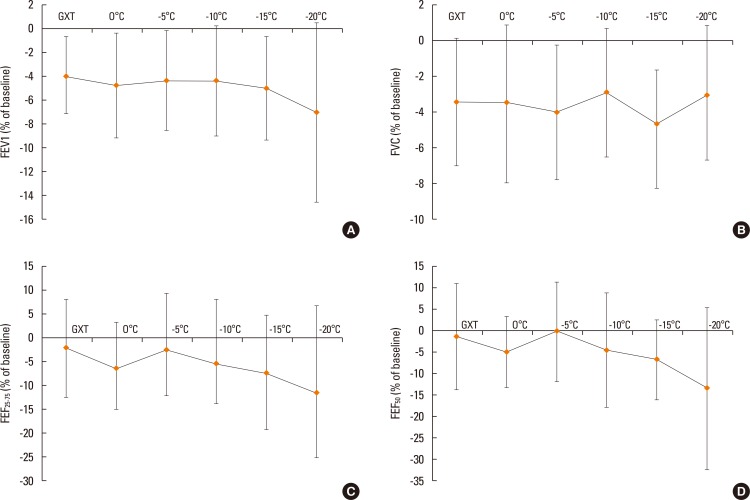
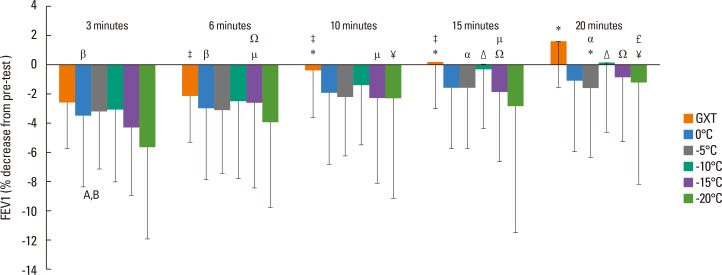
Results: Mean decreases were found in FEV1 (4%-5% at 0°C, -5°C, -10°C, and -15°C; 7% at -20°C). FEF₂₅₋₇₅ and FEF₅₀ decreased 7% and 11% at -15°C and -20°C, respectively. Post-exertion spirometry results were decreased most at 3 to 6 minutes, recovering back to baseline at 20 minutes. Respiratory symptoms and global effort significantly increased at -15°C and -20°C with decreased heart rate. High-ventilation sports decreased function more than low-ventilation participants but had fewer symptoms.
Conclusions: These results indicate that intense exercise at cold air temperatures up to -20°C is achievable; however, greater effort along with transient acute bronchoconstriction and symptoms of cough after exercising in temperatures colder than -15°C are likely. It is recommended that individuals cover their mouth and reduce exercise intensity to ameliorate the effects of cold weather exercise.
Keywords: Exercise-induced asthma; cold climate; cough; exercise-induced bronchospasm; extreme environments; spirometry.
Copyright © 2018 The Korean Academy of Asthma, Allergy and Clinical Immunology · The Korean Academy of Pediatric Allergy and Respiratory Disease
Conflict of interest statement
There are no financial or other issues that might lead to conflict of interest.
Figures
References
-
- Bergeron MF, Bahr R, Bärtsch P, Bourdon L, Calbet JA, Carlsen KH, et al. International Olympic Committee consensus statement on thermoregulatory and altitude challenges for high-level athletes. Br J Sports Med. 2012;46:770–779. - PubMed
-
- Carlsen KH. Sports in extreme conditions: the impact of exercise in cold temperatures on asthma and bronchial hyper-responsiveness in athletes. Br J Sports Med. 2012;46:796–799. - PubMed
-
- Koskela HO. Cold air-provoked respiratory symptoms: the mechanisms and management. Int J Circumpolar Health. 2007;66:91–100. - PubMed
-
- Quirion A, Laurencelle L, Paulin L, Therminarias A, Brisson GR, Audet A, et al. Metabolic and hormonal responses during exercise at 20 degrees, 0 degrees and -20 degrees C. Int J Biometeorol. 1989;33:227–232. - PubMed
-
- Larsson K, Tornling G, Gavhed D, Müller-Suur C, Palmberg L. Inhalation of cold air increases the number of inflammatory cells in the lungs in healthy subjects. Eur Respir J. 1998;12:825–830. - PubMed
LinkOut - more resources
Full Text Sources
Other Literature Sources
Miscellaneous