. 2018 Jan;10(1):62-76.
doi: 10.4168/aair.2018.10.1.62.

Detecting Allergens From Black Tiger Shrimp Penaeus monodon That Can Bind and Cross-link IgE by ELISA, Western Blot, and a Humanized Rat Basophilic Leukemia Reporter Cell Line RS-ATL8

Affiliations

Detecting Allergens From Black Tiger Shrimp Penaeus monodon That Can Bind and Cross-link IgE by ELISA, Western Blot, and a Humanized Rat Basophilic Leukemia Reporter Cell Line RS-ATL8

Thanyapat Jarupalee et al. Allergy Asthma Immunol Res. 2018 Jan.

Abstract

Background: Black tiger shrimp Penaeus monodon is one of the common causes of shellfish allergy that is increasing worldwide. One of the important problems in the management of shellfish allergy is the lack of accurate diagnostic assay because the biological and immunological properties of allergens in black tiger shrimp have not been well characterized. This study aims to detect proteins with the ability to bind and cross-link immunoglobulin E (IgE) from black tiger shrimp by enzyme-linked immunosorbent assay (ELISA), Western blot, and a humanized rat basophilic leukemia reporter cell line RS-ATL8.

Methods: Sera from shrimp allergic subjects were subjected to ELISA and Western blots using raw or cooked shrimp extract as antigens. Pooled sera were used to sensitize the RS-ATL8 reporter cell line and cells were activated by shrimp extract. Eluted protein extracts separated by sodium dodecyl sulfate polyacrylamide gel electrophoresis (SDS-PAGE) were tested on the RS-ATL8 cell line and subjected to mass spectrometry to identify potential candidate allergens.

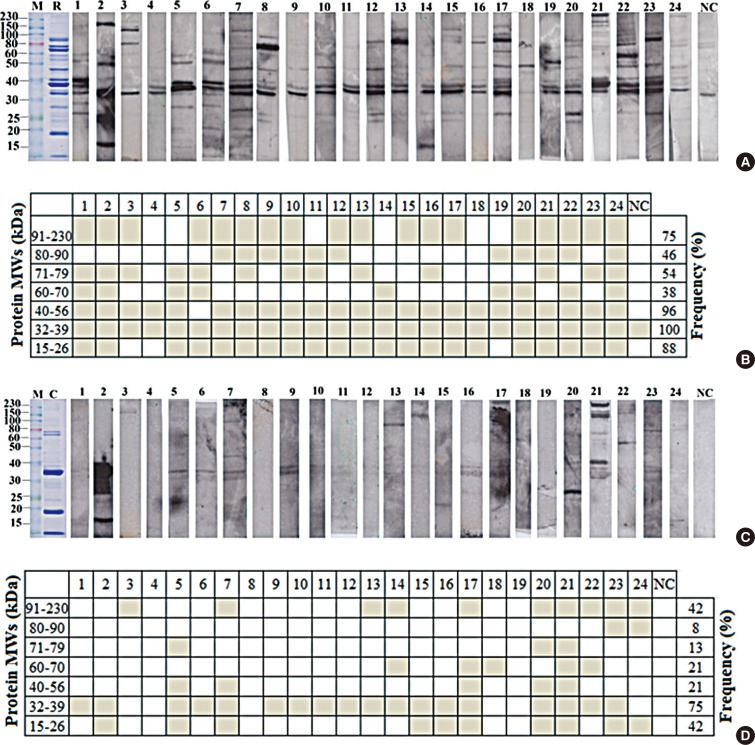
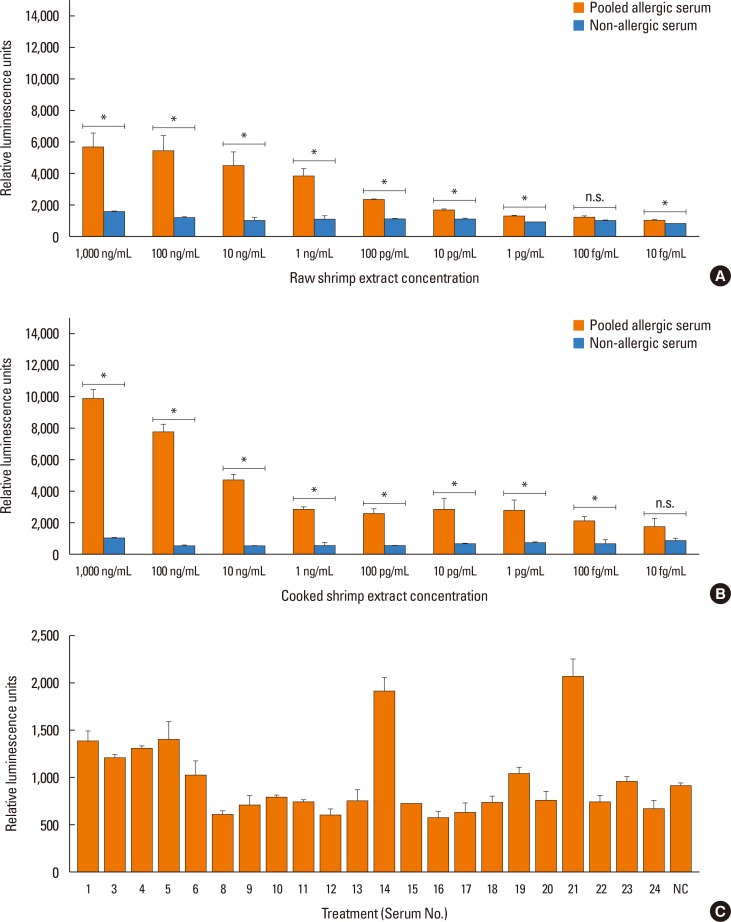
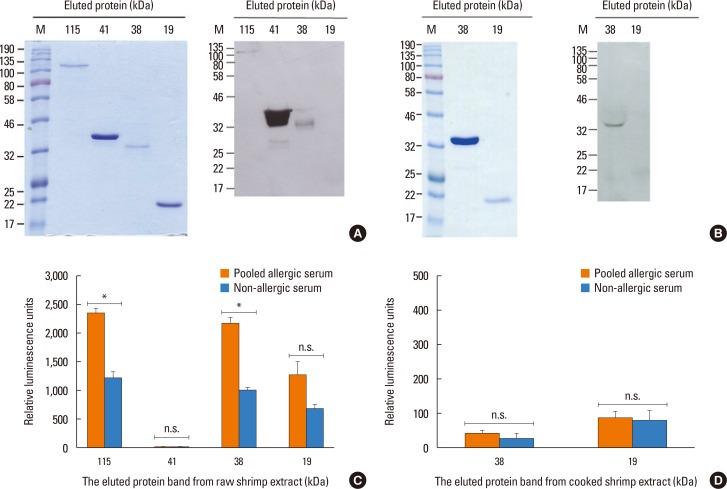
Results: Allergic sera reacted stronger to raw shrimp extract than cooked shrimp extract (P=0.009). Western blot demonstrated that major IgE reactivity protein bands were at 32-39 kDa and 91-230 kDa in both raw and cooked shrimp extracts. The eluted protein bands at the molecular weight of 38 and 115 kDa from raw shrimp extract induced IgE cross-linking as assayed by the RS-ATL8 cell line. These protein bands were subjected to mass spectrometry for analysis. Ubiquitin-activating enzyme and crustacyanin were identified as potential candidate novel shrimp allergens.

Conclusions: The RS-ATL8 reporter cell line can be used to identify potential new shrimp allergens that can functionally cross-link IgE and induce mast cell degranulation.

Keywords: IgE; Penaeus monodon; allergens; humanized basophilic leukaemia reporter cell.


Conflict of interest statement

There are no financial or other issues that might lead to conflict of interest.

Figures
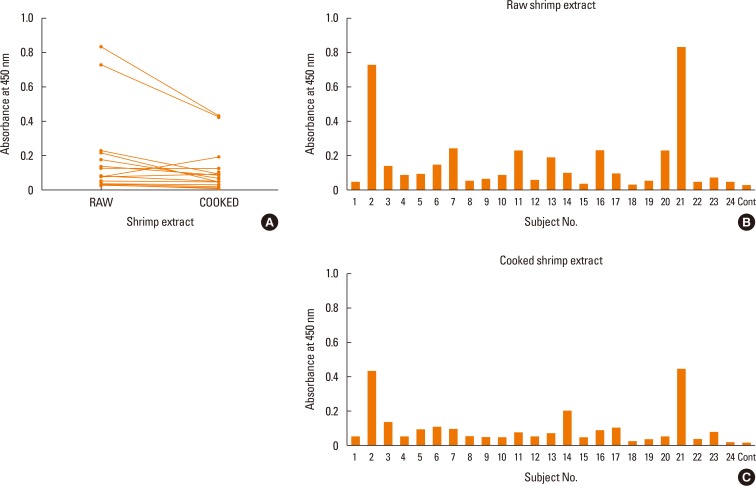
Fig. 1
Fig. 1. Serum IgE reactivity to cooked and raw shrimp extracts by indirect ELISA. (A) Serum IgE reactivity to raw and cooked shrimp extracts of shrimp allergic patients were compared by indirect ELISA. The Wilcoxon test was used to compare serum IgE reactivity between the raw and cooked shrimp extracts (P=0.009). (B, C) Serum IgE reactivity to raw (B) or cooked (C) shrimp extracts was detected by indirect ELISA. The concentration of shrimp extracts was 250 µg/mL. Allergic sera were diluted at 1:50. Patient sera were labeled with arbitrary numbers and the control non-allergic serum was labeled as cont. IgE, immunoglobulin E; ELISA, enzyme-linked immunosorbent assay.
Fig. 2
Fig. 2. Sera IgE reactivity patterns and the frequency of reactivity to raw and cooked shrimp extracts by Western blot. (A, C) All sera were diluted at 1:100. SDS-PAGE and Coomassie blue staining of raw and cooked extracts are shown as Lane R (raw shrimp extract) and Lane C (cooked shrimp extract). Serum from non-allergic healthy control was marked as NC. (B, D) The frequencies of specific sera IgE reactive to raw or cooked shrimp extract by Western blot in (A) and (C) are calculated and shown. The gray boxes indicate the patient sera reacting positively with the proteins with the indicated molecular weight range. IgE, immunoglobulin E; SDS-PAGE, sodium dodecyl sulfate polyacrylamide gel electrophoresis; NC, control non-allergic serum.
Fig. 3
Fig. 3. Reporter assay for the RS-ATL8 reporter cell line against shrimp extracts (A, B) RS-ATL8 cells were sensitized overnight with diluted pooled sera (1:100) from shrimp allergic patients and non-allergic healthy control serum. Cells were stimulated with (A) raw or (B) cooked shrimp extracts. Pooled allergic sera are shown by the gray bars and non-allergic healthy control serum is shown by the black bars. Data are expressed as mean±SD of the readings of triplicates. (C) The RS-ATL8 cells were sensitized overnight with individual shrimp allergic serum and stimulated with 1 µg/mL raw shrimp extract. Luminescence was measured 3 hours after stimulation. Data are expressed as mean±SD of the readings of triplicates. n.s., not significant difference; SD, standard deviation; NC, control non-allergic serum. *P<0.05.
Fig. 4
Fig. 4. Detection of the excised protein bands from raw and cooked shrimp extracts by Western blot and the RS-ATL8 reporter cell line. (A) The excised protein bands of raw shrimp extract (19, 38, 41, and 115 kDa) were analyzed by SDS-PAGE and Coomasie blue staining (left panel). The eluted proteins were detected by pooled allergic sera IgE by Western blot (right panel). (B) The excised protein band of cooked shrimp extract (19 and 38 kDa) were analyzed by SDS-PAGE and Coomasie blue staining (left panel). The eluted proteins were detected by pooled allergic sera IgE by Western blot (right panel). (C and D) RS-ATL 8 cells were sensitized overnight with diluted pooled sera (1:100) from shrimp allergic patient and non-allergic healthy control serum. Cells were stimulated with eluted protein bands of raw (C) and cooked shrimp extracts (D) as shown above. The results of pooled allergic serum are shown in the gray bars and non-allergic healthy control serum are shown in black bars. Data are expressed as mean±SD in triplicates. SDS-PAGE, sodium dodecyl sulfate polyacrylamide gel electrophoresis; IgE, immunoglobulin E; SD, standard deviation; n.s., no statistical significance. *P<0.05.
Fig. 5
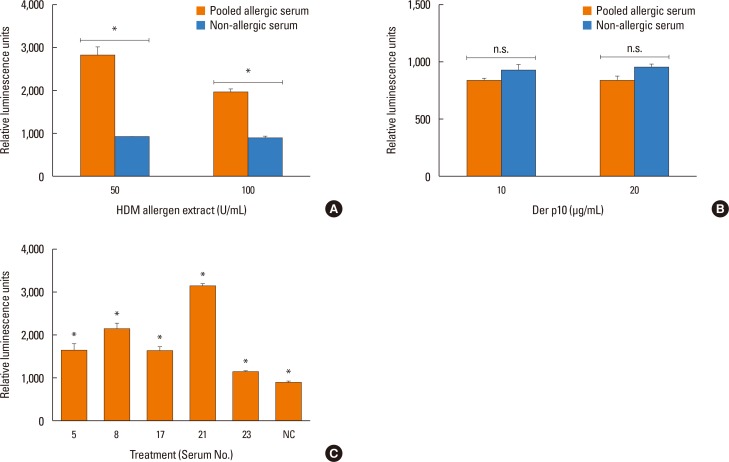
Fig. 5. Detection of dust mite allergens by the RS-ATL8 reporter cell line. (A, B) RS-ATL8 cells were sensitized overnight with diluted pooled sera (1:100) from shrimp allergic patient and non-allergic healthy control serum. Cells were stimulated with HDM allergen extract (A) or purified recombinant Der p10 (B). The results of pooled allergic serum are shown in the gray bars, and non-allergic healthy control serum are shown in black bars. Data are expressed as mean±SD in triplicates. (C) RS-ATL8 cells were sensitized overnight with diluted individual sera (1:100) from shrimp allergic patients and non-allergic healthy control serum. Cells were stimulated with HDM allergen extract (100 U/mL). HDM, house dust mite; n.s., no statistical significance; SD, standard deviation. *P<0.05.
Fig. 6
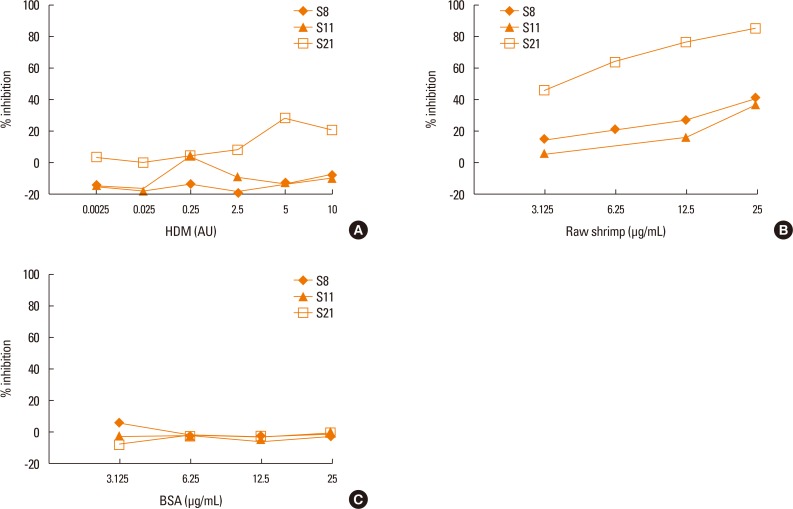
Fig. 6. Competitive ELISA inhibition assay using HDM extract. Competitive ELISA assay was performed using raw shrimp extract as a coated antigen and various concentrations of BSA (A), raw shrimp extract (B) or HDM extract (C) as competitors. Sera from 3 different patients were included. The level of inhibition (%) was calculated. ELISA, enzyme-linked immunosorbent assay; HDM, house dust mite; BSA, bovine serum albumin.

References

    1. Sicherer SH. Food allergy. Lancet. 2002;360:701–710. - PubMed
    1. Lee AJ, Thalayasingam M, Lee BW. Food allergy in Asia: how does it compare? Asia Pac Allergy. 2013;3:3–14. - PMC - PubMed
    1. Daul CB, Morgan JE, Hughes J, Lehrer SB. Provocation-challenge studies in shrimp-sensitive individuals. J Allergy Clin Immunol. 1988;81:1180–1186. - PubMed
    1. Bernstein IL, Li JT, Bernstein DI, Hamilton R, Spector SL, Tan R, et al. Allergy diagnostic testing: an updated practice parameter. Ann Allergy Asthma Immunol. 2008;100:S1–S148. - PubMed
    1. Musmand JJ, Daul CB, Lehrer SB. Crustacea allergy. Clin Exp Allergy. 1993;23:722–732. - PubMed