


Depression comorbid with tuberculosis and its impact on health status: cross-sectional analysis of community-based data from 48 low- and middle-income countries
- PMID: 29179720
- PMCID: PMC5704363
- DOI: 10.1186/s12916-017-0975-5
Depression comorbid with tuberculosis and its impact on health status: cross-sectional analysis of community-based data from 48 low- and middle-income countries
Abstract
Background: Depression in tuberculosis increases the risk for adverse health outcomes. However, little is known about comorbid depression and tuberculosis in the general population. Thus, we assessed the association between depression and tuberculosis, and the decrements in health status associated with this comorbidity in 48 low- and middle-income countries.
Methods: Cross-sectional, community-based data from the World Health Survey on 242,952 individuals aged ≥ 18 years were analyzed. Based on the World Mental Health Survey version of the Composite International Diagnostic Interview, past 12-month depression was categorized into depressive episode, brief depressive episode, subsyndromal depression, and no depression. Health status across six domains (cognition, interpersonal activities, sleep/energy, self-care, mobility, pain/discomfort) was assessed. Multivariable logistic and linear regression analyses were performed to assess the associations.
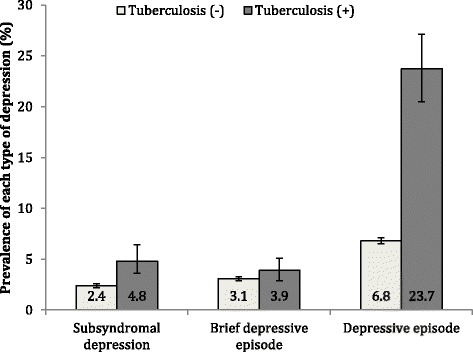
Results: The prevalence of depressive episode among those with and without tuberculosis was 23.7% and 6.8%, respectively (P < 0.001). Tuberculosis was associated with a 1.98 (95% CI 1.47-2.67), 1.75 (95% CI 1.26-2.42), and 3.68 (95% CI 3.01-4.50) times higher odds for subsyndromal depression, brief depressive episode, and depressive episode, respectively. Depressive episode co-occurring with tuberculosis was associated with significantly worse health status across all six domains compared to tuberculosis alone. Interaction analysis showed that depression significantly amplifies the association between TB and difficulties in self-care but not in other health domains.
Conclusions: Depression is highly prevalent in adults with tuberculosis, and is associated with worse health status compared to tuberculosis without depression. Public health efforts directed to the recognition and management of depression in people with tuberculosis may lead to better outcomes.
Keywords: Depression; Epidemiology; Low- and middle-income countries; Tuberculosis.
Conflict of interest statement
Ethics approval and consent to participate
Ethical approval was obtained from each of the following committees in the respective countries for the World Health Survey:
Consent for publication
Not applicable.
Competing interests
The authors declare that they have no competing interests.
Publisher’s Note
Springer Nature remains neutral with regard to jurisdictional claims in published maps and institutional affiliations.
Figures
References
-
- World Health Organization. Tuberculosis. http://www.who.int/mediacentre/factsheets/fs104/en/. Accessed 27 July 2017.
MeSH terms
LinkOut - more resources
Full Text Sources
Other Literature Sources
Medical
Miscellaneous
