. 2017 Nov 27;7(1):16419.
doi: 10.1038/s41598-017-16346-w.

Food availability drives plastic self-repair response in a basal metazoan- case study on the ctenophore Mnemiopsis leidyi A. Agassiz 1865

Affiliations

Food availability drives plastic self-repair response in a basal metazoan- case study on the ctenophore Mnemiopsis leidyi A. Agassiz 1865

Katharina Tissy Bading et al. Sci Rep. .

Abstract

Many marine invertebrates including ctenophores are capable of extensive body regeneration when injured. However, as for the invasive ctenophore Mnemiopsis leidyi, there is a constant subportion of individuals not undergoing whole body regeneration but forming functionally stable half-animals instead. Yet, the driving factors of this phenomenon have not been addressed so far. This study sheds new light on how differences in food availability affect self-repair choice and regeneration success in cydippid larvae of M. leidyi. As expected, high food availability favored whole-body regeneration. However, under low food conditions half-animals became the preferential self-repair mode. Remarkably, both regenerating and half-animals showed very similar survival chances under respective food quantities. As a consequence of impaired food uptake after injury, degeneration of the digestive system would often occur indicating limited energy storage capacities. Taken together, this indicates that half-animals may represent an alternative energy-saving trajectory which implies self-repair plasticity as an adaptive trade-off between high regeneration costs and low energy storage capacities. We conclude that self-repair plasticity could lead to higher population fitness of ctenophores under adverse conditions such as in ships' ballast water tanks which is postulated to be the major vector source for the species' spreading around the globe.


Conflict of interest statement

This work was supported by the German Academic Exchange Service (DAAD), the Kölner Gymnasial und Studienstiftung. CJ received financial support from the Danish Council for Independent Research/European Commission – Marie-Curie Program (DFF-MOBILEX mobility grant number DFF-1325–00102B). Other authors do not have any competing financial interest to declare.

Figures
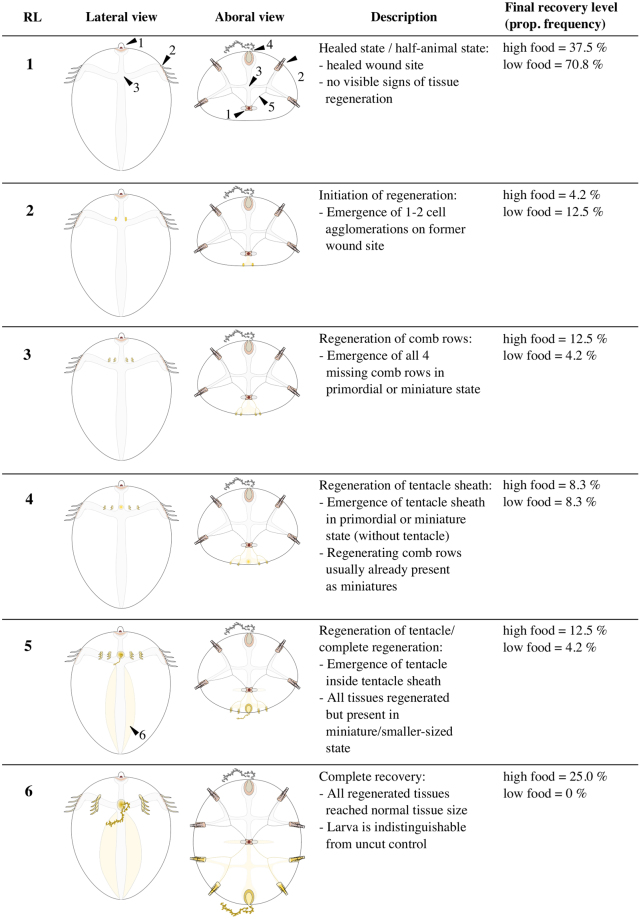
Figure 1
Figure 1
Schematic overview of whole-body regeneration in larval M. leidyi bisected through the esophageal plane with retained apical organ. Recovery levels were categorized according to distinct qualitative morphological recovery stages which are linked to distinct body score ranges/levels (see Fig. 2). For simplicity, tissues on the opposite body side were not depicted in lateral view. Abbreviations: recovery level (RL), proportional (prop) frequency, body score (BS), apical organ (1), comb row tissue (2), gastro-vascular system, i.e. gut and endodermal canals (3), tentacle apparatus, i.e. sheath and retractable tentacle (4), ciliated grooves connecting apical organ with comb row tissues (5), esophageal disc (6). Total n = 24 for both food levels.
Figure 2
Figure 2
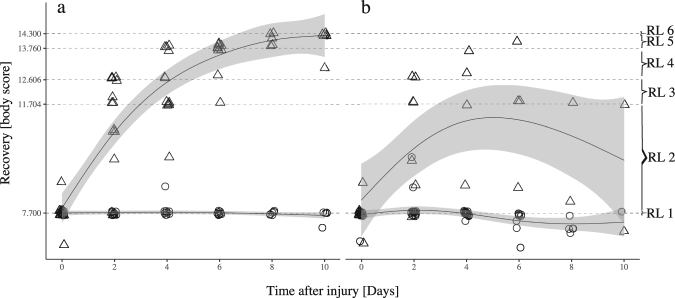
Recovery course over time under different food quantities based on a morphological body score assessment. (a) high and (b) low food quantity treatments. Initial body score after bisection (day 0) was around 7.7. Body score ranges and thresholds represent the six distinct morphological recovery levels (RL) according to Fig. 1. Generalized additive models (GAM) were used to fit the data of regenerating (triangle) and half-animals (circle) juveniles. Smoothers (method = GAM, formula = y ~ s(x, k = 5) were fitted using 95% confidence intervals.
Figure 3
Figure 3
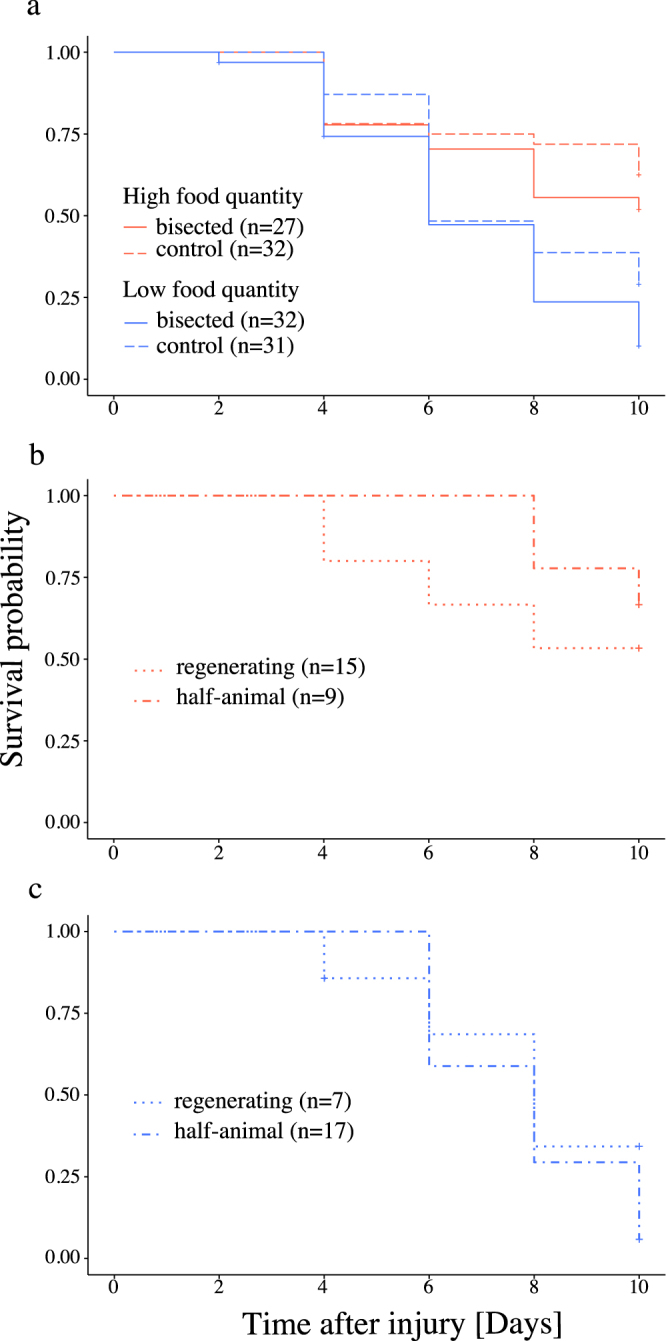
Survival curves based on Kaplan-Meier estimates of regenerating animals, half-animals and intact controls under different food quantity. (a) Comparison between bisected juveniles and intact controls under different food supply level. Comparison between ‘regenerating’ and ‘half-animals’ juveniles under high (b) and low (c) food supply. Cross signs indicate censored observations.

References

    1. Alvarado AS. Regeneration in the metazoans: why does it happen? BioEssays. 2000;22:578–590. doi: 10.1002/(SICI)1521-1878(200006)22:6<578::AID-BIES11>3.0.CO;2-#. - DOI - PubMed
    1. Brockes J, Kumar A, Velloso CP. Regeneration as an evolutionary variable. J. Anat. 2001;199:3–11. doi: 10.1046/j.1469-7580.2001.19910003.x. - DOI - PMC - PubMed
    1. Alvarado AS, Tsonis PA. Bridging the regeneration gap: genetic insights from diverse animal models. Nat. Rev. Genet. 2006;7:873–884. doi: 10.1038/nrg1923. - DOI - PubMed
    1. Bely AE, Nyberg KG. Evolution of animal regeneration: re-emergence of a field. Trends Ecol. Evol. 2010;25:161–170. doi: 10.1016/j.tree.2009.08.005. - DOI - PubMed
    1. Lindsay SM. Frequency of Injury and the Ecology of Regeneration in Marine Benthic Invertebrates. Integr. Comp. Biol. 2010;50:479–493. doi: 10.1093/icb/icq099. - DOI - PubMed