. 2017 Nov 27;7(1):16376.
doi: 10.1038/s41598-017-16233-4.

Prediction of postoperative outcomes using intraoperative hemodynamic monitoring data

Affiliations

Prediction of postoperative outcomes using intraoperative hemodynamic monitoring data

Varesh Prasad et al. Sci Rep. .

Abstract

Major surgeries can result in high rates of adverse postoperative events. Reliable prediction of which patient might be at risk for such events may help guide peri- and postoperative care. We show how archiving and mining of intraoperative hemodynamic data in orthotopic liver transplantation (OLT) can aid in the prediction of postoperative 180-day mortality and acute renal failure (ARF), improving upon predictions that rely on preoperative information only. From 101 patient records, we extracted 15 preoperative features from clinical records and 41 features from intraoperative hemodynamic signals. We used logistic regression with leave-one-out cross-validation to predict outcomes, and incorporated methods to limit potential model instabilities from feature multicollinearity. Using only preoperative features, mortality prediction achieved an area under the receiver operating characteristic curve (AUC) of 0.53 (95% CI: 0.44-0.78). By using intraoperative features, performance improved significantly to 0.82 (95% CI: 0.56-0.91, P = 0.001). Similarly, including intraoperative features (AUC = 0.82; 95% CI: 0.66-0.94) in ARF prediction improved performance over preoperative features (AUC = 0.72; 95% CI: 0.50-0.85), though not significantly (P = 0.32). We conclude that inclusion of intraoperative hemodynamic features significantly improves prediction of postoperative events in OLT. Features strongly associated with occurrence of both outcomes included greater intraoperative central venous pressure and greater transfusion volumes.


Conflict of interest statement

The authors declare that they have no competing interests.

Figures
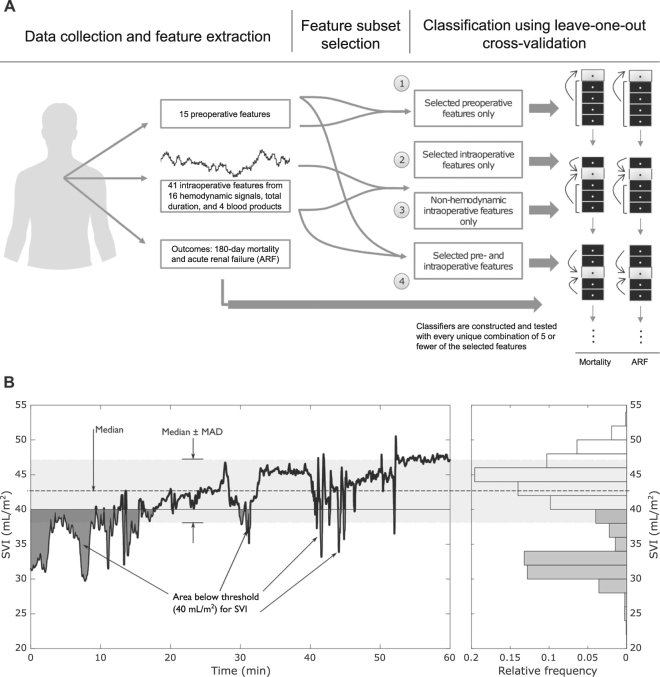
Figure 1
Figure 1
(A) Overview of data collection and outcome prediction procedure. Data were collected and extracted from medical records and intraoperative hemodynamic monitors. Prediction of each outcome was carried out in four separate tasks with different groups of features after performing subset selection within each feature group. In each task, logistic regression classifiers were constructed with every combination of 5 or fewer features and leave-one-out cross-validation was used for training and testing. (B) Illustration of the three features extracted from each continuously computed hemodynamic signal. In addition to the median and median absolute deviation (MAD), the integrated area of the signal relative to a normal threshold (either above or below the threshold) was computed. For the stroke volume index (SVI) signal here, the area below 40 mL/m2 was computed. Left: a 60-minute portion of one patient’s SVI waveform. Right: the histogram of this signal’s values.
Figure 2
Figure 2
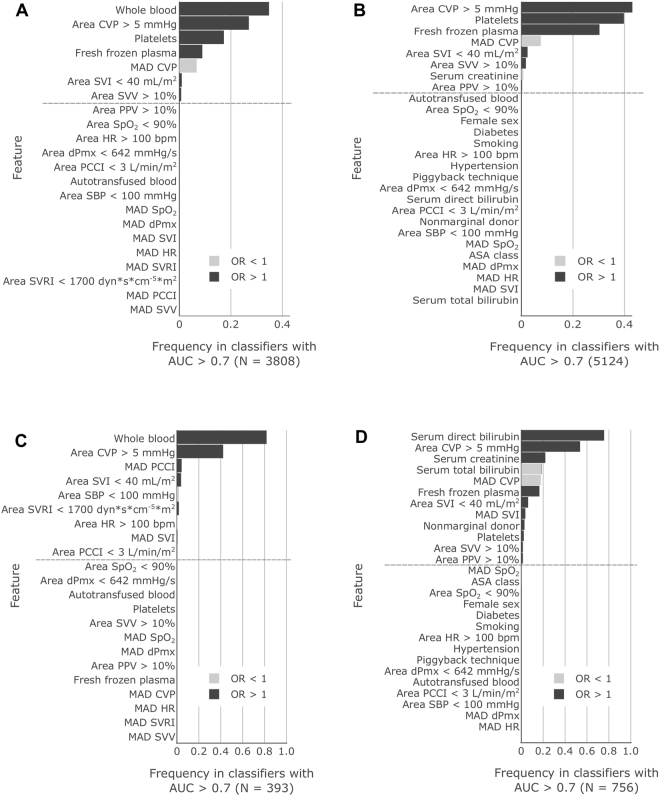
Frequency that features are included at a significant level (P < 0.05) in classifiers with AUC greater than 0.7. (A) Results from 180-day mortality classifiers that used only intraoperative features and (B) that used both pre- and intraoperative features. (C) Results from ARF classifiers that used only intraoperative features and (D) that used both pre- and intraoperative features. Dark shading indicates the fraction of classifiers in which the feature was included with odds ratio (OR) greater than 1 and light shading indicates OR less than 1. The monotone nature of each bar’s shading indicates that features always had ORs on the same side of 1, i.e., they were always associated with risk in the same direction. Features below the dashed line were never included at a significant level.

References

    1. De Hert S, et al. Preoperative evaluation of the adult patient undergoing non-cardiac surgery. Eur. J. Anaesthesiol. 2011;28:684–722. doi: 10.1097/EJA.0b013e3283499e3b. - DOI - PubMed
    1. Liu LL, Niemann CU. Intraoperative management of liver transplant patients. Transplant. Rev. 2011;25:124–129. doi: 10.1016/j.trre.2010.10.006. - DOI - PubMed
    1. Bennett-Guerrero E, et al. Preoperative and intraoperative predictors of postoperative morbidity, poor graft function, and early rejection in 190 patients undergoing liver transplantation. Arch. Surg. 2001;136:1177–1183. doi: 10.1001/archsurg.136.10.1177. - DOI - PubMed
    1. Klein KB, Stafinski TD, Menon D. Predicting survival after liver transplantation based on pre-transplant MELD score: a systematic review of the literature. PLoS One. 2013;8:e80661–e80665. doi: 10.1371/journal.pone.0080661. - DOI - PMC - PubMed
    1. Brandão A, et al. MELD and other predictors of survival after liver transplantation. Clin. Transplant. 2009;23:220–227. doi: 10.1111/j.1399-0012.2008.00943.x. - DOI - PubMed

Publication types

LinkOut - more resources