. 2017 Nov 27;7(1):16429.
doi: 10.1038/s41598-017-16771-x.

Immobilized Cerrena sp. laccase: preparation, thermal inactivation, and operational stability in malachite green decolorization

Affiliations

Immobilized Cerrena sp. laccase: preparation, thermal inactivation, and operational stability in malachite green decolorization

Jie Yang et al. Sci Rep. .

Abstract

Laccases are polyphenol oxidases with widespread applications in various industries. In the present study, the laccase from Cerrena sp. HYB07 was immobilized with four methods, namely entrapment in alginate, covalently binding to chitosan as well as formation of cross-linked enzyme aggregates (CLEAs) and magnetic CLEAs (M-CLEAs). The activity recovery rates of the immobilized laccases ranged from 29% to 68%. Immobilization elevated the reaction temperature optimum and reduced substrate specificity, but not necessarily the turnover rate. pH stability of immobilized laccases was improved compared with that of the free laccase, especially at acidic pH values. Thermal inactivation of all laccases followed a simple first-order exponential decay model, and immobilized laccases displayed higher thermostability, as manifested by lower thermal inactivation rate constants and longer enzyme half-life time. Operational stability of the immobilized laccase was demonstrated by decolorization of the triphenylmethane dye malachite green (MG) at 60 °C. MG decolorization with free laccase was accompanied by a shift of the absorption peak and accumulation of a stable, colored intermediate tetradesmethyl MG, probably due to lower thermostability of the free laccase and premature termination of the degradation pathway. In contrast, complete decolorization of MG was achieved with laccase CLEAs at 60 °C.


Conflict of interest statement

The authors declare that they have no competing interests.

Figures

Figure 1
Figure 1
Effect of pH on stability of free and immobilized laccases.
Figure 2
Figure 2
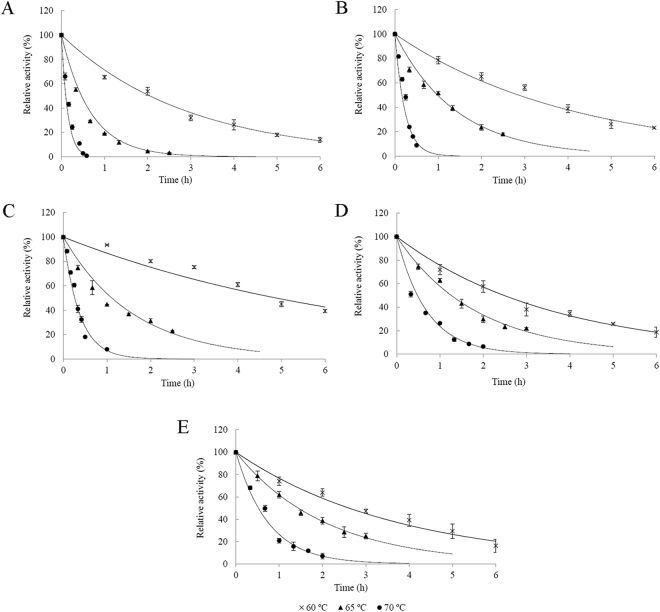
Thermostability of free and immobilized laccases. (A) Free laccase; (B) laccase CLEAs; (C) laccase M-CLEAs; (D) entrapped laccase; (E) chitosan-bound laccase.
Figure 3
Figure 3
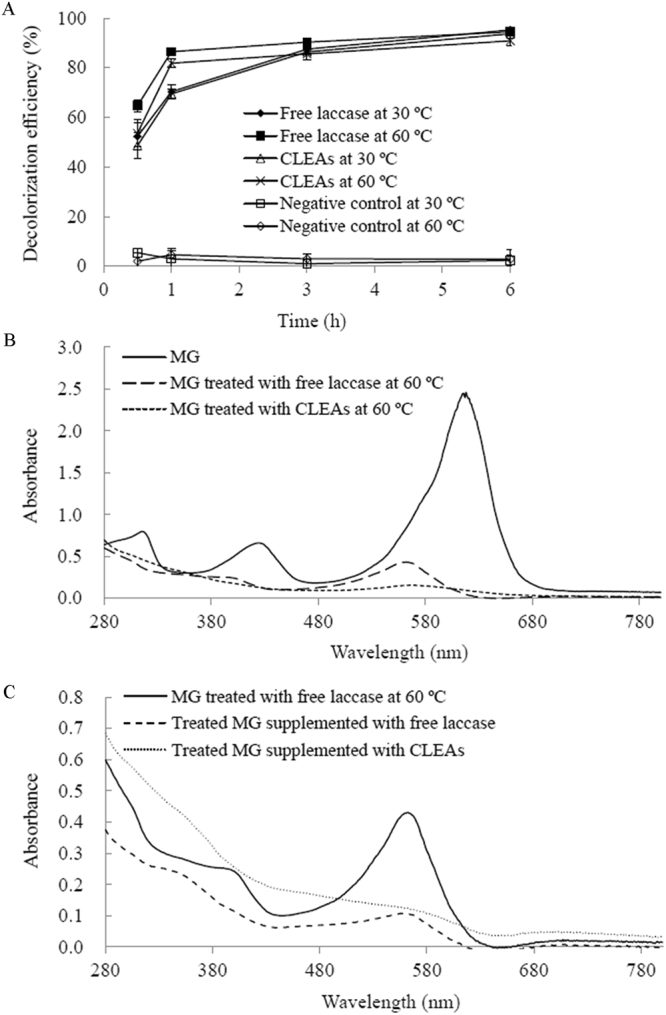
Decolorization of MG by free and immobilized laccases. (A) Efficiencies of MG decolorization by free laccase and laccase CLEAs. (B) UV-vis spectra of MG before and after decolorization by free laccase at 30 and 60 °C. (C) UV-vis spectra of treated MG supplemented with free and immobilized laccases. MG treatment was carried out at 60 °C.
Figure 4
Figure 4
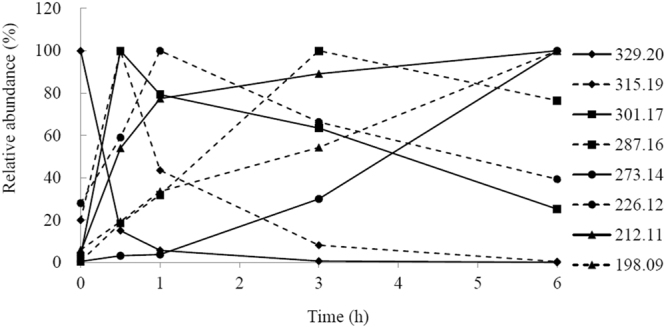
Time course of MG and the transformation products during treatment with free laccase at 30 °C. MG (m/z 329.20) and the transformation products (m/z 315.19, 301.17, 287.16, 273.14, 226.12, 212.11 and 198.09) were detected with LC-TOF MS. The highest level of MG or each transformation product during the treatment was set to 100%.
Figure 5
Figure 5
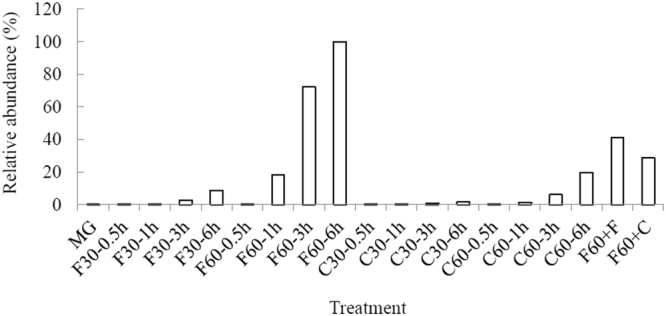
Accumulation of tetradesmethyl MG (m/z 273.14) during MG degradation by free and immobilized laccases at 30 and 60 °C. Tetradesmethyl MG (m/z 273.14) was detected with LC-TOF MS. The highest level of tetradesmethyl MG (m/z 273.14) was observed in MG treated with free laccase at 60 °C for 6 h and was set to 100%. For the laccase treatments of MG, the first letters “F” and “C” indicate free laccase and CLEAs, respectively. The number after the first letter indicates the treatment temperature, and the number after “−” indicates treatment time. After treating MG with free laccase at 60 °C for 6 h, the solution was supplemented with free laccase (F60+F) or CLEAs (F60+C) and incubated overnight.

References

    1. Viswanath B, Rajesh B, Janardhan A, Kumar AP, Narasimha G. Fungal laccases and their applications in bioremediation. Enzyme Res. 2014;2014:1–21. doi: 10.1155/2014/163242. - DOI - PMC - PubMed
    1. Pezzella C, Guarino L, Piscitelli A. How to enjoy laccases. Cell. Mol. Life Sci. 2015;72:923–940. doi: 10.1007/s00018-014-1823-9. - DOI - PMC - PubMed
    1. Kudanga T, Roes-Hill ML. Laccase applications in biofuels production: current status and future prospects. Appl. Microbiol. Biotechnol. 2014;98:6525–6542. doi: 10.1007/s00253-014-5810-8. - DOI - PubMed
    1. Yang J, et al. Laccases: production, expression regulation, and applications in pharmaceutical biodegradation. Front. Microbiol. 2017;8:832. doi: 10.3389/fmicb.2017.00832. - DOI - PMC - PubMed
    1. Fernández-Fernández M, Sanromán MÁ, Moldes D. Recent developments and applications of immobilized laccase. Biotechnol. Adv. 2013;31:1808–1825. doi: 10.1016/j.biotechadv.2012.02.013. - DOI - PubMed

Publication types

LinkOut - more resources