


Are Clowns Good for Everyone? The Influence of Trait Cheerfulness on Emotional Reactions to a Hospital Clown Intervention
- PMID: 29180976
- PMCID: PMC5693907
- DOI: 10.3389/fpsyg.2017.01973
Are Clowns Good for Everyone? The Influence of Trait Cheerfulness on Emotional Reactions to a Hospital Clown Intervention
Abstract
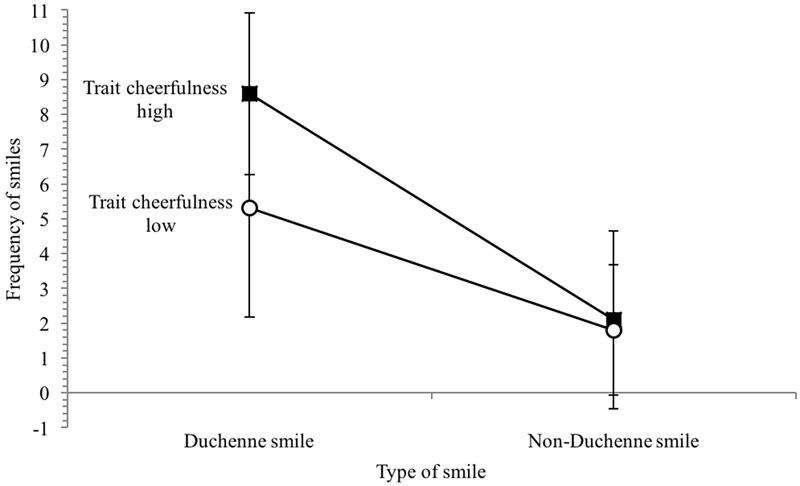
Trait cheerfulness predicts individual differences in experiences and behavioral responses in various humor experiments and settings. The present study is the first to investigate whether trait cheerfulness also influences the impact of a hospital clown intervention on the emotional state of patients. Forty-two adults received a clown visit in a rehabilitation center and rated their emotional state and trait cheerfulness afterward. Facial expressions of patients during the clown visit were coded with the Facial Action Coding System. Looking at the total sample, the hospital clown intervention elicited more frequent facial expressions of genuine enjoyment (Duchenne smiles) than other smiles (Non-Duchenne smiles), and more Duchenne smiles went along with more perceived funniness, a higher level of global positive feelings and transcendence. This supports the notion that overall, hospital clown interventions are beneficial for patients. However, when considering individual differences in the receptiveness to humor, results confirmed that high trait cheerful patients showed more Duchenne smiles than low trait cheerful patients (with no difference in Non-Duchenne smiles), and reported a higher level of positive emotions than low trait cheerful individuals. In summary, although hospital clown interventions on average successfully raise the patients' level of positive emotions, not all patients in hospitals are equally susceptible to respond to humor with amusement, and thus do not equally benefit from a hospital clown intervention. Implications for research and practitioners are discussed.
Keywords: Duchenne smile; Facial Action Coding System; amusement; hospital clown; trait cheerfulness; transcendence.
Figures
References
-
- Auerbach S., Hofmann J., Platt T., Ruch W. (2014). An investigation of the emotions elicited by hospital clowns in comparison to circus clowns and nursing staff. Eur. J. Humour Res. 1 26–53. 10.7592/EJHR2013.1.3.auerbach - DOI
-
- Auerbach S., Ruch W., Fehling A. (2016). Positive emotions elicited by clowns and nurses: an experimental study in a hospital setting. Transl. Issues Psychol. Sci. 2 14–24. 10.1037/tps0000055 - DOI
-
- Carretero-Dios H., Benítez I., Delgado-Rico E., Ruch W., López-Benítez R. (2014). Temperamental basis of sense of humor: the Spanish long form of the trait version of the State-Trait-Cheerfulness-Inventory. Pers. Individ. Dif. 68 77–82. 10.1016/j.paid.2014.03.045 - DOI
LinkOut - more resources
Full Text Sources
Other Literature Sources
