Review
. 2017 Nov 13:8:1544.
doi: 10.3389/fimmu.2017.01544. eCollection 2017.

Interplay between Natural Killer Cells and Anti-HER2 Antibodies: Perspectives for Breast Cancer Immunotherapy

Affiliations
Review

Interplay between Natural Killer Cells and Anti-HER2 Antibodies: Perspectives for Breast Cancer Immunotherapy

Aura Muntasell et al. Front Immunol. .

Abstract

Overexpression of the human epidermal growth factor receptor 2 (HER2) defines a subgroup of breast tumors with aggressive behavior. The addition of HER2-targeted antibodies (i.e., trastuzumab, pertuzumab) to chemotherapy significantly improves relapse-free and overall survival in patients with early-stage and advanced disease. Nonetheless, considerable proportions of patients develop resistance to treatment, highlighting the need for additional and co-adjuvant therapeutic strategies. HER2-specific antibodies can trigger natural killer (NK) cell-mediated antibody-dependent cellular cytotoxicity and indirectly enhance the development of tumor-specific T cell immunity; both mechanisms contributing to their antitumor efficacy in preclinical models. Antibody-dependent NK cell activation results in the release of cytotoxic granules as well as the secretion of pro-inflammatory cytokines (i.e., IFNγ and TNFα) and chemokines. Hence, NK cell tumor suppressive functions include direct cytolytic killing of tumor cells as well as the regulation of subsequent antitumor adaptive immunity. Albeit tumors with gene expression signatures associated to the presence of cytotoxic lymphocyte infiltrates benefit from trastuzumab-based treatment, NK cell-related biomarkers of response/resistance to HER2-specific therapeutic antibodies in breast cancer patients remain elusive. Several variables, including (i) the configuration of the patient NK cell repertoire; (ii) tumor molecular features (i.e., estrogen receptor expression); (iii) concomitant therapeutic regimens (i.e., chemotherapeutic agents, tyrosine kinase inhibitors); and (iv) evasion mechanisms developed by progressive breast tumors, have been shown to quantitatively and qualitatively influence antibody-triggered NK cell responses. In this review, we discuss possible interventions for restoring/enhancing the therapeutic activity of HER2 therapeutic antibodies by harnessing NK cell antitumor potential through combinatorial approaches, including immune checkpoint blocking/stimulatory antibodies, cytokines and toll-like receptor agonists.

Keywords: antibody-dependent cell-mediated cytotoxicity; breast cancer; human epidermal growth factor receptor 2; immunotherapy; natural killer cells; pertuzumab; trastuzumab.


Figures
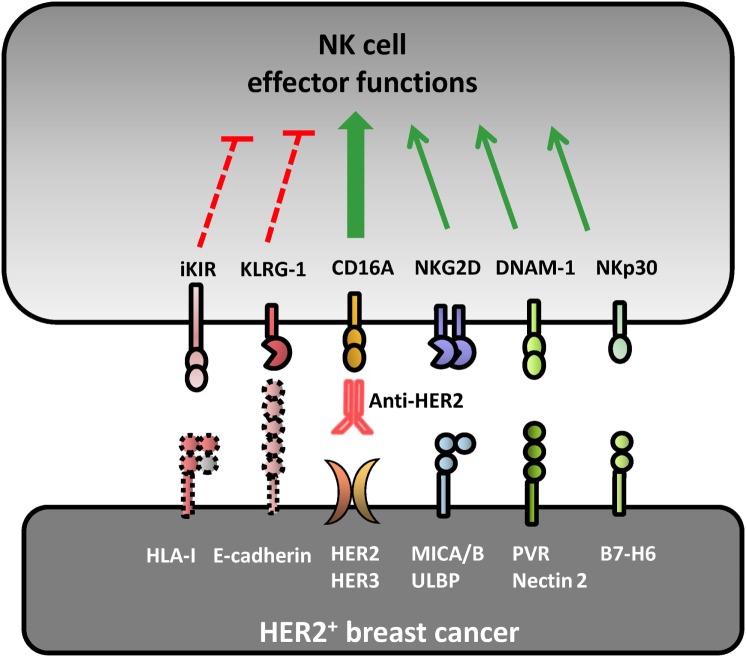
Figure 1
Figure 1
Receptor–ligand pairs involved in natural killer (NK) cell recognition of HER2+ breast cancer cell lines. Several receptor–ligand pairs are involved in the crosstalk between breast cancer (BC) cells and NK lymphocytes. Natural cytotoxicity against HER2+ BC is mainly driven by NKG2D, DNAM-1, and NKp30 activating receptors upon interacting with their cognate ligands MICA/B, PVR/Nectin-2, and B7-H6, respectively. Human epidermal growth factor receptor 2 (HER2)-dependent downregulation of surface HLA-I expression impairs KIR-mediated inhibition facilitating NK cell recognition of BC cell lines. Anti-HER2 therapeutic monoclonal antibodies elicit a strong NK cell-mediated antibody-dependent cell-mediated cytotoxicity response against HER2+ BC cells upon interaction with the activating CD16A receptor. E-cadherin expression can be recognized by KLRG1 inhibitory receptor expressed by some NK cell subsets, modulating their direct and antibody-dependent cytotoxicity.
Figure 2
Figure 2
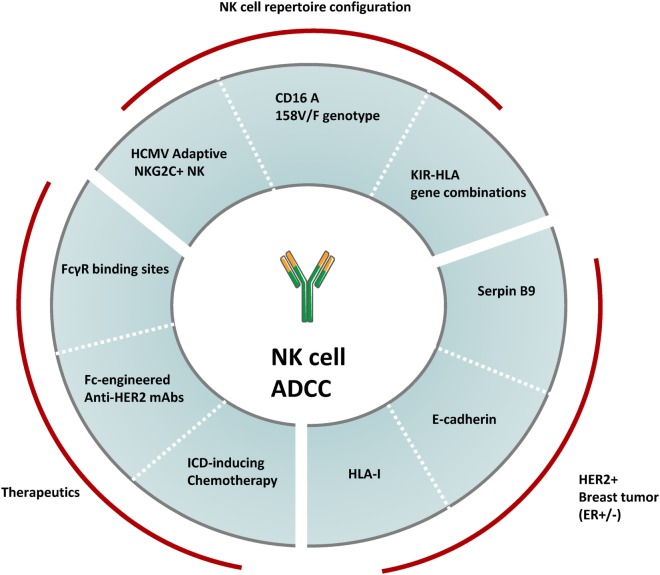
Variables modulating NK cell-mediated ADCC against HER2+ breast cancer. The overall magnitude of NK cell-mediated ADCC induced by anti-HER2 therapeutic monoclonal antibodies can be modulated by several factors including the configuration of the human NK cell repertoire, the heterogeneity in HER2+ breast tumor molecular subtypes and differences in treatment regimens. Factors such as specific KIR-HLA combinations, the CD16A 158V/F genotype and the prevalence of human cytomegalovirus (HCMV) adaptive NKG2C+ NK cells have been shown to modulate the overall NK cell-mediated ADCC potential. A number of tumor molecular features associated to estrogen receptor (ER) co-expression (e.g., expression of Serpin B9, E-cadherin, and HLA-I) can also modulate NK cell-mediated ADCC responses. Finally, the NK cell effector potential against HER2+ breast cancer is also modulated by therapeutic regimens, including the type of HER2-targeting drugs and the combined chemotherapy agents.
Figure 3
Figure 3
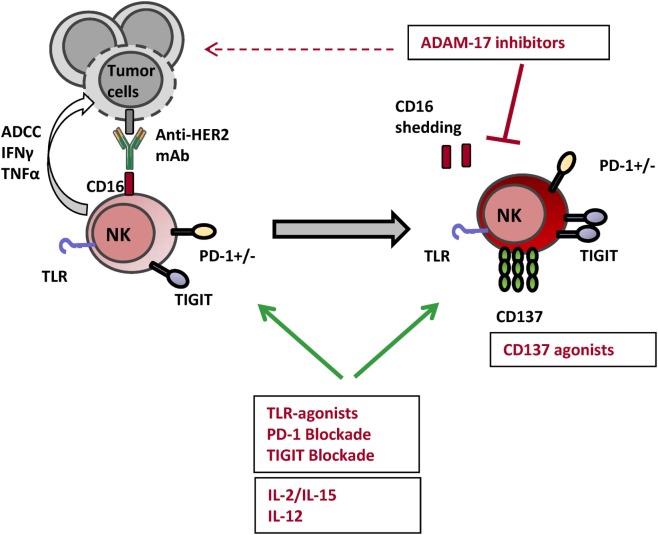
Actionable NK cell checkpoints for enhancing anti-HER2 mAb-induced ADCC responses. Several strategies can be tackled for harnessing NK cell ADCC responses with the objective of enhancing the clinical efficacy of anti-HER2 mAbs. Toll-like receptor (TLR) agonists and cytokines such as IL-2, IL-15, and IL-12 have been shown to lower NK cell activation threshold and enhance their effector potential. Among immune checkpoint modulators targeting surface receptors, anti-TIGIT and anti-PD-1 blocking mAbs as well as anti-CD137 agonist mAbs enhance NK cell-mediated ADCC and survival. Impeding CD16 shedding with A disintegrin and metalloproteinase 17 (ADAM17) inhibitors can be yet another strategy amplifying NK cell-mediated ADCC triggered by HER2-specific therapeutic mAbs.

References

    1. Moasser MM. The oncogene HER2; its signaling and transforming functions and its role in human cancer pathogenesis. Oncogene (2007) 26:6469–87.10.1038/sj.onc.1210478 - DOI - PMC - PubMed
    1. Slamon DJ, Clark GM, Wong SG, Levin WJ, Ullrich A, McGuire WL. Human breast cancer: correlation of relapse and survival with amplification of the HER-2/neu oncogene. Science (1987) 235:177–82.10.1126/science.3798106 - DOI - PubMed
    1. Hortobagyi GN. Trastuzumab in the treatment of breast cancer. N Engl J Med (2005) 353:1734–6.10.1056/NEJMe058196 - DOI - PubMed
    1. Baselga J, Bradbury I, Eidtmann H, Di Cosimo S, de Azambuja E, Aura C, et al. Lapatinib with trastuzumab for HER2-positive early breast cancer (NeoALTTO): a randomised, open-label, multicentre, phase 3 trial. Lancet (2012) 379:633–40.10.1016/S0140-6736(11)61847-3 - DOI - PMC - PubMed
    1. Gianni L, Pienkowski T, Im YH, Roman L, Tseng LM, Liu MC, et al. Efficacy and safety of neoadjuvant pertuzumab and trastuzumab in women with locally advanced, inflammatory, or early HER2-positive breast cancer (NeoSphere): a randomised multicentre, open-label, phase 2 trial. Lancet Oncol (2012) 13:25–32.10.1016/S1470-2045(11)70336-9 - DOI - PubMed