


Recombinant human adenovirus-p53 improves the outcome of mid-late stage pancreatic cancer via arterial infusion
- PMID: 29181104
- PMCID: PMC5696714
- DOI: 10.3892/ol.2017.7058
Recombinant human adenovirus-p53 improves the outcome of mid-late stage pancreatic cancer via arterial infusion
Abstract
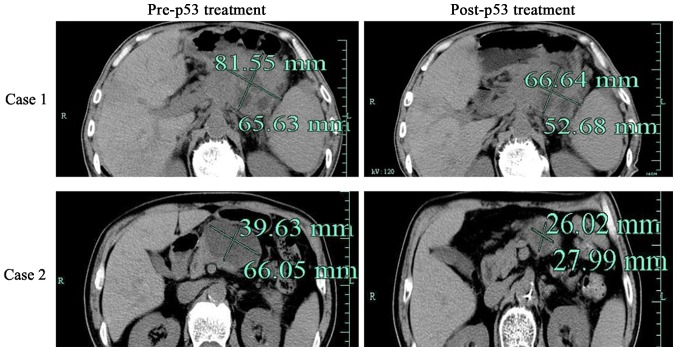
The present study aimed to investigate the therapeutic efficacy and clinical value of recombinant human adenovirus-p53 (rAd-p53) perfusion via the pancreatic artery for the treatment of mid-late stage pancreatic cancer. rAd-p53 (2×10¹² virus particles) in 6 ml normal saline was pushed (intravenous bolus) into the gastroduodenal and superior pancreaticoduodenal arteries via interventional superselection, with the catheter retained for subsequent drug administration at a 3-day interval for 4 cycles. Tumor changes in all patients were observed to evaluate tumor response by computed tomography (CT) at 2, 8 and 16 weeks post-treatment. The following improvements were noted in the 23-patient cohort: A total of 73.9% (17/23) of patients demonstrated significant tumor shrinkage (>20%); the symptoms of abdominal and back pain were relieved in 15 patients; the survival time was >12 months in 1 patient and >6 months in 14 patients; the patient's general condition, including appetite, was improved in 13 patients; body weight was increased in 9 patients; jaundice was attenuated in 12 patients; and ascites subsided in 10 patients. However, the therapeutic outcome was poor in 2 patients whose tumors size did not show significant change after treatment as detected by CT. These 2 patients succumbed within 6 months. In conclusion, rAd-p53 perfusion via the pancreatic artery is a safe and minimally invasive option for the treatment of mid-late stage pancreatic cancer.
Keywords: computed tomography; intervention therapy; pancreatic cancer; recombinant human adenovirus-p53.
Figures
References
-
- Neoptolemos JP, Stocken DD, Bassi C, Ghaneh P, Cunningham D, Goldstein D, Padbury R, Moore MJ, Gallinger S, Mariette C, et al. Adjuvant chemotherapy with fluorouracil plus folinic acid vs gemcitabine following pancreatic cancer resection: A randomized controlled trial. JAMA. 2010;304:1073–1081. doi: 10.1001/jama.2010.1275. - DOI - PubMed
-
- Moore MJ, Goldstein D, Hamm J, Figer A, Hecht JR, Gallinger S, Au HJ, Murawa P, Walde D, Wolff RA, et al. Erlotinib plus gemcitabine compared with gemcitabine alone in patients with advanced pancreatic cancer: A phase III trial of the National Cancer Institute of Canada Clinical Trials Group. J Clin Oncol. 2007;25:1960–1966. doi: 10.1200/JCO.2006.07.9525. - DOI - PubMed
-
- Van Cutsem E, Vervenne WL, Bennouna J, Humblet Y, Gill S, Van Laethem JL, Verslype C, Scheithauer W, Shang A, Cosaert J, Moore MJ. Phase III trial of bevacizumab in combination with gemcitabine and erlotinib in patients with metastatic pancreatic cancer. J Clin Oncol. 2009;27:2231–2237. doi: 10.1200/JCO.2008.20.0238. - DOI - PubMed
LinkOut - more resources
Full Text Sources
Other Literature Sources
Research Materials
Miscellaneous