


Outcome of children and adolescents with relapsed Hodgkin lymphoma treated with high-dose therapy and autologous stem cell transplantation: the Memorial Sloan Kettering Cancer Center experience
- PMID: 29183202
- PMCID: PMC6637236
- DOI: 10.1080/10428194.2017.1403601
Outcome of children and adolescents with relapsed Hodgkin lymphoma treated with high-dose therapy and autologous stem cell transplantation: the Memorial Sloan Kettering Cancer Center experience
Abstract
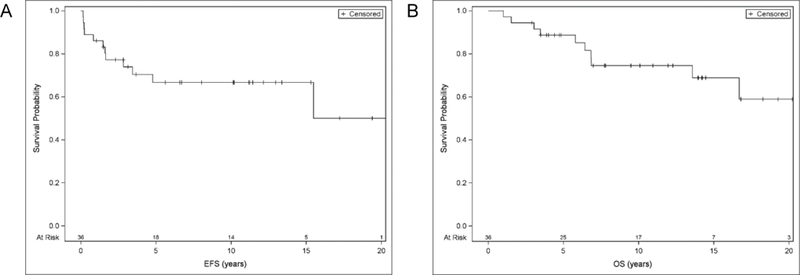
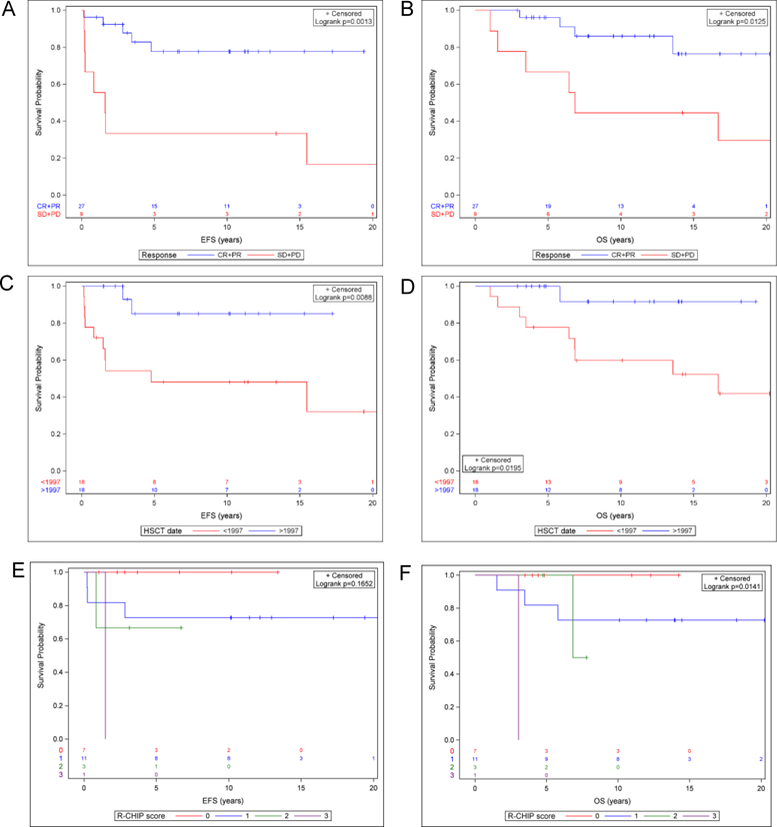
To evaluate outcomes and prognostic markers among children with relapsed Hodgkin lymphoma (HL) treated with autologous stem cell transplant (ASCT), we conducted a retrospective analysis of 36 consecutive pediatric patients treated at Memorial Sloan Kettering Cancer Center from 1989 to 2013. With a median follow-up of 9.6 years, the 10-year overall survival (OS) and event-free survival (EFS) were 74.1 and 67.1% respectively. Absence of B-symptoms, chemotherapy-sensitive disease, and transplant date after 1997 were each associated with superior EFS [HR 0.12 (p = .0015), 0.18 (p = .0039), and 0.17 (p = .0208), respectively]. Childhood Hodgkin International Prognostic Score at relapse (R-CHIPS) was calculated in a subset of patients (n = 22) and a lower score was associated with improved OS (HR 0.29, p = .0352) and a trend toward improved EFS (HR 0.38, p = .0527). In summary, ASCT results in durable remission for the majority of pediatric patients with relapsed HL. R-CHIPS should be evaluated in larger cohorts as a potential predictive tool.
Keywords: Clinical results; lymphoma and Hodgkin disease; marrow and stem cell transplantation; neoplasia; prognostication.
Conflict of interest statement
Acknowledgements and Declaration of Interests: The authors have no conflicts of interest to disclose.
Figures
References
-
- Bradley MB, Cairo MS. Stem cell transplantation for pediatric lymphoma: past, present and future. Bone Marrow Transplant 2008;41:149–158. - PubMed
-
- Horning SJ, Adhikari A, Rizk N, Hoppe RT, Olshen RA. Effect of treatment for Hodgkin’s disease on pulmonary function: results of a prospective study. J Clin Oncol 1994;12:297–305. - PubMed
-
- Hudson MM, Donaldson SS. Treatment of pediatric Hodgkin’s lymphoma. Semin Hematol 1999;36:313–323. - PubMed
-
- Kelly KM, Hodgson D, Appel B, et al. Children’s Oncology Group’s 2013 blueprint for research: Hodgkin lymphoma. Pediatr Blood Cancer 2013;60:972–978. - PubMed
-
- Brice P, Bouabdallah R, Moreau P, et al. Prognostic factors for survival after high-dose therapy and autologous stem cell transplantation for patients with relapsing Hodgkin’s disease: analysis of 280 patients from the French registry. Societe Francaise de Greffe de Moelle. Bone Marrow Transplant 1997;20:21–26. - PubMed
MeSH terms
Grants and funding
LinkOut - more resources
Full Text Sources
Other Literature Sources
Medical
