


Mortality trends for accidental falls in older people in Spain, 2000-2015
- PMID: 29183274
- PMCID: PMC5706309
- DOI: 10.1186/s12877-017-0670-6
Mortality trends for accidental falls in older people in Spain, 2000-2015
Abstract
Background: Accidental falls in older people are a major public health problem but a relatively limited number of studies have analyzed the mortality trends from this cause. Effective public health interventions have been found to prevent the incidence of falls and their complications. Therefore, characterizing the mortality trends of falls for different subpopulations can help to identify their needs and contribute to develop more appropriate prevention programs for specific target groups.
Methods: This study was based on a longitudinal analysis of death rates from accidental falls (2000-2015) stratified by sex for the population ≥ 65 years and by age groups (65-74, 75-84, ≥85). A joinpoint regression model was used to identify trend inflection points. The Annual Percent Change (APC) was estimated for each trend.
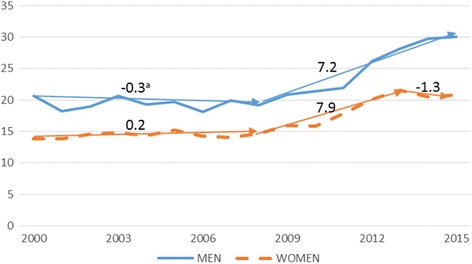
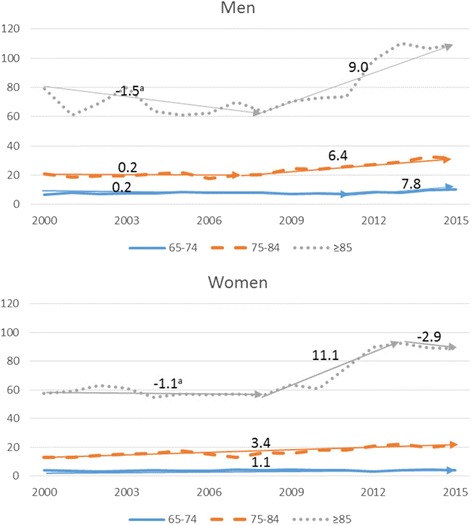
Results: Mortality rates per 100,000 person-years increased from 20.6 to 30.1 for men and 13.8 to 20.8 for women between 2000 and 2015. Men presented a relevant trend increase between 2008 and 2015 (APC [95% CI] 7.2% [5.3;9.2]) and women between 2008 and 2013 (7.9% [4.1;11.8]) There were no trend differences between sexes. For 65-74 years old men we found a relevant increase in the last period (2011-2015) (7.8% [1.0;15.1]). Those aged 75-84 years showed a trend increase between 2007 and 2015 (6.4% [4.4;8.4]) and men ≥85 years presented a remarkably high trend between 2008 and 2015 (9.0% [5.2;13]). There were no relevant differences between age groups. Women aged 65-74 had no relevant trend through the period. Those aged 75-84 presented an uniform trend increase for the whole period, 2000-2015, (3.4% [2.3;4.4]) and women ≥85 had and important trend increase between 2008 and 2013 (11.1% [5.3;17.2]), that has reached an stable level in the last 2 years. There were no relevant differences between the 75-84 and ≥85 age groups.
Conclusions: Recent mortality trends from accidental falls increased in men ≥65 years and women ≥75 years. These results recommend the implementation of specific preventive programs.
Keywords: Aged; Falls; Mortality; Time series.
Conflict of interest statement
Ethics approval and consent to participate
This study was approved by the Institutional Review Board of the Carlos III Institute of Health.
All procedures performed in studies involving human participants were in accordance with the ethical standards of the institutional and/or national research committee and with the 1964 Helsinki declaration and its later amendments or comparable ethical standards. For this type of study, formal consent is not required.
The data was de-identified prior to any of the authors to obtaining it for use in this study.
Consent for publication
Not applicable.
Competing interests
The authors declare that they have no competing interests.
Publisher’s Note
Springer Nature remains neutral with regard to jurisdictional claims in published maps and institutional affiliations.
Figures
References
-
- WHO Regional Office for Europe. Healthy aging. Policy. 2016 http://www.euro.who.int/en/health-topics/Life-stages/healthy-ageing/policy. Accessed 2 June 2017.
-
- Centers for Disease Control and Prevention. Falls Among Older Adults: An Overview. 2012. https://www.giorgiannirehab.com/docs/CDC%20-%20Older%20Adult%20Falls%20-.... Accessed 23 Nov 2017.
-
- European Network for Safety among Elderly (EUNESE). European Association for Injury Prevention and Safety Promotion. Eurosafe. European Commission. Second Interim Technical Implementation Report. 2006. http://docplayer.gr/2514800-Second-interim-technical-implementation-repo.... Accessed 2 June 2017.
MeSH terms
Grants and funding
LinkOut - more resources
Full Text Sources
Other Literature Sources
Medical
