


Sensory and semantic activations evoked by action attributes of manipulable objects: Evidence from ERPs
- PMID: 29183777
- PMCID: PMC5898371
- DOI: 10.1016/j.neuroimage.2017.11.045
Sensory and semantic activations evoked by action attributes of manipulable objects: Evidence from ERPs
Abstract
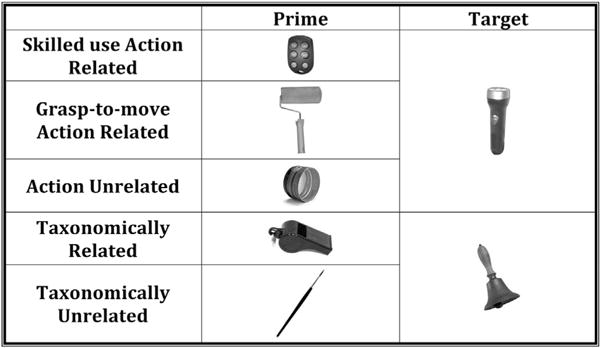
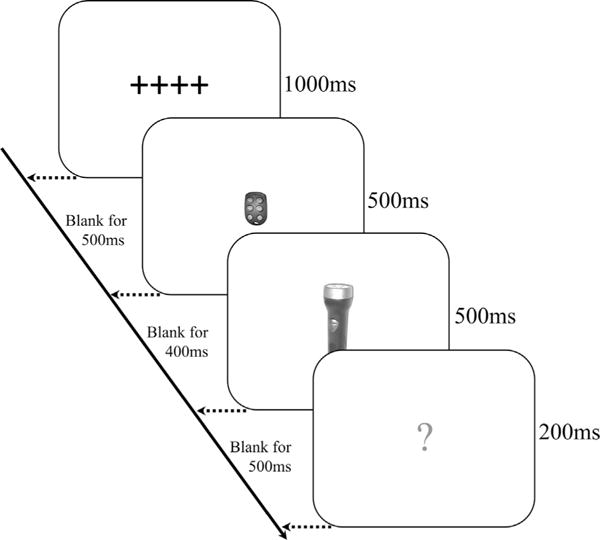
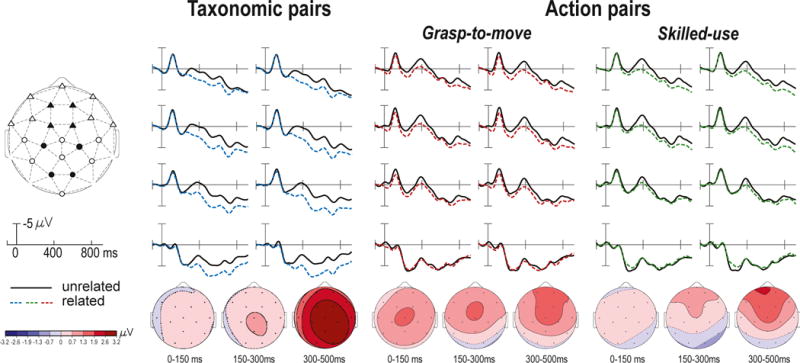
"Two route" theories of object-related action processing posit different temporal activation profiles of grasp-to-move actions (rapidly evoked based on object structure) versus skilled use actions (more slowly activated based on semantic knowledge). We capitalized on the exquisite temporal resolution and multidimensionality of Event-Related Potentials (ERPs) to directly test this hypothesis. Participants viewed manipulable objects (e.g., calculator) preceded by objects sharing either "grasp", "use", or no action attributes (e.g., bar of soap, keyboard, earring, respectively), as well as by action-unrelated but taxonomically-related objects (e.g., abacus); participants judged whether the two objects were related. The results showed more positive responses to "grasp-to-move" primed objects than "skilled use" primed objects or unprimed objects starting in the P1 (0-150 ms) time window and continuing onto the subsequent N1 and P2 components (150-300 ms), suggesting that only "grasp-to-move", but not "skilled use", actions may facilitate visual attention to object attributes. Furthermore, reliably reduced N400s (300-500 ms), an index of semantic processing, were observed to taxonomically primed and "skilled use" primed objects relative to unprimed objects, suggesting that "skilled use" action attributes are a component of distributed, multimodal semantic representations of objects. Together, our findings provide evidence supporting two-route theories by demonstrating that "grasp-to-move" and "skilled use" actions impact different aspects of object processing and highlight the relationship of "skilled use" information to other aspects of semantic memory.
Keywords: Action; Embodied cognition; Event-Related Potentials; Grasp-to-move actions; N400; Skilled use actions.
Copyright © 2017. Published by Elsevier Inc.
Figures
References
-
- Allport D. Current Perspectives in Dysphasia. Churchill Livingstone; Edinburgh: 1985. Distributed memory, modular subsystems and dysphasia; pp. 207–244.
-
- Amazeen EL, DaSilva F. Psychophysical test for the independence of perception and action. J Exp Psychol Hum Percept Perform. 2005;31(1):170–182. https://doi.org/10.1037/0096-1523.31.1.170. - DOI - PubMed
-
- Andersen RA, Andersen KN, Hwang EJ, Hauschild M. Optic ataxia: from Balint’s syndrome to the parietal reach region. Neuron. 2014;81(5):967–983. https://doi.org/10.1016/j.neuron.2014.02.025. - DOI - PMC - PubMed
-
- Bach P, Gunter TC, Knoblich G, Prinz W, Friederici AD. N400-like negativities in action perception reflect the activation of two components of an action representation. Soc Neurosci. 2009;4(3):212–232. https://doi.org/10.1080/17470910802362546. - DOI - PubMed
-
- Barsalou LW. Grounded cognition. Annu Rev Psychol. 2008;59(1):617–645. https://doi.org/10.1146/annurev.psych.59.103006.093639. - DOI - PubMed
Publication types
MeSH terms
Grants and funding
LinkOut - more resources
Full Text Sources
Other Literature Sources
