Review
. 2017 Oct 31:12:8009-8023.
doi: 10.2147/IJN.S142732. eCollection 2017.

Placenta-derived exosomes: potential biomarkers of preeclampsia

Affiliations
Review

Placenta-derived exosomes: potential biomarkers of preeclampsia

Preenan Pillay et al. Int J Nanomedicine. .

Abstract

Preeclampsia remains a leading cause of maternal and fetal mortality, due to ineffective treatment and diagnostic strategies, compounded by the lack of clarity on the etiology of the disorder. Although several clinical and biological markers of preeclampsia have been evaluated, they have proven to be ineffective in providing a definitive diagnosis during the various stages of the disorder. Exosomes have emerged as ideal biomarkers of pathological states, such as cancer, and have more recently gained interest in pregnancy-related complications, due to their role in cellular communication in normal and complicated pregnancies. This occurs as a result of the specific placenta-derived exosomal molecular cargo, which may be involved in normal pregnancy-associated immunological events, such as the maintenance of maternal-fetal tolerance. This review provides perspectives on placenta-derived exosomes as possible biomarkers for the diagnosis/prognosis of preeclampsia. Using keywords, online databases were searched to identify relevant publications to review the potential use of placenta-derived exosomes as biomarkers of preeclampsia.

Keywords: biomarkers; placenta-derived exosomes; preeclampsia.


Conflict of interest statement

Disclosure The authors report no conflicts of interests in this work.

Figures
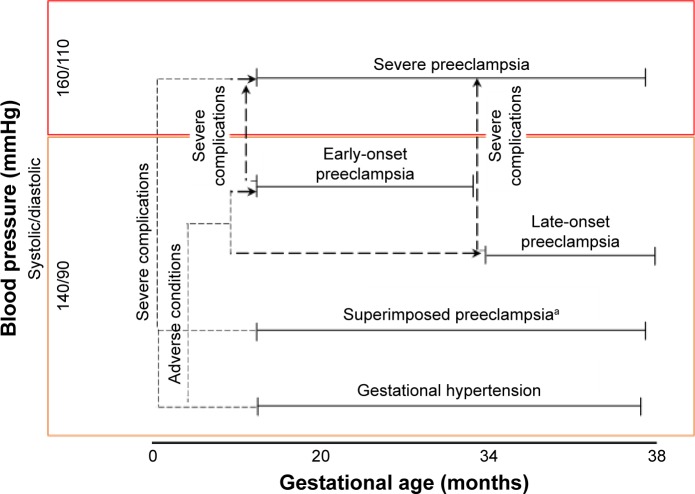
Figure 1
Figure 1
Classification of hypertensive disorders in pregnancy. Notes: Hypertensive disorders with preeclampsia subclassified into early- and late-onset preeclampsia. Adverse conditions are defined as conditions that increase the risk of severe complications. Adverse conditions and severe complications are categorized into the organ system affected (ie, central nervous system, cardiorespiratory, hematological, renal, hepatic, and fetoplacental), as described by Magee et al. aHypertension present either at prepregnancy or that developed at 20 weeks prior to gestation.
Figure 2
Figure 2
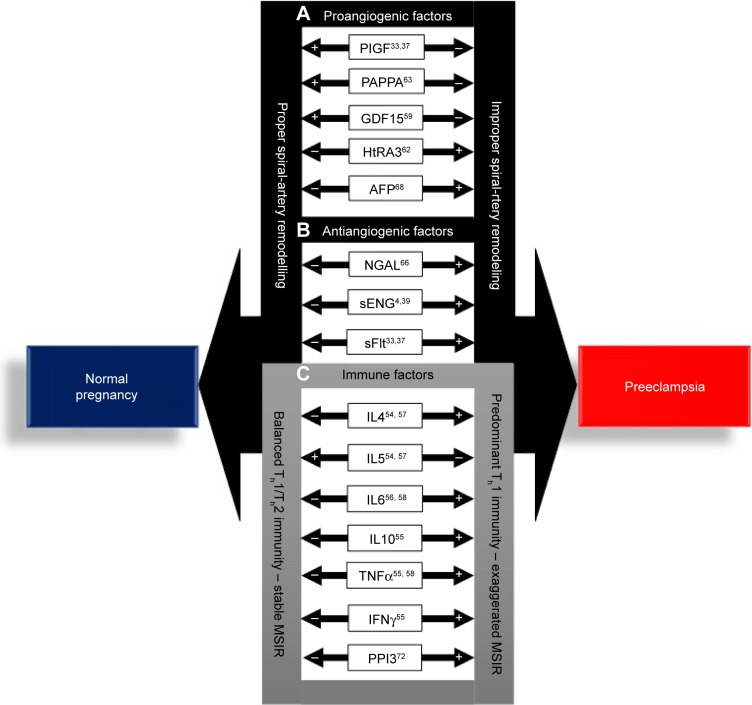
Potential biomarkers involved in the pathogenesis of preeclampsia (PE). Notes: (A) Proangiogenic and (B) anti-angiogenic factors associated with improper spiral-artery remodeling in PE. (C) Immune factors associated with the pathogenesis of PE as a result of the predominant Th1 immunity of the disorder. +Significantly increased expression in comparison to normal pregnancy; significantly lowered expression in comparison to PE pregnancies. Abbreviations: MSIR, maternal systemic inflammatory response; Th, T-helper.
Figure 3
Figure 3
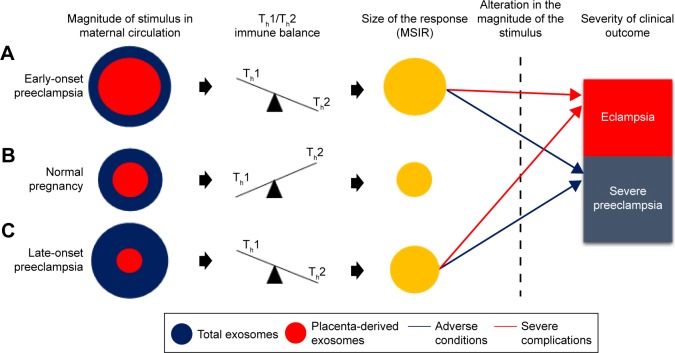
Hypothetical model of exosomes in relation to immunological and clinical outcomes in EOPE, LOPE, and normal pregnancy. Notes: (A) In EOPE, an increase in placenta-derived and total exosomes in comparison to normal pregnancy mediates a shift toward Th1 immunity and thus results in an exaggerated MSIR. (B) In normal pregnancy, there is a balance between placenta-derived and total exosomes that mediates a shift toward Th2 immunity, thereby maintaining a balanced MSIR, a requirement for successful pregnancy. (C) In LOPE, the increase in total and decrease in placenta-derived exosomes in comparison to normal pregnancy mediates a shift toward Th1 immunity, which exaggerates the MSIR to a degree that does not exceed the MSIR in EOPE. (A, C) Alteration in the magnitude of placenta-derived and total-exosomes during the manifestation of LOPE or EOPE results in adverse conditions or severe complications that lead to the clinical manifestation of severe PE or eclampsia. Abbreviations: EOPE, early-onset preeclampsia; LOPE, late-onset PE; MSIR, maternal systemic inflammatory response; Th, T-helper.
Figure 4
Figure 4
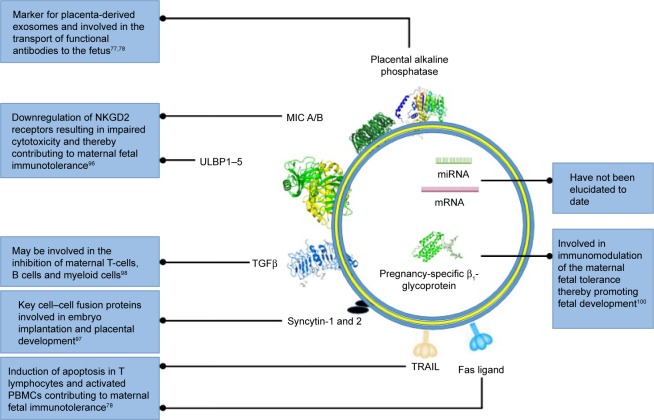
Schematic representation of key pregnancy-associated exosomal molecular cargo and their function. Notes: This figure highlights key transmembrane and cytosolic proteins involved in immunomodulation during normal pregnancy. Key pregnancy-associated exosomal nucleic acids have not been identified to date. Common exosomal markers are not shown. Abbreviation: PBMCs, peripheral blood mononuclear cells.

References

    1. American College of Obstetricians and Gynecologists Hypertension in pregnancy. Obstet Gynecol. 2013;122:1122–1131. - PubMed
    1. Kuklina E, Ayala C, Callaghan W. Hypertensive disorders and severe obstetric morbidity in the United States. Obstet Gynecol. 2009;113:1299–1306. - PubMed
    1. Wagner LK. Diagnosis and management of pre-eclampsia. Am Fam Physician. 2004;70:2317–2324. - PubMed
    1. Redman CW. Current topic: pre-eclampsia and the placenta. Placenta. 1991;12:301–308. - PubMed
    1. Burton GJ, Jauniaux E. Placental oxidative stress: from miscarriage to preeclampsia. J Soc Gynecol Investig. 2004;11:342–352. - PubMed