The role of mHealth intervention on maternal and child health service delivery: findings from a randomized controlled field trial in rural Ethiopia
- PMID: 29184891
- PMCID: PMC5682387
- DOI: 10.21037/mhealth.2017.08.04
The role of mHealth intervention on maternal and child health service delivery: findings from a randomized controlled field trial in rural Ethiopia
Abstract
Background: The provision of consistent and quality maternal and child health (MCH) services is a challenge for Ethiopia where most of the population lives in the rural setup. Health service delivery is constrained mainly by shortage of health professionals, meager resources, limited awareness among the society and bureaucratic procedures. Low health service utilization of antenatal care (ANC), delivery services, and postnatal care (PNC) are believed to contribute for high maternal and child mortality rates. Innovative approach like mHealth based technological intervention believed to alleviate such challenges in countries like ours. However, currently, there are few evidences that demonstrate the impact of mHealth technology applications on the level of service utilization. Therefore, the objective our study is to assess the role of mobile phone equipped with short message service (SMS) based data-exchange software linking community health workers to Health Centers in rural Ethiopia affect selected MCH outcomes.
Methods: A community-based randomized control trial (RCT) was conducted in three woredas of Guraghe zone (Ezha, partial &Abeshge full intervention, Sodo Control). Mobile phones equipped with FrontlineSMS based, locally developed application was distributed to all health extension workers (HEWs) to both intervention woredas who filled maternal, child and stock related forms and submitted to the central server which in turn sends reminder about the scheduled date of ANC visit, expected date of delivery, PNC, immunization schedule and vaccine and contraceptive stock status. Moreover, in Abeshge, the voluntary health workers (vCHW) and HEW supervisors in both intervention woreda were given a phone to facilitate communication with the HEW. No mobile was offered to the control woreda.Pre [2012] and post [2013] intervention community based survey on mothers who have under 5 and under 1 year old child was done to assess the effect of the mobile intervention on selected MCH process indicators. Structured and pretested questionnaire was used to collect data and SPSS v16 statistical software was used for analysis.
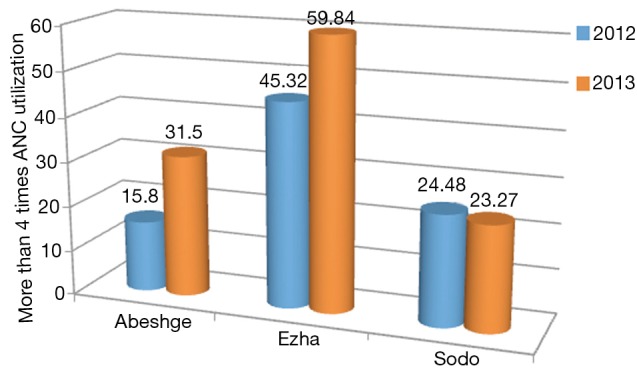
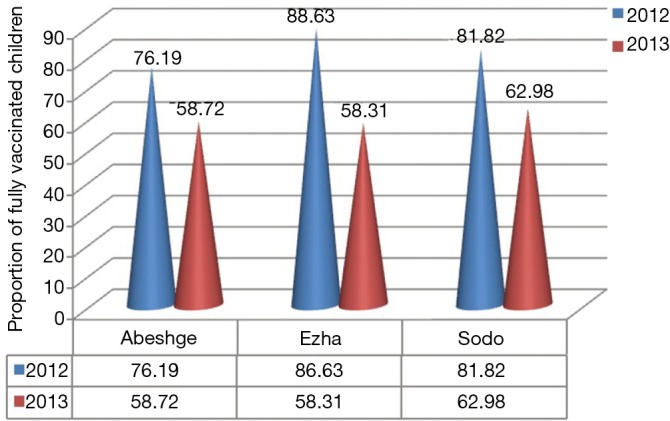
Results: Three thousand two hundred and forty mothers, 1,080 from each, were surveyed in the three woredas. The study revealed that the proportion of mothers receiving more than four ANC visits increased significantly in both intervention woredas. Besides, the rate of ANC delivered by HEWs improved in Ezha woreda (T1) (19.01% to 28.27%), proportions of deliveries attended by skilled health workers increased and home delivery decreased in all woredas; most pronounced increases in referrals from health post to health center by HEWs, reported in Ezha and Abeshge. The intervention also led to a significant reduction in stock-outs of preferred contraceptive products in Ezha (T1) from 16.96% to 8.24% but no change was observed in both contraceptive prevalence and immunization rates in the control and the other intervention woreda.
Conclusions: The study confirmed the positive contribution of SMS based mobile phone intervention in most of the selected MCH service indicators, like improvement in the percent of recommended number of ANC visit, percentage of delivery attended by health workers and facilitating the work processes of the health workers in rural Ethiopia.
Keywords: mHealth; maternal and child health (MCH); mobile health; technology innovation.
Conflict of interest statement
Conflicts of Interest: The authors have no conflicts of interest to declare.
Figures
References
-
- Population growth and universal access to reproductive health. United Nations Department of Social and Economic Affairs Population Division; 2014. Population Facts No. 2014/6. Available online: http://www.un.org/en/development/desa/population/publications/pdf/popfac...
-
- Central Statistical Agency (CSA). Ethiopian Mini Demographic and Health Survey. Addis Ababa, Ethiopia; 2014. Available online: https://www.unicef.org/ethiopia/Mini_DHS_2014__Final_Report.pdf
-
- The Last Ten Kilo Meters Project. Extended program on Immunization (EPI) coverage in selected Ethiopian zones: a baseline survey for Last 10 K’s routine immunization improvement initiatives. Addis Ababa: JSI Research & Training Institute, Inc.; 2015. Available online: http://l10k.jsi.com/Resources/Docs/EPI-baseline-report.pdf
-
- Ethiopian Demographic and Health Survey. Addis Ababa: Central Statistical Agency; 2011. Available online: https://dhsprogram.com/pubs/pdf/PR10/PR10.pdf
-
- FMOH (2010) Health Sector Development Program IV, 2010/11-2014/15. Addis Ababa: Federal Ministry of Health; 2010.
LinkOut - more resources
Full Text Sources
Other Literature Sources