. 2017 Nov 20:147:w14545.
doi: 10.4414/smw.2017.14545. eCollection 2017.

Monobodies as possible next-generation protein therapeutics - a perspective

Affiliations

Monobodies as possible next-generation protein therapeutics - a perspective

Oliver Hantschel. Swiss Med Wkly. .

Abstract

Over the past two decades, hundreds of new somatic mutations have been identified in tumours, and a few dozen novel cancer therapeutics that selectively target these mutated oncoproteins have entered clinical practice. This development has resulted in clinical breakthroughs for a few tumour types, but more commonly patients' overall survival has not improved because of the development of drug resistance. Furthermore, only a very limited number of oncoproteins, largely protein kinases, are successfully targeted, whereas most non-kinase oncoproteins inside cancer cells remain untargeted. Engineered small protein inhibitors offer great promise in targeting a larger variety of oncoproteins with better efficacy and higher selectivity. In this article, I focus on a promising class of synthetic binding proteins, termed monobodies, that we have shown to inhibit previously untargetable protein-protein interactions in different oncoproteins. I will discuss the great promise alongside the technical challenges inherent in converting monobodies from potent pre-clinical target validation tools to next-generation protein-based therapeutics.


Conflict of interest statement

Disclosure statement

The work on monobodies in my laboratory is supported by grants from the European Research Council (Grant ERC-2016-CoG 682311-ON-COINTRABODY) and the National Center of Competence in Research (NCCR) in Chemical Biology. No other potential conflict of interest relevant to this article was reported.

Figures
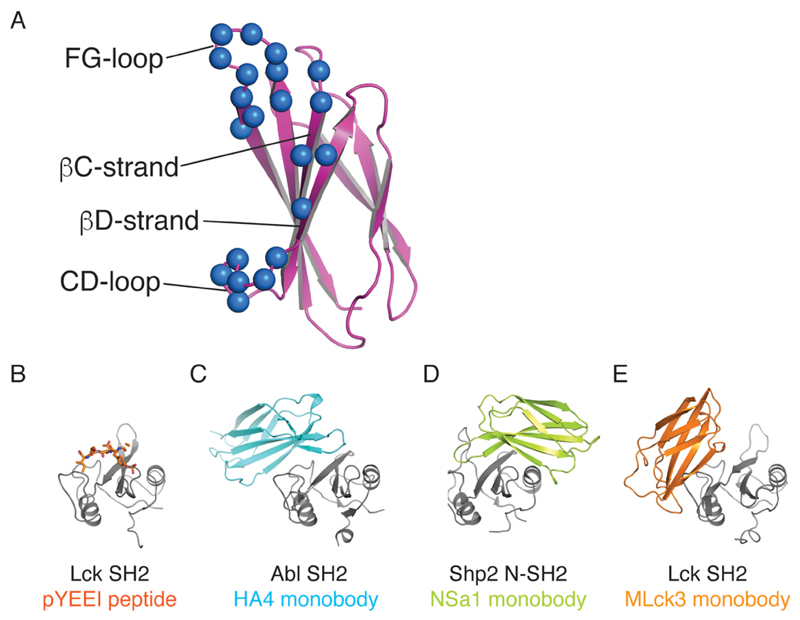
Figure 1
Figure 1
(A) The structure of the FN3 scaffold of a monobody is shown in magenta cartons. The location of the diversified residues in the side-and-loop combinatorial library is shown as blue spheres. (B-E) Co-crystal structures of monobodies targeting three different SH2 domains (panels C, D and E), as well as the pYEEI peptide Lck complex structure (panel B) showing the canonical interaction of an SH2 domain with a phosphotyrosine (pY) peptide, are shown. The SH2 domains are depicted in grey whereas the monobodies and the pYEEI peptide are shown in different colours. The following PDB entries were used to draw this figure: 1LKK (pYEEI peptide-Lck SH2), 3K2M (HA4-Abl SH2), 4JE4 (NSa1-Shp2 N-SH2) and 5MTM (MLck3-Lck SH2).
Figure 2
Figure 2
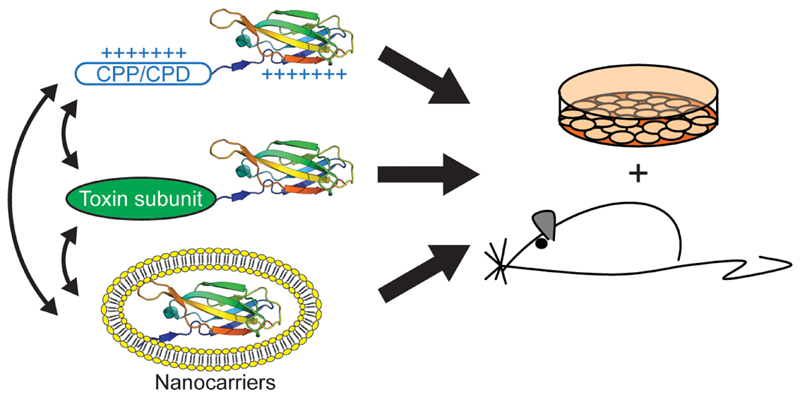
Overview of the three main intracellular delivery strategies for monobodies that are discussed in this review. A cartoon structural representation of the monobody is shown in rainbow coloursCPP: Cell-penetrating peptide, CPD: cell-penetrating poly(disulphide).
Figure 3
Figure 3
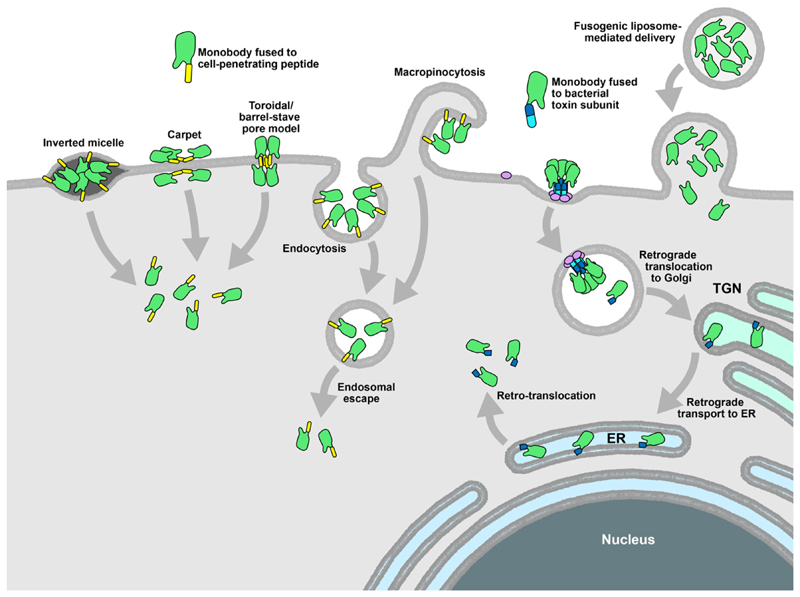
Overview of uptake routes and mechanisms for possible different approaches for monobody cellular delivery.

References

    1. Hanahan D, Weinberg RA. Hallmarks of cancer: the next generation. Cell. 2011;144(5):646–74. doi: 10.1016/j.cell.2011.02.013. - DOI - PubMed
    1. Sliwkowski MX, Mellman I. Antibody therapeutics in cancer. Science. 2013;341(6151):1192–8. doi: 10.1126/sci-ence.1241145. - DOI - PubMed
    1. Hantschel O. Unexpected off-targets and paradoxical pathway activation by kinase inhibitors. ACS Chem Biol. 2015;10(1):234–45. doi: 10.1021/cb500886n. - DOI - PubMed
    1. Gambacorti-Passerini C, Antolini L, Mahon F-X, Guilhot F, Deininger M, Fava C, et al. Multicenter independent assessment of outcomes in chronic myeloid leukemia patients treated with imatinib. J Natl Cancer Inst. 2011;103(7):553–61. doi: 10.1093/jnci/djr060. - DOI - PubMed
    1. Holohan C, Van Schaeybroeck S, Longley DB, Johnston PG. Cancer drug resistance: an evolving paradigm. Nat Rev Cancer. 2013;13(10):714–26. doi: 10.1038/nrc3599. - DOI - PubMed